
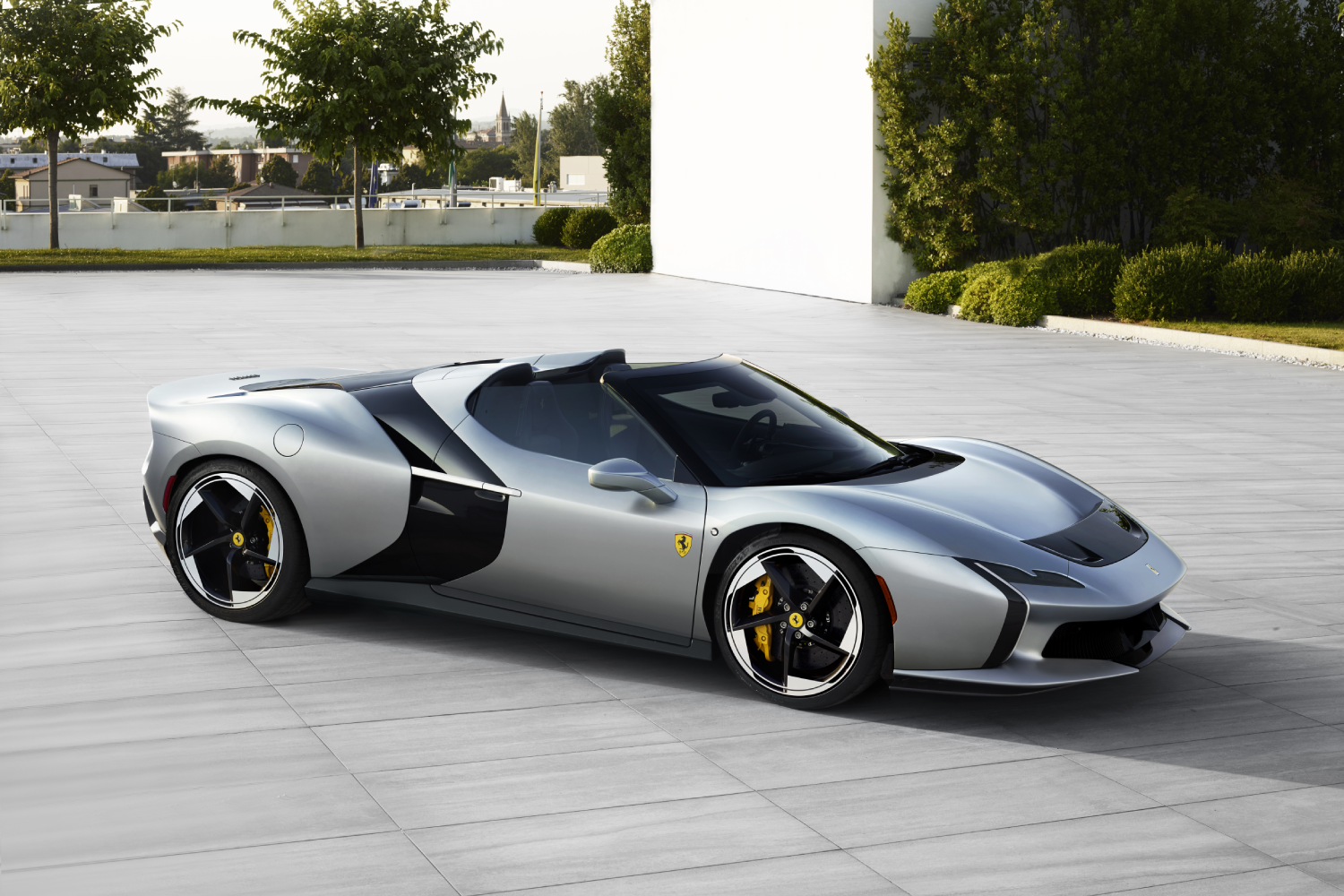
Incredible Features That Make the Ferrari HC25 One of Ferrari’s Most Exciting New Cars

Ferrari has revealed another extraordinary creation from its ultra-exclusive Special Projects programme. Meet the Ferrari HC25, a bespoke open-top machine built for one client and unveiled at the Ferrari Racing Days in Austin, Texas.
Based on the Ferrari F8 Spider, the HC25 takes Ferrari’s final non-hybrid mid-engined V8 spider platform and reshapes it into something far more dramatic. It keeps the proven mechanical package underneath. However, visually, it heads in an entirely different direction.
Created by the Ferrari Design Studio under the leadership of Flavio Manzoni, the HC25 looks ahead to Ferrari’s future while also closing the book on one of Maranello’s most loved layouts.
For collectors, it represents the very peak of Ferrari personalisation. For everyone else, it offers a fascinating glimpse into where Ferrari design may be heading next.
A One-Off Ferrari With a Very Clear Purpose
Ferrari’s Special Projects division exists for a simple reason: to create one-of-one cars for clients with very deep pockets and very specific ideas.
Unlike limited-run hypercars, these projects are built around a single customer. Every surface, detail, and proportion is tailored during a close two-year collaboration between the owner and Ferrari’s design team.
The HC25 therefore joins a small and highly secretive club of modern Ferraris that will never be repeated.
Yet it also carries broader importance.
The car sits on the underpinnings of the F8 Spider, meaning it uses Ferrari’s final mid-mounted twin-turbo V8 without hybrid assistance in an open-top configuration. In a world rapidly moving towards electrification and hybrid power, that alone gives the HC25 serious significance.
Inspired By The Future, Yet Rooted In Ferrari Tradition
Although the HC25 shares its architecture with the F8 Spider, the styling could not be more different.
Ferrari describes the shape as a reinterpretation of its classic mid-engined spiders, viewed through a more futuristic lens. That ambition becomes obvious from every angle.
The bodywork appears cleaner, tighter, and more sculpted than the softer lines of the F8. Sharp creases meet muscular rear arches, while geometric details create a stronger technical feel.
There are also clear visual links to the Ferrari F80 and the new Ferrari 12Cilindri.
As a result, the HC25 feels like a bridge between two Ferrari eras. One foot stands firmly in the world of traditional combustion supercars. The other steps towards Ferrari’s next generation of flagship design.
The Black Ribbon Changes Everything
The most distinctive feature is impossible to miss.
A large black band wraps around the centre of the car, visually splitting the body into separate upper and lower sections. Ferrari says this was designed to create the impression of two connected volumes rather than one continuous shape.
It works brilliantly.
The glossy black section adds drama and tension to the side profile. At the same time, it hides several cooling functions, including radiator intakes and heat extraction outlets for the engine.
From the side, the ribbon creates an arrow-like motion that pushes the eye forward before sweeping back into the rear deck. Consequently, the car appears lower, longer, and more aggressive than the standard F8 Spider.
Ferrari has also cleverly integrated the door handle into a long aluminium blade hidden within the design. It keeps the surface clean while adding another technical detail for owners to admire up close.
A More Focused And Modern Front End
The front of the HC25 introduces lighting elements never previously seen on a Ferrari road car.
The slim headlamps feature a central notch, which mirrors the split layout of the rear lights. Meanwhile, the daytime running lights now sit vertically for the first time, forming a striking boomerang effect along the edges of the front wings.
These details give the HC25 a sharper and more modern face compared with the softer expression of the F8 Spider.
Ferrari has also worked carefully on the proportions. The glasshouse appears smaller, while the shoulder line sits visually lower. Together, these tweaks give the car a more planted stance.
Moonlight Grey Paint Adds Extra Presence
Colour and texture play a huge role in the HC25’s identity.
The body is finished in matt Moonlight Grey, which highlights the sculpted surfaces and gives the car a solid, almost architectural appearance. In contrast, the central black ribbon uses a glossy finish to create a strong visual divide.
Yellow details then provide just enough energy without overwhelming the design.
Ferrari has echoed these accents inside the cabin, pairing technical grey fabrics with bright yellow graphics inspired by the boomerang lighting signatures outside.
The wheels deserve attention too.
Their five-spoke layout combines diamond-finished outer rims with darker inner spokes, helping the wheels appear even larger. It is an intricate design, yet it avoids looking fussy.
The Twin-Turbo V8 Still Delivers Serious Pace
Underneath the dramatic bodywork sits one of Ferrari’s finest modern engines.
The HC25 uses the same 3.9-litre twin-turbocharged V8 found in the F8 Spider, producing 720cv and 770Nm of torque. Power goes to the rear wheels through Ferrari’s seven-speed dual-clutch gearbox.
Performance remains deeply impressive:
0-62mph in 2.9 seconds
0-124mph in 8.2 seconds
Top speed of 211mph
Even by current supercar standards, those numbers remain brutally quick.
More importantly, the HC25 preserves something many enthusiasts fear is slowly disappearing: the character of a lightweight, non-hybrid Ferrari V8.
Without battery assistance or added electrical weight, the driving experience should feel sharper and more immediate than newer hybrid models.
Ferrari Special Projects Continues To Grow In Importance
Ferrari’s One-Off programme has become increasingly significant in recent years.
Ultra-wealthy clients no longer want merely rare cars. They want something completely unique. Special Projects answers that demand by allowing customers to shape everything from proportions and materials to colours and design themes.
However, Ferrari maintains strict control over engineering standards. Every One-Off must still meet the same technical benchmarks as any production Ferrari.
That balance matters.
The result is not simply a custom body draped over an existing platform. Instead, cars like the HC25 feel fully resolved and factory-developed from the beginning.
For Ferrari, the programme also serves another purpose. It allows designers to experiment with new ideas before elements potentially appear on future production models.
The HC25’s lighting signatures and graphic surfaces may therefore offer clues about the styling direction of future Ferraris.
Ferrari HC25 Technical Specifications
Engine
3.9-litre twin-turbocharged V8
720cv at 7,000rpm
770Nm at 3,250rpm
8,000rpm redline
Transmission
Seven-speed dual-clutch F1 gearbox
Rear-wheel drive
Performance
0-62mph: 2.9 seconds
0-124mph: 8.2 seconds
Top speed: 211mph
Dimensions
Length: 4,758mm
Width: 2,006mm
Height: 1,183mm
Wheelbase: 2,650mm
Wheels And Tyres
Front: 245/35 ZR20
Rear: 305/35 ZR20
Final Thoughts
The HC25 may be a one-off creation destined for a private collection, yet it carries genuine importance beyond its exclusivity.
It marks the closing chapter for Ferrari’s non-hybrid mid-engined V8 spider platform. At the same time, it introduces styling themes that could influence future road cars from Maranello.
More importantly, it proves Ferrari still understands how to make a bespoke car feel emotional, dramatic, and beautifully engineered without relying purely on power figures or technology headlines.
Would you take the HC25 over a standard F8 Spider? And do you prefer Ferrari’s cleaner new design direction, or the softer shapes of older models? Share your thoughts in the comments below.
The post Incredible Features That Make the Ferrari HC25 One of Ferrari’s Most Exciting New Cars appeared first on My Car Heaven.


More Stories
A Simple Pre-Winter Check for Your Tires and Battery
The first cold morning of the season has a way of finding the weak spots in a car. A tire...
Porsche Mission S Hypercar Teased with 8,000-RPM Redline Ahead of October 15 Reveal
Porsche is preparing to make a serious statement in the world of high-performance automobiles, and its upcoming Mission S hypercar...
Chinese Automaker Geely Coming to Canada in 2027 as New Import Rules Open the Door to Affordable EVs
The North American automotive landscape could be in for a significant shakeup as Chinese automotive giant Geely Auto has officially...
Rivian Goes Ghostbusters for Halloween with Ecto-1 Inspired EVs and Spooky Software Update
Rivian is getting into the Halloween spirit in a big way this year, and fans of the iconic Ghostbusters movies...
Keeping the Ram You Love, Updating the Part You Use Every Day
A favorite vehicle earns its place through use. There are the trips you planned for months, the quick runs for...
Is Your Car Ready for Colorado’s Traction Law?
A clear forecast in Denver can turn into a whiteout at the Eisenhower Tunnel. When that happens, the Colorado Department...