
Iran Turns to China Rail Link to Bypass US Blockade, but It Has Limited Effect, Analysts Say

By Alex Wu
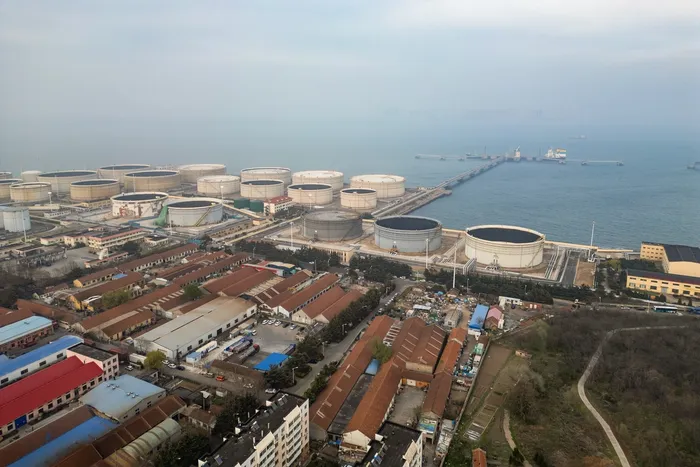
As the U.S. military continues to blockade Iranian ports, Iran has increased overland railway shipment with China in an attempt to mitigate the blockade’s devastating impact on its economy.
However, the trade volume via rail is only a fraction of what can be handled through sea freight and could only slightly delay the collapse of Iran’s economy, analysts told The Epoch Times.
In order to counter the Iranian regime’s blockade of the Strait of Hormuz holding international shipping hostage in the war with the United States, the U.S. Navy has blockaded Iran’s ports for three weeks. The U.S. blockade has effectively cut off the bulk of Tehran’s oil exports and imports of basic supplies. The Iranian economy is already showing signs of collapse, with its national currency plummeting to a historic low—$1 to 1,311,500 Iranian rials as of May 10.
Last week, Kambiz Etemadi, head of the Container Committee of the Iranian Maritime Transport Union, said that Iran can transfer 40 percent of its usual maritime trade to land routes, according to Iran’s semi-official Fars news agency.
Since mid-April, when the U.S. military imposed the blockade, freight train services from Xi’an in northwestern China to Tehran have increased from one departure per week to one every three to four days. Driven by demand, freight rates for standard 40-foot containers have jumped to about $7,490, a 40 percent increase, according to Bloomberg.
This railway route is part of Beijing’s Belt and Road Initiative—the Chinese regime’s global project to extend Beijing’s political and economic influence through investment in infrastructure projects in other countries.
The rail route originating in Xi’an traverses Kazakhstan and Turkmenistan before entering Iran. The line has been operational since 2014 and underwent significant upgrades in 2025. Freight transit takes just 15 days—more than twice as fast as the 30 to 40 days for sea transport, according to public data.
Industry data indicates that the railway shipping capacity is unable to support Iran’s energy exports. A single very large crude carrier can carry 1.9 million to 2.2 million barrels of crude oil in a single trip. In contrast, a specialized oil tanker train with 110 cars can only carry approximately 70,000 barrels, according to industry estimates.
According to the specialized analytics firm Energy News Beat, Iran would require 25 to 35 full-length trains to match the transport capacity of a single oil tanker. Currently, the rail route from China to Iran primarily carries shipping containers and high-value goods, while facilities for handling bulk crude oil are severely lacking.
Limited Capacity: Analysts
Analysts say that the high costs and limited capacity of the China–Iran railway cannot resolve the core issue of oil export, and since Iran lost its primary maritime lifeline, these overland initiatives merely serve to delay the process of its economic collapse under the U.S. naval blockade.
The blockade has severely restricted Iran’s oil exports, threatening to force the shutdown of Iranian oil wells due to limits on storage capacity, which could cause long-term oil reservoir damage.
Despite the limited volume, by utilizing overland routes for oil exports, Iran can somewhat delay the process of shutting down its oil wells, Mark Cao, a U.S.-based military analyst and host of Chinese-language military news YouTube channel Mark Space, told The Epoch Times.
“However, land-based transport ultimately cannot serve as a substitute for maritime shipping. This strategy can only serve to prolong the Iranian regime’s economy, preventing an immediate, sudden collapse,” he said.
The China–Iran railway is useful for higher-value goods, spare parts, electronics, machinery, civil military dual-use items, or emergency supplies, “but it cannot carry the volume of crude oil, fuel, grain, raw materials, or containerized goods that large ships can move,” Sun Kuo-hsiang, a professor of international affairs and business at Nanhua University in Taiwan, told The Epoch Times.
The Iran-flagged tugboat Basim sails near a ship anchored in the Strait of Hormuz off Bandar Abbas in southern Iran, in this picture obtained from Iran’s ISNA news agency on May 4, 2026. Amirhossein Khorgooei/ISNA/AFP via Getty Images
China’s ruling Communist Party (CCP) will try to assist Iran in staying afloat, Cao said. “The CCP hopes that Iran can tie down the United States as long as it can, thereby ultimately inflicting a more severe blow upon the Trump administration, because the longer this situation drags on, the more trouble Trump will face,” he said.
In addition to the China route, Iran has invested billions of dollars to build the International North-South Transport Corridor (INSTC) connecting Russia, aiming to forge a corridor linking Europe to the Indian Ocean. However, INSTC is operational but not yet fully completed, and is constrained by the Russia–Ukraine War. The stability of this route as a result falls short of that of the Chinese routes.
Russia is deeply embroiled in the war in Ukraine, Cao noted. “Consequently, I estimate that the assistance Russia provides to Iran is extremely limited. This is particularly true given that Russia is itself an oil-producing nation—meaning it has no need for crude oil—and its manufacturing sector is not highly developed.”
China is the only nation that both needs Iranian crude oil and is capable of supplying Iran with essential daily necessities—as well as critical dual-use civilian and military goods, according to Cao.
“Iran’s destiny is now firmly in the grip of the CCP. Given this situation, the CCP’s leverage over Iran is likely to intensify, and its influence—specifically regarding the negotiations between Iran and the United States—will become significantly greater,” Cao said. “I believe this constitutes a pivotal point of contention and strategic maneuvering within the upcoming summit between Trump and Xi.”
Trump is scheduled to meet CCP leader Xi Jinping in Beijing from May 14–15.
“The reason is that the CCP has sustained the Iranian regime—specifically, by utilizing overland routes to prevent the Iranian regime from collapsing—thereby furnishing Xi Jinping with an exceptionally powerful bargaining chip to wield during his future negotiations with President Trump,” Cao said.
Iran, on the one hand, is seeking to resolve its economic difficulties by exporting crude oil via overland routes, and simultaneously, in exchange, acquiring essential daily necessities that it urgently requires, Cao said.
The primary significance of this rail route at present is that it now serves as a lifeline for transporting Chinese-made consumer goods—particularly urgently needed medical supplies to Iran, U.S.-based China analyst Wang He told The Epoch Times.
Using Each Other
The risks of U.S. military attack over the land routes, such as bombing railways or trains, appear minimal compared to sea routes under U.S. blockade, according to analysts.
The United States is currently focused primarily on blockading Iranian ports in the Persian Gulf. As a result, unless the United States possesses intelligence indicating the CCP intends to transport military supplies via the land routes to Iran—it would not typically take action against such rail shipments, Wang said.
A container on the first train connecting China and Iran upon its arrival at Tehran Railway Station in Iran on Feb. 15, 2016. Stringer/AFP via Getty Images
The route passes through China, Central Asia, and Iran; bombing trains or rail infrastructure outside Iran would risk violating third-country sovereignty and widening the war, Sun said.
“Once cargo enters Iran, however, if it is clearly linked to military supply chains, it could become a more plausible target,” he said.
China’s involvement primarily consists of selling dual-use civilian-military goods to Iran, and it doesn’t dare to directly supply firearms, ammunition, or missiles, according to Wang.
“Beijing cannot allow its backing of Iran to directly derail the upcoming negotiations between China and the United States—this constitutes a fundamental red line for the CCP,” he said.
The supplies that the CCP gave to Iran through the rail route are not for the common Iranian people but for the Iranian regime, Cao said. “These materials may be enough for the Iranian regime to maintain their rule, allocating the resources to the Islamic Revolutionary Guard Corps, the ruling class, or specific individuals,” Cao said.
“Maintaining the rule of this Iranian theocratic regime is the CCP’s greatest purpose.”
Meanwhile, the Iranian military attacked a Chinese-owned oil tanker near the Strait of Hormuz on May 4. The Iranian navy announced that on May 8 it seized a Chinese oil tanker whose owner is based in Shanghai.
To date, Beijing has not fully complied with the agreement signed in 2021 to invest $400 billion in Iran over a 25-year period, due to concerns about the unstable situation in Iran. Beijing’s trade and investment volume in Saudi Arabia and the UAE far exceeds that in Iran, according to public data.
“China has delayed the investment of 400 billion dollars in the 25-year agreement, which has caused dissatisfaction from the Iranian regime,” Wang said. “Iran has urged China to speed up the investment through diplomatic channels since 2025.”
“The two sides will continue to use each other; neither party would ever go to extreme lengths, risking their own life, to defend the other,” Wang said of Iran–CCP relations. “Iran seeks to drag the CCP into the trap–Iran’s war with the United States—while the CCP will employ every conceivable means to resist being drawn in,” he said.
As to the future, “their engagement remains primarily diplomatic. Indeed, the most aggressive action the CCP is likely to take to defend the Iranian regime would be to exercise its veto power over certain resolutions within the United Nations Security Council,” Wang said.
Under U.S. military pressure and on the verge of economic collapse, Iran may compromise with the United States, but probably not in a way that looks like surrender, Sun said.
“Tehran may accept a temporary arrangement,” he said. “The most likely outcome would be a phased or face-saving deal: partial reopening of the Strait of Hormuz, limits on escalation, humanitarian or oil-related exemptions, and delayed negotiations over the nuclear issue.”
Luo Ya, Li Yan, and Reuters contributed to this report.

More Stories
Jessica Biel Bio: Net Worth, Career, and Personal Life
Jessica Biel has built a notable career in Hollywood. She began as a teenage television star and has since moved...
Why the Bakken Remains One of America’s Most Important Oil-Producing Regions
When most Americans think about domestic oil production, Texas probably comes to mind first. But more than a thousand miles...
Is A Different World Season 2 Renewed? Release Date, Episodes & More
Finished watching the first season of A Different World! Now searching for the renewal status and more details about A...
The Gentlemen Season 2 is Airing: Know About the Plot, Episodes, and Cast
Eddie has returned with season 2 of The Gentlemen. This time, his appearance and costumes reflect his new life as...
LEGO ONE PIECE is Live! Where to Watch and Full Cast Updates
Good news for Straw Hats fans who were waiting for the release of LEGO ONE PIECE Season 3. No, its...
Rebel Moon 3: Release Date, Cast Members, and Production Details
Zack Snyder has finally spoken about the release of Rebel Moon 3 after the release of the second sequel in...