
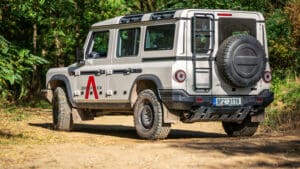
Ratcliffe’s Grenadier rolls into battle for MoD’s £900m Land Rover replacement

Sir Jim Ratcliffe has thrown his Ineos Grenadier into one of the most coveted defence procurement contests of the decade, gunning for a Ministry of Defence contract worth an initial £900 million to replace the British Army’s ageing fleet of Land Rovers.
The billionaire industrialist, tax exile and part-owner of Manchester United has been in active discussions with the MoD, lining his utilitarian 4×4 up for a tender that opens shortly and could ultimately deliver up to 7,000 vehicles to the armed forces. A formal announcement from Ineos Grenadier is understood to be imminent, with initial bids due on Monday.
It sets the stage for a four-way scrap that pits Ratcliffe directly against his long-standing rival, Jaguar Land Rover, the British marque he once tried, unsuccessfully, to acquire. JLR is fielding a military variant of its commercially successful new Defender, the modernised reincarnation of the very vehicle the Grenadier was inspired by. The two firms previously clashed in court when JLR accused Ratcliffe of copying the original Land Rover silhouette; the judge ruled there had been no breach of copyright, though Ratcliffe has never disguised the lineage of his design.
Also in the running are BAE Systems, which has paired with the American giant General Motors under the working title Team LionStrike, offering GM’s Infantry Squad Vehicle already in service with US forces, with engineering support based in Leamington Spa and Silverstone. Devon’s Supacat, working alongside defence contractor Babcock, is pitching an armoured derivative of the Toyota Hilux fitted with a bespoke chassis and combat cell.
Mike Whittington, chief commercial officer at Ineos, made it clear the Grenadier’s ambitions stretch well beyond Whitehall. “The Grenadier is the ideal choice for defence services as it’s the most capable 4×4,” he said. “Its local supply lines make it ideal for deployment in European countries, for sovereign defence and operations in the UK and on the continent.” Whittington pointed to existing demand from elite counter-terrorism and special operations units in Germany and France, alongside border forces in Germany, Poland, Serbia, Slovakia, Hungary and Spain.
Mark Cameron, managing director of the Defender programme at JLR, was equally bullish. “Defender will again begin supplying UK-designed and engineered light logistics vehicles for people and equipment transportation for the defence and blue light sectors, which Defender has a long history of supporting.”
For all the patriotic flag-waving, neither of the two frontrunners is actually built in Britain. The Grenadier rolls off a production line on the French–German border, in the former Smart car plant at Hambach, while the Defender is assembled at JLR’s Slovakian facility in Nitra. The MoD’s tender notably stops short of demanding domestic manufacture, a concession that will raise eyebrows in Westminster given Ratcliffe’s increasingly vocal criticism of the Labour government’s industrial policy.
The MoD confirmed in March that it was retiring the Land Rover from frontline duties after more than seven decades of service, describing the moment as “the end of an era for the vehicle that has been a cornerstone of military operations”. Officials want the first replacement vehicles in soldiers’ hands by 2030, with the initial tranche of 3,000 vehicles, plus engineering support, valued at £900 million.
For Ratcliffe, the contract represents more than a commercial prize. Having built Ineos into one of Britain’s largest privately-held chemicals empires, the Grenadier was always a passion project, conceived over a pint in a Belgravia pub and named after it. Winning the MoD’s blessing would validate his bet on a market that the original Land Rover effectively abandoned and hand him a powerful reference customer to chase further European defence deals.
For JLR, the stakes are arguably even greater. Losing the Land Rover’s spiritual home contract to an upstart designed by a critic of its design heritage would be a public relations setback of considerable magnitude, particularly as the Tata-owned business pushes its premium Defender into ever-higher price brackets and away from the workhorse roots that earned it military favour in the first place.
Read more:
Ratcliffe’s Grenadier rolls into battle for MoD’s £900m Land Rover replacement

More Stories
Mike Lynch’s estate wins right to challenge £920m HP fraud ruling
The estate of Mike Lynch has been granted permission to challenge a court order requiring it to pay Hewlett Packard...
Aldi accused of desperation after attack on supermarket loyalty schemes
Aldi has been accused of desperation by senior retail figures after its UK chief executive attacked rival supermarkets’ loyalty schemes,...
Shop price inflation hits two-year high as energy costs reach the shelves
Shop price inflation climbed to its highest level in more than two years in August, as retailers began passing higher...
Amazon accused of rigging ad auctions as FTC and 22 states allege $20bn overcharge
Amazon secretly overcharged more than a million advertising customers by manipulating the online auctions it uses to set ad prices,...
Parents of seriously ill children should get 12 weeks’ paid leave, says children’s commissioner
Parents of seriously ill children should be given three months of paid leave so they do not have to choose...
Victoria Beckham brand turns its first profit as revenue climbs 15% to £129.8m
Victoria Beckham’s fashion and beauty brand has turned a profit for the first time since it launched in 2008, a...