

Waitrose places champagne under lock and key as retail crime wave bites

Waitrose is to put bottles of champagne behind locked glass before the end of the year, as the upmarket grocer escalates its fight against an unrelenting wave of shoplifting that has swept through Britain’s high streets.
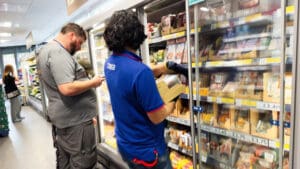
The John Lewis Partnership-owned chain has told its 50,000-strong workforce of partners that it will pilot so-called “smart cabinets” to protect premium spirits and champagne, marking one of the most striking acknowledgements yet that organised retail crime has begun to reach into the aisles of Britain’s most genteel supermarkets.
The cabinets, already trialled at rivals including Sainsbury’s, typically require shoppers to navigate a multi-step process on a touchpad before the doors will release. Some retailers have gone further, demanding customers scan a loyalty card or enter a mobile telephone number to gain access, creating a digital paper trail that can later be cross-referenced if stock goes missing. The technology can also log how long a cabinet door has been open, flagging suspicious behaviour such as bulk emptying to staff in real time.
Waitrose has declined to disclose the precise mechanics of its own system, but the move comes alongside a broader package of measures: protective “meat nets” wrapped around premium joints, reinforced screens at tobacco counters to deter the increasingly common practice of vaulting kiosks to grab cigarettes, and an expanded rollout of body-worn cameras for staff on the shop floor.
In an internal communication to partners, Lucy Brown, the John Lewis Partnership’s director of central operations, framed the investment as proof that the business was not “standing still” in the face of what she conceded had been characterised as “a tide of retail crime and epidemic of shoplifting”. She acknowledged the frustration felt by staff who watch thieves walk out unchallenged, but warned that intervention was rarely the safer option.
“It may feel like standing back is us not acting, but this isn’t the case,” Ms Brown wrote, urging partners to resist their “first instinct” to detain suspects or wrestle back stock. Detaining “potentially volatile” individuals in front of other customers, she said, risked escalating an already fraught situation.
The guidance follows a bruising month for Waitrose’s public image. The retailer faced sharp criticism in April after dismissing Walker Smith, a 17-year veteran of the chain, who said he had been sacked for confronting a shoplifter attempting to make off with Easter eggs. The Partnership declined to comment on the specifics, citing employment confidentiality, but said it had followed “the correct process” and pointed to the “serious danger to life in tackling shoplifters”.
Jason Tarry, the John Lewis chairman who joined from Tesco last year, has since written in The Telegraph that the answer to the crime wave was emphatically not to “encourage” workers to take on thieves themselves. Trained security personnel would “intervene to challenge shoplifters”, he said, “but only if they’ve been trained and it’s safe to do so”.
The retreat into hardened technology reflects the scale of the problem confronting British retailers. Industry body the British Retail Consortium has repeatedly warned that shop theft has reached levels not seen in a generation, with the cost to retailers running into the billions and assaults on shop workers rising sharply. For a chain such as Waitrose, whose brand has long traded on a relaxed, customer-trusted shopping experience, the optics of placing Bollinger behind a touchscreen-controlled glass door represent a notable cultural shift.
A spokesman for John Lewis confirmed the direction of travel: “We are currently investing in a range of advanced technology, including smart technology to deter theft. As part of this we are planning to pilot lockable smart cabinets for areas such as spirits and champagne soon. We already use smart shelf technology in our health, beauty and spirits aisles, which are able to sense unusual customer behaviour, so this would provide an additional layer of security.”
For Britain’s SME retailers, who lack the capital to deploy comparable systems, the message from Waitrose is sobering. If a chain of its size and security spend has concluded that its most prized stock now needs locking up, the implication for the independent off-licence or village convenience store is uncomfortable indeed.
Read more:
Waitrose places champagne under lock and key as retail crime wave bites

More Stories
Henry Gabay Started Duet Group With $10 Million. Two Decades Later, It Managed More Than $5 Billion.
By the time Financial News reported on the firm’s 2013 results, that early bet had compounded into one of the...
Planning an Antarctica Cruise Tour
Poseidon Expeditions runs its Antarctica program aboard the 114-passenger M/V Sea Spirit, an ice-strengthened ship led by a team of...
Vincent “Vinny” Colardi on Running, Music and Making Room for Different Passions
Between his career, playing guitar, writing music, running, and exploring his interest in food, Colardi has built a life around...
Why the Rolex Air King Makes More Sense in an Era of Lookalike Luxury Watches
Dials in black, metal bracelets, highly readable markings, and sport-inspired cases are common throughout many current product ranges, while social...
Viriora Expands Online Trading Access Across Forex, Stocks and Crypto Markets
The platform is designed around a broad selection of markets, with published information about available instruments and trading conditions. More...
Markets too ready for conflict over Taiwan – US diplomat
Investors are overestimating the threat of a military confrontation over the island, Michael DeSombre has told CNBC Investors are exaggerating...