
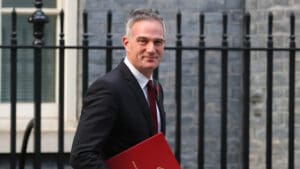
Kyle vows no climbdown on late payment crackdown as landmark bill enters parliament

Peter Kyle has issued a defiant message to the boardrooms of corporate Britain: the government’s long-awaited crackdown on late payments will not be diluted, no matter how loudly big business lobbies against it.
In an interview with Business Matters, the Business Secretary said he would not “resile from delivering” what he described as a “step change in the relationship between all larger businesses and their supply chains” as the Small Business Protections (Late Payments) Bill is laid before parliament on Tuesday.
The legislation, billed by Whitehall as the most far-reaching shake-up of commercial payment rules in more than 25 years, caps payment terms at 60 days for large firms paying smaller suppliers, imposes mandatory interest of 8 per cent above the Bank of England base rate on overdue invoices, and hands the Small Business Commissioner sweeping new powers to investigate, name and fine serial offenders. It also outlaws the controversial use of “retentions” in the construction sector, a practice in which main contractors withhold a portion of a supplier’s bill, ostensibly as a defects guarantee, but which the government argues has long been abused to prop up cashflow further up the chain.
According to government figures, poor payment practices drain roughly £11 billion a year from the UK economy and contribute to the closure of an estimated 38 small businesses every day.
A line in the sand
Kyle was unequivocal when asked whether ministers would soften the bill in the face of pressure from corporate Britain. “I am fighting to bring more fairness to our economy,” he told Business Matters. “Sixty days is a solid, reasonable outer limit for paying a small business.”
He claimed the reforms would give the UK “the strongest legal framework in the G7” on commercial payments — a point ministers have made repeatedly since the package was first trailed earlier this year.
“An unhealthy economy is one in which businesses are exploited or strangled to death,” he said. “I don’t think there are many people in their personal lives, let alone in their professional lives, that think it’s reasonable to wait more than two full months to be paid.”
His comments come amid mounting unease in Westminster that the legislation could be watered down at committee stage. Both the British Retail Consortium and the Confederation of British Industry have flagged concerns. The CBI warned last week that the new rules must be “balanced carefully against the need to protect the competitiveness of larger businesses — particularly those operating across complex supply chains”.
Supporters of the bill, however, see those interventions as precisely the reason ministers cannot afford to flinch. Craig Beaumont, executive director at the Federation of Small Businesses, pulled no punches. “Many big businesses are using small businesses for free credit, and some are busy lobbying to keep it,” he said. “As this bill goes through parliament, it absolutely must not be watered down. Victims don’t want a balanced approach with perpetrators.”
A commissioner with teeth
For the reforms to bite, much will hinge on enforcement — and on Emma Jones, the small business commissioner appointed last year to take on Britain’s payment culture. Until now her office has been seen by critics as toothless, having not used its existing “name and shame” powers since Labour came to power. The government has said that is because no complaint from suppliers had merited that step.
Kyle insisted that would change once the new bill became law, and made clear he expected Jones to use her new powers assertively, including fines that could run into the tens of millions of pounds for “persistently” late payers.
“I’m empowering her to do these things, and she also has my full backing to act as swiftly as possible,” he said. “We need to have swift inquiries, swift judgments, and we need to have swift enforcement. And that will lead to the behaviour change we need.”
A drag on growth
The political logic for Kyle is clear enough. Cashflow remains the single biggest pressure point for Britain’s 5.5 million small and medium-sized enterprises, and recent figures suggest the problem is getting worse, not better, with UK firms hitting record levels of late invoice payments and SMEs collectively left more than £100 billion out of pocket last year.
For a government that has staked its growth agenda on unblocking the supply side of the economy, the message that businesses can no longer treat their smaller suppliers as a free line of credit is, by ministerial standards, an unusually sharp one. Whether the bill survives its passage through parliament without significant amendment will be the first real test of how serious Kyle is about that promise.
Read more:
Kyle vows no climbdown on late payment crackdown as landmark bill enters parliament


More Stories
Henry Gabay Started Duet Group With $10 Million. Two Decades Later, It Managed More Than $5 Billion.
By the time Financial News reported on the firm’s 2013 results, that early bet had compounded into one of the...
Planning an Antarctica Cruise Tour
Poseidon Expeditions runs its Antarctica program aboard the 114-passenger M/V Sea Spirit, an ice-strengthened ship led by a team of...
Vincent “Vinny” Colardi on Running, Music and Making Room for Different Passions
Between his career, playing guitar, writing music, running, and exploring his interest in food, Colardi has built a life around...
Why the Rolex Air King Makes More Sense in an Era of Lookalike Luxury Watches
Dials in black, metal bracelets, highly readable markings, and sport-inspired cases are common throughout many current product ranges, while social...
Viriora Expands Online Trading Access Across Forex, Stocks and Crypto Markets
The platform is designed around a broad selection of markets, with published information about available instruments and trading conditions. More...
Markets too ready for conflict over Taiwan – US diplomat
Investors are overestimating the threat of a military confrontation over the island, Michael DeSombre has told CNBC Investors are exaggerating...