
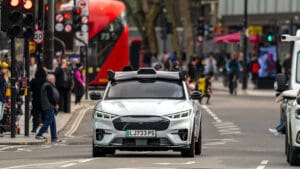
Wayve lands government deal in race to put Britain in the self-driving fast lane

Britain’s ambitions to lead the global race for driverless cars took a significant step forward today as the Government inked a formal partnership with Wayve, the London-headquartered artificial intelligence scale-up that has emerged as the country’s standard-bearer in autonomous vehicle technology.
The Memorandum of Understanding, signed between Wayve and the Department for Business and Trade, is designed to deepen collaboration on next-generation self-driving systems and underpin the company’s continued expansion on home soil, a notable vote of confidence at a time when many of Britain’s most promising tech firms have been lured across the Atlantic by deeper pools of capital.
For the SME and high-growth community, the deal is being read as a barometer of Whitehall’s willingness to back homegrown champions with more than warm words. Under the agreement, Government and industry will pool research interests around the responsible deployment of automated vehicles, with the explicit aim of converting Britain’s world-class AI research into commercial reality on its roads, in its factories and across its supply chains.
Officials hope the partnership will act as a catalyst for fresh investment, skilled employment and long-term growth across an automotive ecosystem that has been buffeted in recent years by the transition to electric vehicles, supply-chain disruption and intensifying competition from China and the United States. The signal to international investors, ministers insist, is unambiguous: the UK is open for business and intends to be the destination of choice for ambitious technology companies looking to scale.
Business Secretary Peter Kyle said the agreement demonstrated how the Government’s Modern Industrial Strategy was being put into practice. “This partnership with Wayve shows how government is backing high-growth British scale-ups through our Modern Industrial Strategy to turn world-leading research into real-world deployment,” he said. “By working hand-in-hand with innovative companies, we are accelerating self-driving technology while anchoring jobs, investment and manufacturing here in the UK, making Britain the best place to start, scale and grow a business.”
Alex Kendall, Wayve’s co-founder and chief executive, struck a similarly bullish tone. “I’m delighted to deepen our collaboration with the Department for Business and Trade. We share the Government’s ambition to drive economic growth through the development of the self-driving vehicle sector in the UK and globally,” he said. “Strengthening domestic capabilities will anchor high-value manufacturing in the UK, create thousands of skilled jobs across the supply chain, and support the future of the automotive industry. This is in addition to the transformative benefits to road safety to be gained from self-driving vehicles deployed at scale.”
Founded in 2017 and now one of Britain’s most valuable AI businesses, Wayve has established itself as a pioneer of so-called “embodied AI”, training vehicles to learn from experience rather than relying solely on hand-coded rules and high-definition mapping. The company’s investor roster reads like a who’s who of global capital, and its decision to keep its centre of gravity in the United Kingdom has become a touchstone for the broader debate about retaining home-grown intellectual property.
Science and Technology Secretary Liz Kendall described Wayve as “a true British AI success story, putting the UK at the forefront of self-driving technology.” She added that the agreement would “help secure high-skilled tech and advanced manufacturing jobs in this country” and send a clear signal that “the UK is the best place for ambitious tech firms to start up and scale up.”
The substance of the MoU is squarely aimed at moving automated vehicles beyond the prototype phase and into commercially viable services on British roads. Joint workstreams will cover safety assurance, large-scale simulation and the integration of full self-driving capability into production-ready vehicle platforms, areas where Britain has long held latent expertise but has often struggled to commercialise at pace.
The partnership also reinforces the Government’s ambition to position the UK as a global hub for automated vehicle manufacturing, strengthening domestic supply chains in artificial intelligence, systems integration and advanced automotive hardware. Wayve, for its part, has agreed to share insights from real-world trials with ministers and regulators, providing the empirical foundation for the rules and standards that will govern a national roll-out of self-driving services.
For an automotive sector in the throes of structural reinvention, the implication is significant. Closer collaboration between industry, Government and local partners is intended to revive and evolve British vehicle manufacturing, demonstrating that fast-growing companies can scale at home rather than relocating overseas in search of supportive policy and patient capital.
The announcement comes against the backdrop of the Modern Industrial Strategy, which Whitehall says has already crowded in private investment into priority growth sectors. The Government points to roughly £360 billion in investment commitments, £33 billion in export announcements and 120,000 jobs secured since publication, figures that ministers will be keen to translate into a wider narrative of economic renewal as the political cycle wears on.
For founders, investors and SME leaders watching from the sidelines, the lesson is straightforward enough. When Government and a scale-up of Wayve’s calibre line up around a shared industrial agenda, the message is that Britain intends to compete at the sharpest end of the technology frontier, and that the long-promised marriage between policy and enterprise may, finally, be moving from theory into practice.
Read more:
Wayve lands government deal in race to put Britain in the self-driving fast lane


More Stories
Henry Gabay Started Duet Group With $10 Million. Two Decades Later, It Managed More Than $5 Billion.
By the time Financial News reported on the firm’s 2013 results, that early bet had compounded into one of the...
Planning an Antarctica Cruise Tour
Poseidon Expeditions runs its Antarctica program aboard the 114-passenger M/V Sea Spirit, an ice-strengthened ship led by a team of...
Vincent “Vinny” Colardi on Running, Music and Making Room for Different Passions
Between his career, playing guitar, writing music, running, and exploring his interest in food, Colardi has built a life around...
Why the Rolex Air King Makes More Sense in an Era of Lookalike Luxury Watches
Dials in black, metal bracelets, highly readable markings, and sport-inspired cases are common throughout many current product ranges, while social...
Viriora Expands Online Trading Access Across Forex, Stocks and Crypto Markets
The platform is designed around a broad selection of markets, with published information about available instruments and trading conditions. More...
Markets too ready for conflict over Taiwan – US diplomat
Investors are overestimating the threat of a military confrontation over the island, Michael DeSombre has told CNBC Investors are exaggerating...