
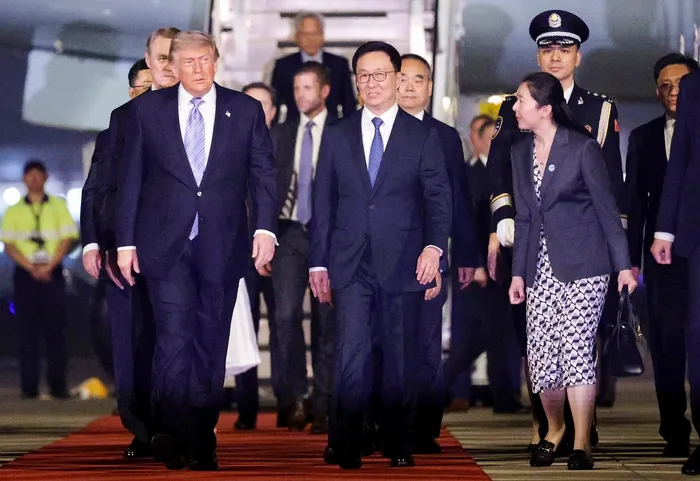
Trump Arrives in Beijing for High-Stakes Summit Amid Taiwan, Iran Tensions

By Michael Zhuang
President Donald Trump landed in Beijing on May 13 for his first trip to China in nearly nine years. Ahead of the trip, Beijing has revived familiar rhetoric about “peaceful coexistence” with Washington, amid tensions over Taiwan, Iran, technology, and regional security.
The Chinese communist regime confirmed on May 10 that Trump will visit China from Wednesday through Friday for a state visit and talks with Chinese leader Xi Jinping. The meeting will mark the first face-to-face summit between the two leaders since October last year in South Korea.
Hours before confirming Trump’s visit, China’s Foreign Ministry released a short video on X titled “Peaceful Coexistence,” calling on China and the United States to “engage in sincerity and good faith.”
The video repeated a phrase long used by Xi and other Chinese officials: “The Earth is too small for China and the U.S. to turn against and confront each other, and the Pacific Ocean is vast enough for both to prosper in their own ways.”
Xi used similar language during a 2013 meeting with then-U.S. President Barack Obama. Since then, Beijing has repeatedly invoked the slogan in discussions of bilateral relations.
William Chih-tung Chung, an associate research fellow at Taiwan’s Institute for National Defense and Security Research (INDSR), told The Epoch Times that Beijing’s message reflects a long-standing effort to carve out spheres of influence in the Pacific, with the United States dominant in the eastern Pacific, and China asserting primacy in East Asia.
“That is China’s strategic ambition,” Chung said. “But this approach is unlikely to work on Trump.”
He pointed to the 2025 U.S. National Security Strategy, emphasizing the strengthening of the “First Island Chain” and countering China’s regional expansion. Trump, he said, has sought both to block Beijing’s influence in the Western Hemisphere and preserve American dominance in the Indo-Pacific.
Chung added that many Asian countries, particularly Japan, continue to support a strong U.S. presence in the region as a counterweight to China.
President Donald Trump waves as he boards Air Force One at Joint Base Andrews, Maryland, on May 12, 2026. Alex Wong/Getty Images
Su Tzu-yun, another Taiwanese researcher at the INDSR, told The Epoch Times that the Chinese Foreign Ministry video was strategic messaging intended to portray Beijing as a peaceful and reliable global actor.
“In the short term, this kind of messaging may have tactical value,” Su said. “But in the longer term, the structural competition between the democratic camp and authoritarian systems will remain. That is a fundamental challenge Beijing cannot overcome.”
China’s Ministry of Public Security highlighted a joint U.S.–China anti-narcotics operation in April involving a cross-border drug trafficking case, Chinese state media Xinhua News Agency reported on May 11.
U.S.-based China current affairs commentator Wang He told The Epoch Times that Beijing’s gestures were largely symbolic.
“Calls for ‘peaceful coexistence’ and selective cooperation are mainly cosmetic,” Wang said. “They do not change the underlying tensions.”
A paramilitary police officer stands guard outside a building of the Foreign Ministry in Beijing on Nov. 18, 2025. Pedro Pardo/AFP via Getty Images
Taiwan, Iran Expected to Dominate Talks
During a May 12 briefing, Chinese Foreign Ministry spokesperson Guo Jiakun reiterated Beijing’s opposition to U.S. arms sales to Taiwan, calling China’s position “consistent and clear,” according to Xinhua News Agency.
Trump said on May 11 in the Oval Office that he expected to discuss Taiwan during the trip. He also said he would again raise the case of jailed Hong Kong media mogul and pro-democracy activist Jimmy Lai with Chinese officials.
Chung said both nations are likely to use different regional flashpoints as leverage.
According to Chung, Beijing’s priority remains the Taiwan Strait, while Washington is focused on the Strait of Hormuz and Iran.
The Arleigh Burke-class guided-missile destroyer USS Ralph Johnson (DDG 114) conducts routine underway operations in the Taiwan Strait, on Sept. 9, 2023. Mass Communication Specialist 1st Class Jamaal Liddell/U.S. Navy via AP
“Trump wants Beijing to pressure Iran toward a broader agreement with the United States,” he said. “China, meanwhile, may try to use Taiwan as a bargaining chip in those discussions.”
On May 11, the Treasury Department imposed sanctions on twelve individuals and entities accused of helping transport Iranian oil to China. The entities included firms based in Hong Kong, the United Arab Emirates, and Oman.
The same day, the Justice Department announced that Eileen Wang, the Chinese American mayor of Arcadia, California, had agreed to plead guilty to acting as an illegal agent on behalf of China and resign from office.
Chung said such developments underscore the increasingly adversarial nature of the relationship and reduce the likelihood of major breakthroughs during the summit.
“The United States will not stop arms sales to Taiwan because of Beijing’s objections,” he said. “In fact, [Washington] is increasingly encouraging Taiwan to strengthen its own defense capabilities.”
He added that although the United States and China are unlikely to fully decouple economically as the United States and Soviet Union once did during the Cold War, strategic competition—particularly in the Indo-Pacific—is expected to intensify.
Taiwanese military personnel rappel down from a Black Hawk helicopter during a spring military exercise in Taichung. Taiwan, on Jan. 27, 2026. Photo by I-Hwa Cheng/AFP via Getty Images
Regarding Taiwan, Wang said Trump is unlikely to retreat on arms sales, while China is unlikely to secure a stronger U.S. commitment to opposing Taiwanese independence.
“My expectation is that there will be no major breakthrough,” he said. “This summit is more likely to serve as a preliminary step for future negotiations.”
Su said that Trump’s broader strategic framework toward China is unlikely to change because of Taiwan’s importance to U.S. interests.
“It’s not just about semiconductors,” Su said. “Taiwan’s geographic position is irreplaceable. At its core, this is about maritime power competition between the United States and China.”
He said Beijing understands it cannot fundamentally alter U.S. policy toward Taiwan and instead has adopted a gradual approach, slowly pushing for incremental changes over time.
Taiwanese soldiers stand next to a military unmanned aerial vehicle in Taichung, Taiwan, on Jan. 27, 2026. I-Hwa Cheng/AFP via Getty Images
Su also warned that Taiwan should avoid relying solely on external guarantees.
“Taiwan ultimately needs to strengthen its own defense capabilities,” Su said. “Rather than constantly worrying about whether Xi will attack Taiwan or whether the United States will sell weapons, Taiwan needs to become more mature and focus on strengthening itself.”
Tang Bing and Luo Ya contributed to this report.


More Stories
Federal Agents Search Rep. Ilhan Omar’s Home: AP Report
By Zachary Stieber Federal agents on Oct. 12 searched the home of Rep. Ilhan Omar (D-Minn.) as part of a...
30-Year Fixed-Rate Mortgage Rate Hits 7.4 percent
By Naveen Athrappully The average weekly rate on a 30-year fixed-rate mortgage hit 7.4 percent, according to a Oct. 8...
US Issues Security Alert to Citizens in Middle East After Houthis Attack Saudi Arabia
By Aldgra Fredly The United States warned American citizens in the Middle East to remain vigilant on Thursday after Yemen’s...
Americans’ Incomes, Net Worth Climbed in Post-Pandemic Years: Federal Reserve
By Andrew Moran Americans’ incomes and net worth rose in the years after the pandemic, the Federal Reserve said in...
Judge Bars Deportation of Illegal Immigrant Shot by ICE in New York
By Aldgra Fredly A federal judge barred the Trump administration from deporting a Dominican immigrant who was shot by a...
‘It’s Time for Ukraine to Get a New President,’ Trump Says
By Timothy Frudd U.S. President Donald Trump suggested on Oct. 10 that Ukraine needs a new leader, one day after...