
Coast Guard Offloads $28 Million Worth of Seized Cocaine in Miami Beach

By Naveen Athrappully
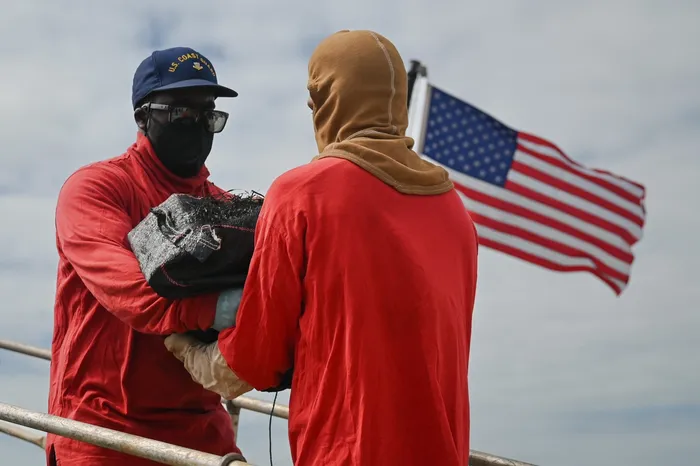
The crew of U.S. Coast Guard Cutter Tampa offloaded roughly 3,825 pounds of cocaine valued at over $28 million at Base Miami Beach on Thursday.
The seized cocaine is enough to kill more than 1.4 million U.S. citizens, the U.S. Coast Guard said in an April 16 statement. The seizure was the result of two interdictions in the Eastern Pacific Ocean as part of Operation Pacific Viper.
Cmdr. Joshua DiPietro, commanding officer of Tampa, said the performance of the crew over the past 74 days was “nothing short of phenomenal,” having seized almost $45 million in illicit drugs during this period.
“They met every challenge head-on, working seamlessly with our partner agencies and international allies to disrupt transnational criminal organizations.”
The Coast Guard said that since Operation Pacific Viper was launched last year, there has been an acceleration in counter-drug operations in the Eastern Pacific, with the Coast Guard deploying its assets to disrupt the influx of cocaine and other illicit drugs via the region into the United States.
The Eastern Pacific Ocean is a primary corridor used by Central and South American criminal groups to smuggle narcotics into America.
“Since launching this operation in early August, the Coast Guard seized over 215,000 pounds of cocaine and apprehended 160 suspected narco-traffickers,” the statement said.
“The Coast Guard’s persistent operations and rapid response denied criminal organizations billions in illicit revenue and prevented the flow of dangerous drugs into American communities.”
During President Donald Trump’s first year in office of his second term, the Coast Guard seized almost 470,000 pounds of cocaine, equalling 177 million lethal doses, according to a Jan. 20 statement from the Department of Homeland Security.
In April last year, the White House released the Trump administration’s Statement of Drug Policy Priorities document.
The document clarified that the administration aims to secure the global supply chain against drug trafficking, stop the flow of drugs from across the border, and reduce the number of drug overdose fatalities in the country.
“To achieve our vision of a safer, healthier future for Americans, we will disrupt the supply chain from tooth to tail. We will partner with or otherwise hold accountable countries that are sources of precursor chemicals and finished drugs that enter the United States. We will use new authorities to target the finances of drug trafficking organizations and the global distribution networks,” the document said.
Onshore Drug Crackdown
Customs and Border Protection (CBP) also reported several drug seizures this week.
On April 16, the agency announced a large drug seizure of more than 430 pounds of cocaine and methamphetamine in two enforcement actions on April 7 and 8.
The narcotics have an estimated street value of $2.8 million and were seized by officers at the Otay Mesa Port of Entry in California. The vehicles used to transport the drugs were also seized, and two drivers were arrested, with both of them facing federal prosecution.
“These back-to-back seizures stopped dangerous criminals in their tracks and prevented deadly narcotics from ever reaching our communities,” Otay Mesa Port Director Rosa E. Hernandez said.
“By combining their professional expertise with advanced technology, our officers demonstrate their commitment to securing our borders and keeping our country safe.”
The same day, CBP said it had recently made another seizure of over 60 pounds of cocaine valued at more than $1.15 million at the San Ysidro Port of Entry in California.
Officials also seized the vehicle involved in transporting the narcotics and two cellphones. The driver was arrested and faces federal prosecution for narcotics smuggling and importation.
On March 7, Trump announced a military coalition with several Latin American nations to tackle the drug trafficking problem.
“On this historic day, we come together to announce a brand new military coalition to eradicate the criminal cartels plaguing our region,” Trump said at a summit in Florida.
The initiative, the Americas Counter Cartel Coalition, will leverage military resources to deal with cartels. The event was attended by heads of state from Argentina, Bolivia, Chile, Costa Rica, the Dominican Republic, Ecuador, El Salvador, Honduras, Panama, Paraguay, and Trinidad and Tobago.
More Stories
Jessica Biel Bio: Net Worth, Career, and Personal Life
Jessica Biel has built a notable career in Hollywood. She began as a teenage television star and has since moved...
Why the Bakken Remains One of America’s Most Important Oil-Producing Regions
When most Americans think about domestic oil production, Texas probably comes to mind first. But more than a thousand miles...
Is A Different World Season 2 Renewed? Release Date, Episodes & More
Finished watching the first season of A Different World! Now searching for the renewal status and more details about A...
The Gentlemen Season 2 is Airing: Know About the Plot, Episodes, and Cast
Eddie has returned with season 2 of The Gentlemen. This time, his appearance and costumes reflect his new life as...
LEGO ONE PIECE is Live! Where to Watch and Full Cast Updates
Good news for Straw Hats fans who were waiting for the release of LEGO ONE PIECE Season 3. No, its...
Rebel Moon 3: Release Date, Cast Members, and Production Details
Zack Snyder has finally spoken about the release of Rebel Moon 3 after the release of the second sequel in...