
US Says Iran Port Blockade Fully Enforced as Trump Signals Possible Return to Talks

By Evgenia Filimianova
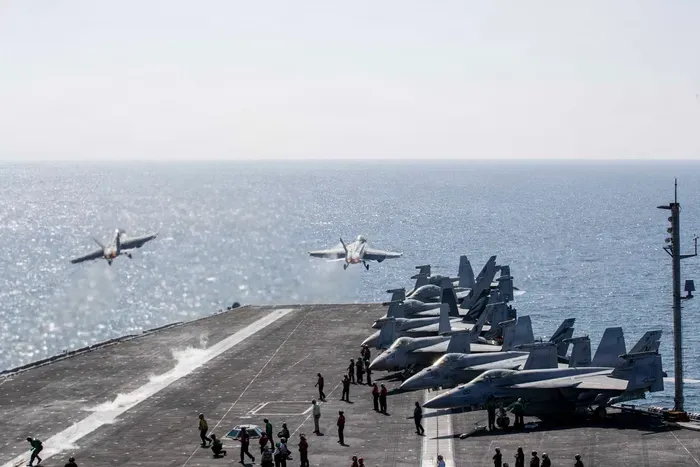
The United States said on April 15 that a sweeping naval blockade of Iranian ports had been fully implemented, effectively halting the vast majority of the country’s seaborne trade.
U.S. Central Command Commander Adm. Brad Cooper said in a post on X that U.S. forces maintain “maritime superiority in the Middle East.”
Cooper added that in less than 36 hours since the blockade was implemented on April 13, U.S. forces have completely halted economic trade going into and out of Iran by sea, adding that about 90 percent of the Iranian economy depends on maritime trade.
The blockade of Iranian ports aims to increase pressure on Tehran after negotiations on April 12 in Islamabad, Pakistan, failed to produce an agreement.
U.S. Vice President JD Vance, who led the American delegation, said Iran had rejected Washington’s terms for a lasting peace. According to Vance, the main obstacle was Tehran’s refusal to commit to abandoning nuclear weapons development.
The U.S. military said in an April 14 post on X that the blockade was being enforced “impartially against vessels of all nations” seeking access to Iranian ports in the Arabian Gulf and Gulf of Oman.
U.S. forces were continuing to support freedom of navigation for ships transiting the Strait of Hormuz to non-Iranian destinations, U.S. Central Command said.
Shipping in the Gulf and along the narrow Strait of Hormuz, which carries around a fifth of the world’s oil, has been restricted since the United States and Israel began strikes on Iran on Feb. 28, sending global oil prices surging to highs not seen since 2022.
Iran effectively shut down the Strait of Hormuz, a crucial global waterway for crude and gas transport, cutting shipments from the Gulf to global buyers, particularly in Asia and Europe, leaving importers scrambling to secure alternative supplies.
A vessel at the Strait of Hormuz, off the coast of Oman’s Musandam province, on April 12, 2026. Reuters
Under the U.S. blockade of Iranian ports, more vessels were being turned back, including U.S.-sanctioned, Chinese-owned tanker Rich Starry, which was making its way back to the Strait of Hormuz on April 15 after exiting the Persian Gulf.
The Iranian military warned on April 13 that no port in the Persian Gulf or Gulf of Oman would remain secure if Washington proceeded with the blockade of Iran’s ports.
Diplomatic Opening
Despite the escalation, Trump has said that diplomacy could soon resume.
In an April 14 interview with the New York Post, he said a second round of talks with Iran “could be happening over the next two days,” possibly in Europe or Pakistan.
Motorists ride past Serena Hotel, the venue where Iran and the United States held peace talks earlier in Islamabad, Pakistan, on April 14, 2026. Farooq Naeem/AFP via Getty Images
In an April 15 post on X, ABC News correspondent Jonathan Karl said Trump told him that he did not expect to extend the two-week ceasefire, which ends on April 21.
“I think you’re going to be watching an amazing two days ahead,” Trump said. “I really do.”
When asked whether the conflict would end through a deal or military success, Trump said it “could end either way, but I think a deal is preferable because then they can rebuild.”
“No matter what, we took out the radicals. They’re gone, no longer with us,” Trump added. “If I weren’t president, the world would be torn to pieces.”
U.N. Secretary-General António Guterres said on April 14 it was “highly probable” that talks would restart after discussions with Pakistani Foreign Minister Ishaq Dar.
Guterres previously urged restraint in an April 13 statement on X, saying the April 7 ceasefire “must be preserved – and extended as necessary,” and calling for respect for navigational rights, including in the Strait of Hormuz.
Pakistani Prime Minister Shehbaz Sharif speaks at a news conference at the United Nations in Geneva on Jan. 9, 2023. Denis Balibouse/Reuters
The office of Pakistani Prime Minister Shehbaz Sharif said he would travel to Saudi Arabia on April 15 and later attend the Antalya Peace Forum in Turkey, as Islamabad works to facilitate further talks.
French President Emmanuel Macron said in an April 14 post on X that he had spoken with both Trump and Iranian President Masoud Pezeshkian, urging a return to negotiations and warning against escalation.
Macron said it was essential that the ceasefire be respected and that the Strait of Hormuz be reopened “unconditionally, without restrictions or tolls.”
He added that France and the UK would host a conference in Paris to organize a “multilateral and purely defensive mission” aimed at restoring freedom of navigation in the strait.
Reuters contributed to this report.


More Stories
Jessica Biel Bio: Net Worth, Career, and Personal Life
Jessica Biel has built a notable career in Hollywood. She began as a teenage television star and has since moved...
Why the Bakken Remains One of America’s Most Important Oil-Producing Regions
When most Americans think about domestic oil production, Texas probably comes to mind first. But more than a thousand miles...
Is A Different World Season 2 Renewed? Release Date, Episodes & More
Finished watching the first season of A Different World! Now searching for the renewal status and more details about A...
The Gentlemen Season 2 is Airing: Know About the Plot, Episodes, and Cast
Eddie has returned with season 2 of The Gentlemen. This time, his appearance and costumes reflect his new life as...
LEGO ONE PIECE is Live! Where to Watch and Full Cast Updates
Good news for Straw Hats fans who were waiting for the release of LEGO ONE PIECE Season 3. No, its...
Rebel Moon 3: Release Date, Cast Members, and Production Details
Zack Snyder has finally spoken about the release of Rebel Moon 3 after the release of the second sequel in...