
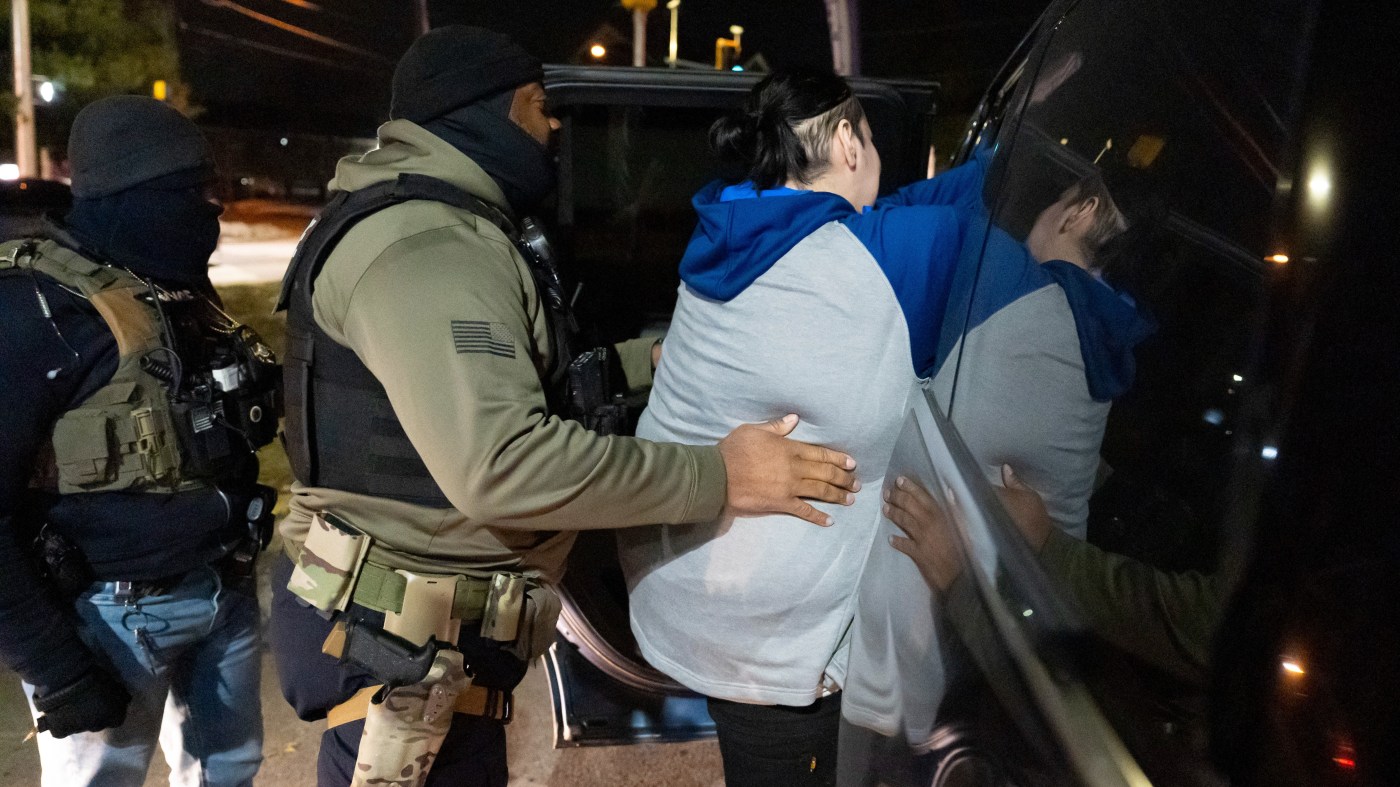
Uncertainty, rumors abound in Twin Cities as ICE raids increase nationally

Even in tense times for his clients, some online rumors can still get a chuckle out of Ryan Perez, organizing director of the Latino rights organization COPAL Minnesota. There was the recent unfounded social media post claiming, for instance, that immigration officials conducted a raid at Hola Arepa, a trendy Mexican-American restaurant in Minneapolis more popular with hipsters and upper-middle-class families than working-class immigrants.
Other rumors have struck Perez nowhere near as funny. Facebook posts claiming that U.S. Immigration and Customs Enforcement was recently stationed outside of United Hospital in downtown St. Paul, stopping patients, rang hollow, but the social media thread spread rapidly, instilling fear in the population that COPAL serves.
“We had some people go and check that out, and didn’t see or hear anything,” Perez said.
A string of executive orders signed by President Donald Trump set a quota for ICE of at least 1,800 arrests per day nationwide, which is about double previous targets, and workplace raids have already begun in Miami, Atlanta, Chicago and New York City, according to national news reports.
There’s little evidence widespread enforcement escalation has taken place yet in Minnesota beyond what’s typical — ICE detained about 1,000 immigrants in the state last year, and some of what individuals are reacting to online are standard operations. Still, immigrants’ rights organizations say that could change at any time, raising fears compounded by misinformation that has spread quickly online.
“We’re seeing false reports of raids that people are reacting to and sharing on social media,” Perez said. “We’re seeing people knowingly or unknowingly posting on social media false information about what the administration is doing. … (And) we’re seeing an echo of what happened during the first Trump administration — a lot of anti-immigrant rhetoric, right from the mouths of officials.”
ICE officials in the Twin Cities did not respond to a request for comment.
Focus of enforcement unclear
It’s unclear to what degree ICE will continue to prioritize arresting violent offenders and others among the “worst” actors, or focus more broadly on workplaces such as plants and factories. In December 2006, hundreds of workers at a Worthington, Minn., food-processing plant were detained by immigration officials in what would become one of the largest such actions in state history.
Under former President Joe Biden, ICE avoided “collateral” arrests, or detentions of non-intended targets who agents came across while searching for a particular offender.
Trump has lifted that policy, allowing or even encouraging such arrests, while also lifting Biden-era restrictions against immigration enforcement actions at or near schools, churches and hospitals.
“Minnesota has been a target before, especially in the food-processing plants,” Perez said. “Most ICE operations are very targeted operations. They know who they’re going after. But what’s new is the roundups of people with no criminal records because the administration wants to hit their numbers.”
Related Articles
Maplewood man runs ‘deceptive’ nonprofits, Keith Ellison lawsuit alleges
St. Paul man held girlfriend in his apartment, poured boiling water on her, charges say
Family identifies DC crash victim as Mahtomedi native
St. Paul man charged with sexually assaulting 71-year-old woman he befriended on Facebook
Fallout of release of MN undercover officers’ names: ‘Hit’ placed, more home security, amended lawsuit says
Workforce Summit
Business advocates have taken notice. The Minnesota Chamber of Commerce plans to host a “Workforce Summit” on Feb. 26 focused largely on how immigration policies, as well as artificial intelligence and other emerging trends, will impact a labor supply that’s already tight for most industries. The summit, which will feature breakout sessions with immigration attorneys and advocates for previously incarcerated “second-chance” workers, will take place at the Minneapolis Marriott Northwest in Brooklyn Park.
The Trump administration’s new directives go beyond detention of immigrants who reside in the country without legal status. Lawful refugee resettlements into the U.S. have been frozen for at least 90 days, as was expected by resettlement organizations based on the president’s actions in his last term.
What was unexpected, according to administrators with the International Institute of Minnesota, was a freeze on federal funding for initial services to refugees who have just arrived in the country.
“All resettlement agencies, including the International Institute of Minnesota, received an unprecedented order to immediately suspend any work aiding newly arrived refugees through the federally sponsored program,” reads a notice posted to the organization’s website last Monday. “This devastating blow impacts new arrivals who arrived as recently as 10 days ago.”
Micaela Schuneman, senior director of Immigration and Refugee Services with the St. Paul-based nonprofit, said they provide new refugees housing and food assistance, as well as help with school registrations and health screenings, to help them get on their feet before they land their first job and paycheck.
The institute welcomed 183 individuals in the past 90 days who are currently receiving services, and the decision to cut federal funding to assist with initial resettlement costs has left the nonprofit relying more than ever on public donations. Those individuals — “who were already extensively vetted, approved for resettlement, and have work authorization” — came from Somalia, the Democratic Republic of Congo, Guatemala, El Salvador, Sudan, Burma and Afghanistan, according to the nonprofit.
“The Trump administration’s pause in the refugee resettlement program was expected,” reads the institute’s written notice. “The refusal to honor the federal government’s commitment and breaking a promise to refugees who are already in our community was not.”
St. Paul police statement
St. Paul officials have sought to reassure all residents that they can continue to access city services without fear of immigration-related detention. While they say the city would cooperate with federal authorities investigating a violent crime, a city ordinance restricts city employees from asking members of the public about their immigration status, and the Ramsey County jail hasn’t boarded detainees for ICE since 2018.
During a panel discussion on regional needs at Allianz Field on Thursday, St. Paul Mayor Melvin Carter noted that if an immigrant neighbor fears calling 911 when their house is on fire, “your house is probably going to catch fire, too.”
Around the same time, the St. Paul Police Department put out a statement on social media saying it has received “numerous inquiries related to the current immigration activities” around the country.
The department made these points:
• St. Paul police do not have the authority to arrest or detain individuals solely based on immigration status.
• To participate in federal immigration enforcement, St. Paul police would need to sign a memorandum of agreement with ICE, giving them that authority. No agreement exists, nor has one been requested by either St. Paul police or ICE.
• St. Paul police will only detain or arrest those with probable cause or a warrant for a crime in its local jurisdiction, not a crime of entering the country.
• St. Paul police officers are required to be in uniform or have clear SPPD markings on them when engaged in arrest activities. This means if you see a St. Paul police officer or their markings — e.g. squad, vest, jacket — in the community, it is not an immigration detail.
St. Paul police officials also noted that those seeking help determining if a person has been detained by ICE can contact the ICE Field Office for the Midwest at 612-843-8600 or access the ICE Online Detainee Locator System at locator.ice.gov/odls/#/search.
Related Articles
Pentagon prepares to deploy 1,000 more troops to bolster Trump’s immigration crackdown
Colombia’s president calls for migrants to leave jobs in the US and return home
Nick Gillespie: We need more workers, not fewer
Refugee resettlement agencies scramble after Trump orders them to halt their federally funded work
While signing Laken Riley Act, Trump says he’ll send ‘worst’ criminal migrants to Guantanamo


More Stories
AI could soon hijack household appliances – Anthropic
Rogue agents could take control of smart TVs, ovens and other internet-connected devices, researchers have warned Artificial intelligence models could...
Owning Apple, Nvidia and Microsoft from Your Phone: How to Invest in US Stocks from India
You no longer need to be based in the US or set up a complicated overseas structure to explore international...
The Evolution of Surveillance: How AI is Transforming Modern Security Cameras
In particular, the development of surveillance cameras and the integration of artificial intelligence (AI) technologies are at the forefront of...
West increasingly vulnerable to energy shocks – IMF
Dwindling oil inventories, low gas stocks and mounting public debt are leaving European economies exposed to further price surges, according...
Best Sites to Buy TikTok Followers, Views and Likes in the UK
Some turn to paid engagement services to increase their follower counts, views and likes. These services can make profiles and...
Tony Buzbee: Why the Buzbee Law Firm Treats Community Work as Part of the Business
The firm takes on personal injury claims, workplace accidents, defective products and medical devices, commercial disputes, and gender discrimination cases,...