
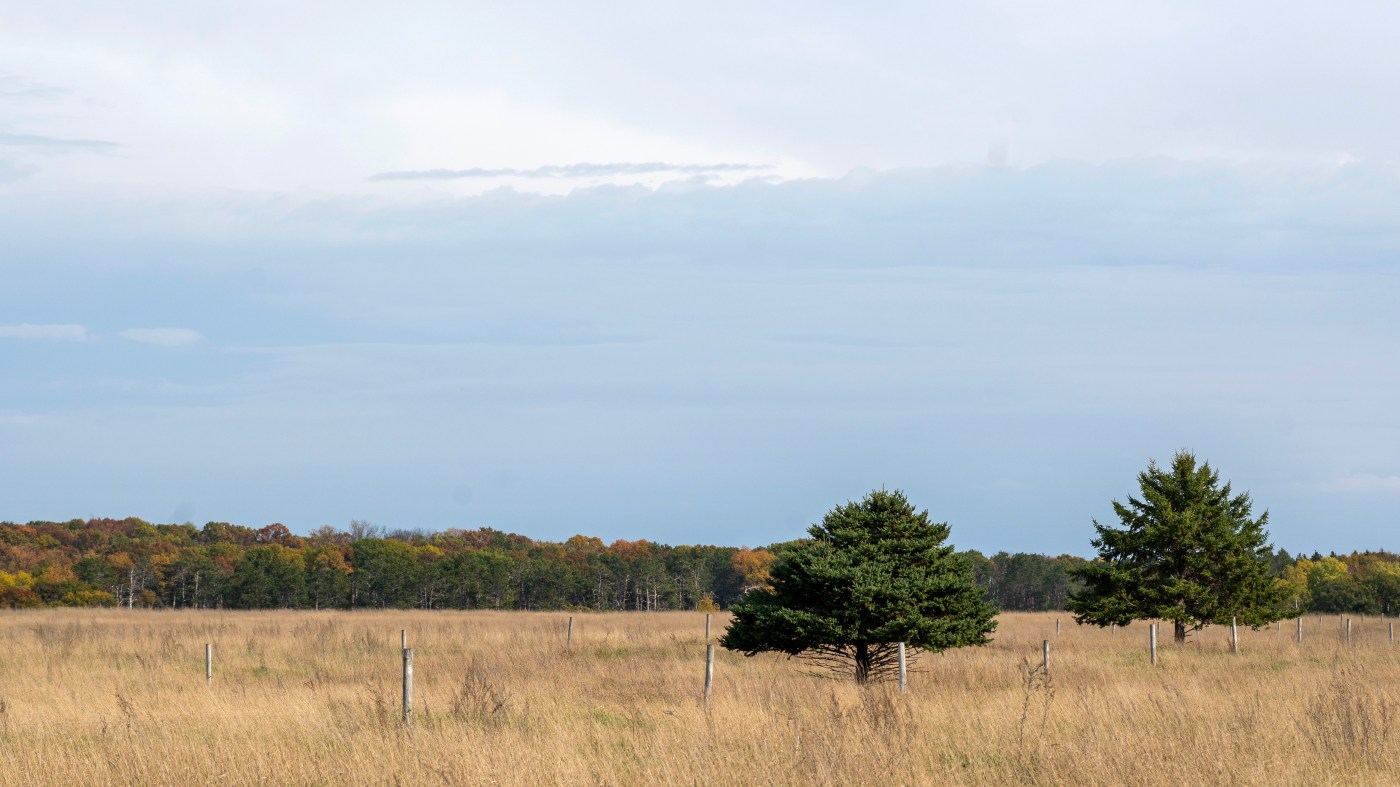
New Keystone Woods WMA is already popular with birders. What else should happen there?

The Keystone Woods Wildlife Management Area has only been open to the public for a couple of months, but it’s already become a popular destination for birders.
Among the birds spotted in the 1,820-acre property in northern Washington County is the rough-legged hawk, the northern harrier and the rare short-eared owl, a buffy-brown bird with long wings that the Minnesota Department of Natural Resources has classified as a species of special concern.
DNR officials are holding two public meetings this month — one online and one in person — to talk about the future of Keystone Woods WMA, and birders are expected to weigh in, said Lauren Peck, a spokeswoman for the agency.
“We definitely have had birders venturing out there,” she said. “It’s a chance to see rare birds without having to travel too far.”
A pair of short-eared owls at the new Keystone Woods Wildlife Management Area in northern Washington County were photographed on Oct. 10, 2024, by photographer and writer Greg Seitz. (Greg Seitz / St. Croix 360)
Greg Seitz, founder, editor and publisher of St. Croix 360, an independent online news source that covers the 7,700-mile St. Croix watershed, spotted a pair of short-eared owls at Keystone Woods just a few days after the WMA opened to the public in October.
“Another hiker was walking in front of me, and I think he flushed them up,” said Seitz, an avid amateur birder. “This was a ‘lifer’ species for me and, incidentally, the 150th species of bird I’ve observed in the St. Croix River watershed.”
Seitz reported the sighting to eBird, an online database maintained by the Cornell Lab of Ornithology, and wrote about it in St. Croix 360, and visitors began flocking to Keystone Woods to see the owls in person, he said.
“Seeing those owls was confirmation that this really was a place worth protecting,” Seitz said. “It’s a unique habitat in that it’s a really large grassland, which is what those owls need.”
Keystone Woods, which opened to the public in September, is the former Kelley Land and Cattle Co. property. The former cattle ranch, which had been owned by the same family since the 1950s, is considered one of the largest tracts of undeveloped land in the Twin Cities metropolitan area.
A dirt road winding through the Keystone Woods Wildlife Management Area, prior to restoration, in northern Washington County. (Courtesy of the Minnesota Department of Natural Resources)
James Kelley, a prominent Twin Cities attorney and businessman, purchased the property in 1958. According to an article published in the Pioneer Press in 1997, Kelley once had the biggest registered Hereford herd in Minnesota, about 600 head, which were sold and shipped to Wyoming. When he died in 1989, the farm was taken over by members of his family.
The property, located in Hugo and May Township, includes forest, woodlands, grasslands, wetlands and small lakes, Peck said.
“It has a wide variety of landscapes and has really stayed in its natural state,” she said. “It’s a really gorgeous property, and we’re excited to have people come out and visit and enjoy and learn about this area of the state.”
Future amenities
Currently, signs have been posted for the WMA and three temporary parking lots have been constructed: two off of Manning Trail and one off of 55th Street North. Visitors are asked to use the designated parking lots and not park on the shoulder of the roads.
The frozen shores of Barker Lake in the Keystone Woods Wildlife Management Area in northern Washington County. (Courtesy of the Minnesota Department of Natural Resources)
The DNR will accept public feedback on Keystone Woods through March 2. As part of the DNR’s outdoor recreation system, WMAs such as Keystone Woods are established to protect lands and waters that have a high potential for wildlife production, public hunting, trapping, fishing and other compatible recreational uses.
“Because it’s so close to the Twin Cities metro, Keystone Woods has the potential to offer expanded amenities and opportunities that aren’t typically available at our other WMAs,” said Gretchen Miller, the DNR’s central region wildlife manager. “We’re excited to hear the public’s thoughts and explore what recreation and outreach ideas would work well within our WMA system.”
Adjacent parkland coming
The remainder of the former Kelley land is in the process of being purchased by Washington County — in three different phases — to become a 685-acre addition to Big Marine Park Reserve. The northern third of the land — 240 acres of vacant land in the southeast quadrant of 170th Street and Manning Avenue in May Township — was acquired in May for $3.6 million; officials hope that all the parcels would be under county ownership by 2026.
Keystone Woods Wildlife Management Area opened in September 2024 on part of the former Kelley Land and Cattle Co. property. Washington County plans to purchase another 760 acres of the Kelley land to add to Big Marine Regional Park. (Courtesy of Minnesota Department of Natural Resources)
Purchasing the land in phases allows county officials to request reimbursement from the Metropolitan Council for regional park acquisition funds; the remainder will be funded by the county’s Land and Water Legacy Program, said Alex McKinney, parks director for Washington County.
The Kelley land has been in the master park plan for Big Marine Park Reserve for 40 years, and the sale was initiated by the property owner, McKinney said.
The Keystone Woods portion of the land was purchased by the national nonprofit Trust for Public Land, which then donated the land to the state of Minnesota. Trust for Public Land, which acted as an intermediary for the sale, purchased the WMA piece of the property using $27 million from the Outdoor Heritage Fund, which was created in 2008 by voters’ enactment of the Clean Water, Land and Legacy Amendment to the state constitution.
Washington County officials spent $3.6 million on Phase I of the Big Marine acquisition; the Metropolitan Council reimbursed 75% of the cost, or $2.7 million, McKinney said. The other 25% was covered with Washington County Land and Water Legacy Fund dollars. There’s no cost estimate yet for the next phases.
Hiking, horseback and mountain-biking trails are planned for the Big Marine reserve, as well as an archery course and multiple types of camping areas. Plans also include a separate trail crossing to connect over, under or across Washington County Highway 4. No hunting will be allowed within the park.
County staff expect design work to be done in 2027, and the land to open to the public in 2028. Crews must first add amenities such as trails and parking “to protect the high-quality resources of the land,” McKinney said. “It’s a phenomenal piece of property. The rolling topography is just gorgeous. It’s really a legacy piece for the county’s park system.”
Keystone Woods meetings
Related Articles
Rats! More rodents are infesting cities as scientists say warmer temperatures mean more rat babies
Climate change threatens the mental well-being of youths. Here’s how to help them cope
Study finds India doubled its tiger population in a decade and credits conservation efforts
Big Oil wants a lot from Trump. It has an ally in Doug Burgum, the president’s Interior pick
Many animals and plants are losing their genetic diversity, making them more vulnerable
An online meeting about the future of the Keystone Woods WMA will be 6 to 8 p.m. Feb. 12 via WebEx; a link to join the webinar is available on the Keystone Woods WMA webpage.
An in-person meeting will be 6 to 8 p.m. Feb. 13 at Hugo City Hall.
Members of the public who would like to weigh in also can complete an online survey, email northmetro.wildlife@state.mn.us, call Keystone Woods staff at 651-539-3324 or mail Keystone Woods WMA Public Input, 5463 C West Broadway Ave., Forest Lake, MN, 55025. Comments will be accepted until March 2.
For more information, go to dnr.state.mn.us/wmas/keystone-woods-wma.html.


More Stories
AI could soon hijack household appliances – Anthropic
Rogue agents could take control of smart TVs, ovens and other internet-connected devices, researchers have warned Artificial intelligence models could...
Owning Apple, Nvidia and Microsoft from Your Phone: How to Invest in US Stocks from India
You no longer need to be based in the US or set up a complicated overseas structure to explore international...
The Evolution of Surveillance: How AI is Transforming Modern Security Cameras
In particular, the development of surveillance cameras and the integration of artificial intelligence (AI) technologies are at the forefront of...
West increasingly vulnerable to energy shocks – IMF
Dwindling oil inventories, low gas stocks and mounting public debt are leaving European economies exposed to further price surges, according...
Best Sites to Buy TikTok Followers, Views and Likes in the UK
Some turn to paid engagement services to increase their follower counts, views and likes. These services can make profiles and...
Tony Buzbee: Why the Buzbee Law Firm Treats Community Work as Part of the Business
The firm takes on personal injury claims, workplace accidents, defective products and medical devices, commercial disputes, and gender discrimination cases,...