
Battle to Reopen Strait of Hormuz Begins With US Air Strikes, Allies Deploying Apaches

By Tom Ozimek
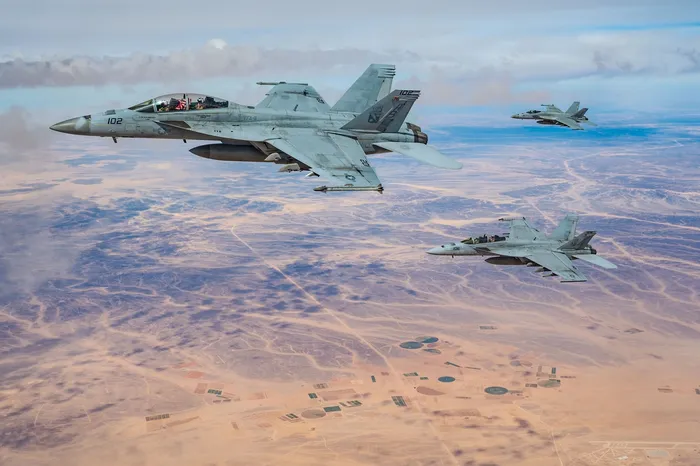
The battle to reopen the Strait of Hormuz has begun, with Pentagon officials announcing the launch of an offensive with the support of allies to reopen the critical oil shipping waterway that Iran has blocked in a bid to weaponize energy and other key commodity shipments in the ongoing conflict.
U.S. forces have deployed low-flying jets and Apache helicopters to strike Iranian vessels in the Strait of Hormuz, with some U.S. allies assisting by using Apaches to take on Iranian attack drones, Gen. Dan Caine, chairman of the U.S. Joint Chiefs of Staff, said during a March 19 press briefing.
“The A-10 Warthog is now in the fight across the southern flank and is hunting and killing fast attack watercraft in the Straits of Hormuz,” Caine said. “In addition, AH-64 Apaches have joined the fight on the southern flank, and they continue to work on the southern side. And that includes some of our allies who are using Apaches to handle one way attack drones.”
Caine did not name the allies involved. Typically carrying about one-fifth of the world’s oil, the strait has been largely closed as Tehran threatens vessels with mines, fast-attack craft, and missile strikes.
While Iran has allowed some tankers and other vessels to pass, shipping has slowed to a trickle due to the blockade, sending oil prices soaring and raising broader inflationary and food shortage fears as other key commodities like fertilizer have been affected.
U.S. officials last week suggested that the U.S. Navy—individually or as part of an international coalition—could deploy naval escorts to allow ships to pass through the strait, while also releasing oil from America’s strategic stockpile in a bid to stabilize energy market volatility.
Seeking to marshal a broader coalition to unblock Hormuz, U.S. President Donald Trump put pressure on NATO members and others to join in the effort to restore freedom of navigation in the critical shipping lane and counter what the International Energy Agency has called the largest supply disruption in the history of the global oil market.
“I wonder what would happen if we ‘finished off’ what’s left of the Iranian Terror State, and let the Countries that use it, we don’t, be responsible for the so called ‘Strait?’” Trump wrote in a March 18 post on social media. “That would get some of our non-responsive ‘Allies’ in gear, and fast.”
Following Trump’s call, a handful of European countries, along with Canada and Japan, announced their willingness to assist in some way.
“We call on Iran to cease immediately its threats, laying of mines, drone and missile attacks and other attempts to block the Strait to commercial shipping,” a March 19 joint statement from the UK, France, Germany, Italy, the Netherlands, Canada, and Japans stated. “We express our readiness to contribute to appropriate efforts to ensure safe passage through the Strait.”
NATO Secretary-General Mark Rutte said on March 19 that member states are engaged in intensive talks on how to tackle the blockage of Hormuz.
“Everybody agrees this strait cannot stay closed. It has to open up again as soon as possible. This is crucial for the world’s economy,” Rutte said. “I am confident that allies, as always, will do everything in support of our shared interests, as we always do. So we will find a way forward.”
Iran Escalates Gulf Strikes
Iran has widened attacks on Gulf energy infrastructure.
On March 19, Iranian forces hit refineries in Saudi Arabia and Kuwait and liquefied natural gas (LNG) facilities in Qatar, jolting global markets. The strikes came a day after Israel hit Iran’s South Pars gas field, prompting Tehran to threaten broader retaliation.
The attacks continued on March 20, with Iran firing missiles at Israel and Israel hitting targets in Tehran, as Gulf states reported fresh threats, including a drone strike on a Kuwaiti refinery and intercepted projectiles over Saudi Arabia, the United Arab Emirates, and Bahrain.
Disruptions to Qatari LNG exports and damage to regional facilities raised oil and gas prices, while shipping risks intensified. QatarEnergy said Iranian strikes have knocked out 17 percent of Qatar’s LNG export capacity, and the outages could trigger force majeure, meaning that it can’t guarantee deliveries, tightening supply to key importers.
During the Pentagon briefing on March 19, officials said the U.S. military had dropped 5,000-pound penetrator bombs on Iran’s underground facilities storing cruise missiles along the coast that could be used to hit ships in the Strait of Hormuz and other targets.
“We continue to hunt and kill mine storage facilities and naval ammunition depots,” Caine told reporters on March 19. “We continue to hunt and kill afloat assets, including more than 120 vessels and 44 mine layers, and the pressure will continue.”
The United States has also accelerated the deployment of the 11th Marine Expeditionary Unit from California to the Middle East, a task force made up of about 5,000 sailors and Marines. This comes just days after the Pentagon ordered the USS Tripoli ARG and its attached 31st Marine Expeditionary Unit to relocate from the waters near Japan to the Middle East.
“We’re doing this excursion, and when we’re completed, we’re going to have a much safer world,” Trump told reporters at the White House on March 19. “We’re defending the strait for everyone else.”

More Stories
Netflix’s Fauda Season 5: Release Date, Cast Members, Plot, and Episodes
Fauda season 5 is coming to Netflix soon! Your years of waiting are finally over. Are you also one of...
How to Cancel Hulu Subscriptions? A Complete Guide For Beginners
Worried about your money being deducted? Do you also have a subscription and now don’t know how to cancel your...
Dolly Parton, queen of country music, dies at 80
By Reuters Aug 25 (Reuters) – Dolly Parton was around six when she wrote her first song: “Little Tiny Tasseltop,”...
Canada’s Dollar-for-Dollar Tariff Response Exposes a Trade Relationship America Should Have Reexamined Decades Ago
By Stephen Zogopoulos, USNN World News Canada has now formally answered Washington’s latest tariffs with what it calls a “dollar-for-dollar,...
South Carolinians Go to Polls for Key Republican Senate Primary
By Joseph Lord CHARLESTON, S.C.—South Carolina voters will head to the polls today to make their pick in a runoff...
Iran Vows to Retaliate After US Rolls Out ‘Economic D-Day’ Sanctions
By Owen Evans Iran has promised to retaliate against the United States after Washington rolled out an “economic D-Day” sanctions...