
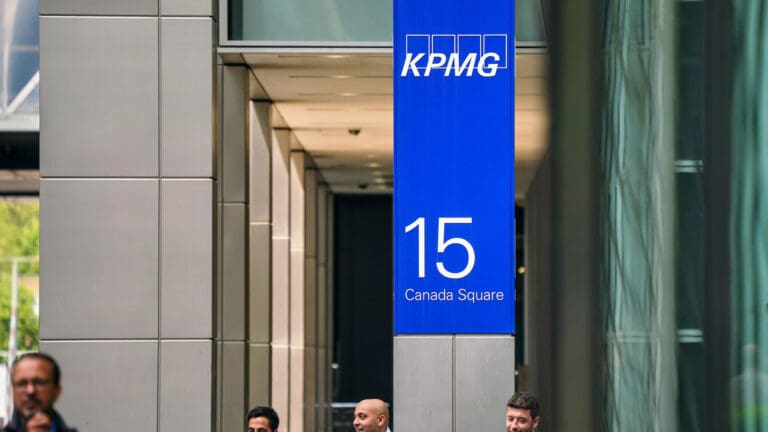
KPMG says AI auditors nearly as good as humans in FTSE 250 pilot

KPMG has piloted its first audit carried out by artificial intelligence agents and said the results were “in most cases” as good as the work produced by its own accountants, and potentially better in some areas.
The Big Four firm built and deployed dozens of AI agents this year to check over the financial statements of an unnamed FTSE 250 company. The experiment ran alongside KPMG’s conventional audit of the same business.
“In most cases, [the AI-based audit] was aligning to what we were doing as part of the normal audit,” said Cath Burnet, KPMG UK’s head of audit.
According to Burnet, the AI agents were much quicker than people at digesting large datasets, which allowed them to provide “deeper insights” than the firm’s human teams.
Auditors already use AI to assist their work. Burnet said the pilot was about “taking it a step further to see if we can get AI agents working together throughout the whole audit”.
“We wanted to find out what the power of AI was within an audit,” she said. “The world is changing and we want to make sure we’re changing with it.”
One view in the debate over the technology holds that audit could eventually be reduced to a piece of software that tracks a company’s finances in perpetuity, making most human auditors redundant.
Burnet said the pilot, despite its results, had hardened her view that humans would remain essential to the audit process.
“What the project really helped to show us was that the human element remains really important,” she said. “We knew that going into it, but this really reinforced it. Our auditors having the right technical knowledge and understanding of the business to apply their professional judgment was really key.”
She added that AI agents “absolutely will help us with audit quality” and said this was already happening, particularly in developing risk assessments and in analysing volumes of data that would take a human too long to process.
“Previously we may have taken quite a sampled approach, [but] with AI we can test the complete [data] population,” Burnet said. “That’s quite a different level of assurance we’re providing. It’s like dipping a fishing net into a river and putting a net right across it.”
According to Burnet, the technology should also allow human auditors to avoid some of the more routine tasks that “might not necessarily be auditors’ favourite things to do”. She said this would free them to explore angles of interest and hold more productive conversations with clients.
KPMG would “continue to evolve” its AI testing projects, Burnet said, but she did not believe the firm would reach the point where AI replaced people.
“I don’t think AI will ever run an audit. My belief is that you need human judgment. I call it ‘AI-enabled, human assured’, because without the human element we wouldn’t be able to [reach a conclusion].”
KPMG uses the same phrase to describe its Clara intelligence audit platform, which the firm says brings together AI capabilities, data, workflow and its audit methodology in a single system.
The pilot follows guidance from the Financial Reporting Council, the UK audit regulator, on the use of the type of tools KPMG has been testing. On 30 March 2026 the FRC published its Generative and Agentic AI Guidance, which sets out risks to audit quality from generative and agentic AI tools, possible mitigations and principles for exercising professional judgement when relying on their outputs.
The trial comes after KPMG said in September that it would cut about 200 UK advisory roles, citing low staff turnover and weaker client spending on consultants.

More Stories
Review Brexit red lines and keep EU membership open, says Prosper UK
The government should review the red lines drawn in 2017 on the single market, the customs union and free movement,...
BAE Systems plans 1,070 voluntary redundancies to become “more agile”
BAE Systems, Britain’s biggest defence company, plans to cut more than 1,000 jobs from its head office and air division...
Kutcher-backed fund’s Anthropic stake valued at $7bn as IPO prices at $83
Anthropic priced its initial public offering at $83 a share yesterday, above its marketed range of $70 to $78, ahead...
Rick Stein restaurant group losses almost double to £814,000
Pre-tax losses at The Seafood Restaurant Group, the company behind Rick Stein’s restaurants, hotels, online shop and cookery school, almost...
Companies House begins enforcement as ID verification reaches 90 per cent
Around 90 per cent of live companies have complied with mandatory identity verification requirements, Companies House said yesterday, one year...
What those little orders cost your business over a month
By the time the invoices reach the bookkeeper, one is filed under packaging and the other under general expenses. Both...