
Unison backs Miliband for chancellor as union battle over the Treasury intensifies

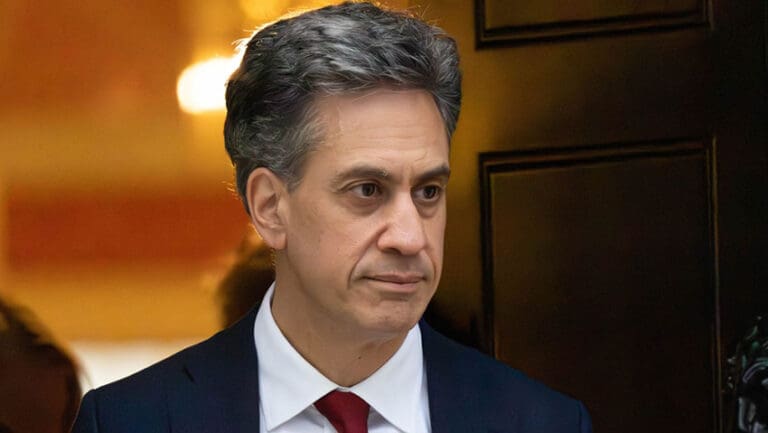
Britain’s largest trade union has thrown its weight behind Ed Miliband to become the next chancellor, a move that sharpens an increasingly bitter contest for control of the Treasury under a prospective Andy Burnham government.
Andrea Egan, general secretary of Unison, has backed the energy secretary as one of two frontrunners to replace Rachel Reeves in No 11. Her endorsement matters: Unison is the largest union in the country, with more than 1.3 million members concentrated in the public sector. Yet the support is far from unanimous across the movement, with two other big unions, GMB and Unite, lining up against him.
The jockeying between supporters of Miliband and his most likely rival, Wes Streeting, comes as Burnham prepares to deliver his first major policy speech since being elected as the MP for Makerfield. The former Greater Manchester mayor will set out his thinking on devolution and the economy in Manchester on Monday, but he is under mounting pressure to name his chancellor, a choice that investors, MPs, unions and business groups all regard as the single most consequential decision he will make in office. For business owners watching from the sidelines, the identity of the next occupant of No 11 will shape everything from the autumn Budget to the future ownership of Britain’s utilities. We have set out the runners and riders for the Treasury here.
Egan did not mince her words. “Andy Burnham has a historic opportunity to rebuild our country in the interests of workers and communities, but that chance will be squandered if his government is made up of politicians determined to continue the same failed approach,” she said.
“We need a chancellor who will rewire the economy and properly invest to improve the lives of the majority. Of those reported to be in the running, only Ed Miliband could enact the kinds of policies trade unions and our members urgently need.”
Burnham is assembling his inner circle of advisers and ministers, having entered the Commons only a week ago. Sir Keir Starmer’s announcement on Monday that he intends to resign as prime minister, swiftly followed by Streeting’s endorsement of Burnham, has made it overwhelmingly likely that the outgoing Manchester mayor will walk into No 10 as soon as next month.
Labour’s ruling national executive committee confirmed on Thursday that a new leader would be named on 17 July if only one candidate comes forward. Should a rival secure the backing of 81 Labour MPs and force a contest, the party will hold a full leadership election and declare the result on 29 August.
The new prime minister’s first appointment is already drawing fire. Burnham has chosen his former cabinet colleague and long-standing friend James Purnell as chief of staff, a decision that has irritated parts of the Labour left, who are wary of Purnell’s Blairite pedigree.
Attention has now turned squarely to who will run the Treasury, a brief that extends well beyond setting tax policy in this autumn’s Budget. The next chancellor will be charged with reigniting growth and overseeing the de-privatisation of some of Britain’s largest utilities, an agenda with direct consequences for investors and the wider business community.
The two leading contenders, Streeting and Miliband, hail from different wings of the party and would almost certainly pursue different priorities. Streeting, like Purnell, is a Blairite who, as health secretary, welcomed private sector involvement in the NHS. He is regarded as the more business-friendly option and the candidate most likely to reassure international investors, though some on the left worry he would be lukewarm on returning water and energy companies to public ownership.
Miliband, by contrast, is seen as more ideologically aligned with Burnham’s programme. But he has drawn anger from sections of both the unions and the business community over his approach to net zero. Some investors believe he would prove anti-business, pointing back to his time as Labour leader, when he drew a sharp line between companies he cast as “producers” and those he branded “predators”.
Unions with a strong presence in the North Sea oil industry have been exasperated by Miliband’s refusal to soften his pledge not to issue new exploration licences. They also fear he will decline to approve the Jackdaw and Rosebank megafields, even though waving them through would not technically breach that promise, since both already hold licences. The two projects, analysed in detail by the Institute for Government, have become a lightning rod in the wider argument over energy security and the pace of the transition.
One senior union official told the Financial Times on Thursday: “There are ongoing discussions to try to stop Ed Miliband. There is a GMB-Unite axis on this.”
Unison’s endorsement will strengthen Miliband’s standing within the labour movement, and he is not without other backers. Smaller unions, including the TSSA, are expected to issue similar messages of support in the coming days, while the National Education Union came out for him earlier on Thursday.
Even so, Miliband and Streeting are not the only names in the frame. Other possible candidates include Shabana Mahmood, the home secretary, Yvette Cooper, the foreign secretary, Pat McFadden, the work and pensions secretary, John Healey, the former defence secretary, and Jonathan Reynolds, the chief whip.
Allies of Reeves insist she would like to stay put, arguing she is best placed to keep markets calm while giving Burnham’s platform her full support. Her own appetite for the job has not gone unnoticed in the City, and her position has fed into a broader debate about fiscal devolution as Burnham eyes No 10.
Asked by the BBC on Wednesday about her chances of remaining in cabinet, Reeves said: “I’m not going to pre-empt the decisions that the new prime minister will make. I’m backing Andy and I think he’d be a great prime minister, but those are his decisions, not mine to make.”
She later told the British Chambers of Commerce annual conference: “I hope that whoever is chancellor in the future, whenever that future may be, sticks to what I’m doing. Because it is beginning to bear fruit, and we are seeing that investment return to the economy, that growth return to the economy, and crucially, that stability, so that businesses can plan and invest in the future.”
Allies of Burnham, however, are adamant that he will not keep her in place. For Britain’s businesses, the only certainty is that the answer is coming, and soon.


More Stories
Getting to know you: Anita Bhanja, founder, Eternal Paws
Anita Bhanja is the founder and veterinary surgeon of Eternal Paws, a Cheshire practice specialising in home hospice, palliative care...
Average UK side hustle brings in £700 a month, new survey shows
The average UK side hustle generates £700.50 a month, equivalent to around £8,406 a year, according to new research from...
Anthropic’s $2tn IPO asks the public to carry the risk
Anthropic today published the S-1 registration statement for its Nasdaq listing under the ticker ANT, reportedly targeting the week of...
Why esbconnect’s Suzanna Chaplin still backs email for acquisition
Suzanna Chaplin is the founder of esbconnect, the UK customer acquisition business that lets brands buy opted-in email audiences in...
Manchester graphene spin-out Concretene raises £4.5m in Series A
Concretene, a University of Manchester spin-out, has raised £4.5m in the first close of a Series A round to scale...
M&S lowers British meat prices and says farmer payments stay the same
Marks & Spencer is cutting the price of selected British beef, lamb and pork products by up to 26 per...