
Trump Tells Germany’s Merz to Stop Interfering Over Iran

By Victoria Friedman
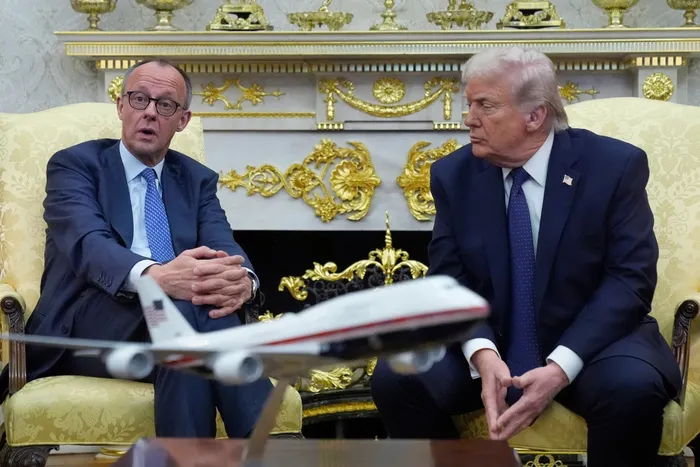
U.S. President Donald Trump has again criticized German Chancellor Friedrich Merz over Iran, telling Merz to stop interfering in the Middle East conflict and focus on domestic issues.
Trump said in an April 30 Truth Social post that Merz should “spend more time on ending the war with Russia/Ukraine” and on “fixing his broken Country, especially Immigration and Energy, and less time on interfering with those that are getting rid of the Iran Nuclear threat, thereby making the World, including Germany, a safer place!”
Germany is one of several European countries that has been giving Ukraine military aid.
Berlin and Kyiv recently upgraded their bilateral relationship to a strategic partnership, with the new framework committing Germany and Ukraine to closer political, security, and economic ties.
The U.S. president made the remarks following a series of comments between the two G7 leaders over the Iran war.
Trump in an April 28 Truth Social post strongly disputed Merz’s statement made the day before in which he said that the United States had been “humiliated” by the Iranian leadership over attempts to hold peace talks to end the two-month U.S.–Iran war.
Merz then on April 29 said that his personal relationship with Trump “remains good,” adding in comments to reporters that he “simply had doubts from the start about what was begun with the war in Iran.”
Trump has criticized NATO allies for not sending naval support to help open the Strait of Hormuz, saying earlier this month that the defense alliance could face a “very serious examining” as a result.
Since then, the U.S. Department of War said that it was working closely with European allies to get NATO members to step up with their defense strategies and responsibilities, with Berlin taking a leading role.
Germany Stepping Up on Defense
Germany’s new military strategy document says that Berlin will take on “additional burdens,” including “targeted strategic responsibility for Europe at the conventional level.”
“This increases Germany’s strategic weight for our Allies, particularly for the United States.”
German Chancellor Friedrich Merz drives in the Boxer armoured fighting vehicle during his visit to the army at the Bundeswehr base in Munster, Germany, on April, 30, 2026. Markus Schreiber/AP Photo/Pool
Trump on April 29 said that the United States was reviewing a possible reduction in the number of troops it maintains in Germany, which has the second-highest number of American active service troops overseas, after Japan.
The president has previously spoken about reducing troop numbers in Germany, saying in June 2020 that the deployment was expensive and unfair to American taxpayers.
As of December 2025, the United States had 36,436 active-duty troops stationed in Germany.
Trump said a decision is expected “over the next short period of time.”
While visiting troops on Thursday at a military training area in Munster, northern Germany, Merz did not directly address Trump’s comments, but alluded to working “shoulder to shoulder for mutual benefit and in deep trans-Atlantic solidarity.” He said his government has “made great efforts to strengthen Germany’s security.”
Iran’s Nuclear Weapons
Trump’s initial criticisms of Merz stemmed from the German chancellor’s comments that the United States had been humiliated by Tehran.
“The Iranians are obviously very skilled at negotiating, or rather, very skillful at not negotiating, letting the Americans travel to Islamabad and then leave again without any result,” Merz said on April 27 during a talk to students in Marsberg, Germany.
“An entire nation is being humiliated by the Iranian leadership, especially by these so-called Revolutionary Guards. And so I hope that this ends as quickly as possible,” he added.
The U.S. president then criticized Merz in a Truth Social post on April 28, saying that the German chancellor “thinks it’s OK for Iran to have a Nuclear Weapon.”
“He doesn’t know what he’s talking about! If Iran had a Nuclear Weapon, the whole World would be held hostage. I am doing something with Iran, right now, that other Nations, or Presidents, should have done long ago. No wonder Germany is doing so poorly, both Economically, and otherwise!”
Merz has said that Iran must not have a nuclear weapon.
A woman holds up pictures of the Iranian leader Ayatollah Mojtaba Khamenei, left, and his father, the slain Ayatollah Ali Khamenei in a state-organized rally celebrating the birthday of Imam Reza, the 8th Shiite Muslims’ imam, and supporting the supreme leader, in Tehran, Iran, on April 29, 2026. Vahid Salemi/AP Photo
On April 30, Iran’s leader Ayatollah Mojtaba Khamenei vowed to protect the Islamic Republic’s nuclear and missile capabilities.
“Ninety million proud and honorable Iranians inside and outside the country regard all of Iran’s identity-based, spiritual, human, scientific, industrial and technological capacities—from nanotechnology and biotechnology to nuclear and missile capabilities—as national assets, and will protect them just as they protect the country’s waters, land and airspace,” Khamenei said, per a statement read by a news anchor on Iranian state television.
Khamenei, who the Pentagon said was wounded in the Feb. 28 airstrike that killed his father Ali Khamenei, has not been seen in public since taking over as leader.
The Associated Press contributed to this report.

More Stories
DOJ Charges 28 Noncitizens in California With Election Crimes
By Tom Gantert The Justice Department announced on Oct. 19 that 28 noncitizens living in California face election-related criminal charges,...
Homebuilder Confidence Drops in October Amid Weak Demand, Rising Costs
By Bill Pan Confidence among U.S. homebuilders fell in October, as rising mortgage rates discouraged buyers while construction costs and...
Elon Musk Pledges to Give ‘Every Kid in America’ 1 SpaceX Share
By Andrew Moran Billionaire Elon Musk said he will give every child in the United States a stake in his...
Vance Says He’ll Wait Until After Midterms to Decide on Presidential Run
By Jack Phillips Vice President JD Vance said he will wait until after the upcoming November midterm elections before making...
Oil Retreats From 5-Month High as Markets Weigh Trump’s Russia Sanctions Waiver
By Tom Ozimek Oil prices fell on Oct. 19, with Brent retreating from a five-month high as investors weighed President...
The Babysitter 3: Renewal Status, Release Date, Cast Members & Plot
Nine years after Netflix’s debut, the horror-comedy film The Babysitter remains one of the biggest hits. What began as a...