
Chevron, Exxon Decline to Boost Oil Production Despite Trump Admin Requests

By Guy Birchall
ExxonMobil and Chevron have said they won’t boost oil production despite the Trump administration’s calls for them to do so to help address the energy shortage caused by the war with Iran.
Exxon’s chief financial officer Neil Hansen told the Financial Times in an article published on May 1 that there had been “no change” to the company’s strategy in the Permian Basin, the highest producing oil and gas region in the United States.
Chevron’s finance chief Eimear Bonner, speaking to the same publication, echoed the sentiment, stating that “the crisis has not prompted any change to any of our plans”.
The statements from the American oil giants were made amid what analysts are calling one of the worst energy crises in history, and a day after Brent crude briefly spiked to over $126 dollars a barrel, the highest price in four years.
“There’s really no need for us to shift up because we’re already up, we’re already in high gear,” Hansen told the paper. “That doesn’t mean we aren’t looking at the potential to expand that, but there are limitations.”
Bonner said that Chevron “could grow in the Permian, but that’s not the strategy we have.”
“Our strategy is to grow free cash flow, not grow production,” she said, adding it wouldn’t be expected for the company to significantly change plans ”on the back of eight weeks of disruption.”
Energy Secretary Chris Wright and Interior Secretary Doug Burgum held a call with oil executives on April 16 to encourage them to increase drilling, according to a statement from White House spokesperson Taylor Rogers.
“Secretaries Burgum and Wright had a very productive call with American oil and gas executives to thank them for their record-high production and discuss actions that the Administration has implemented to eliminate unnecessary red tape and encourage even more drilling,” the statement given to journalists read.
Exxon and Chevron both released their first quarter earnings on May 1, with Exxon reporting a net income of $4.2 billion in the three months to the end of March, down 46 percent on the same period a year ago, but beating earlier estimates, Reuters reports.
That figure, the lowest since the first quarter of 2021 and down from $7.7 billion in the year-ago period, was attributed to disruptions caused by the ongoing war in Iran.
Exxon has one of the highest exposures to the crisis in the Middle East, with operations in the region accounting for 20 percent of its oil production last year.
Chevron, which is less exposed to the Middle East market, with only 5 percent of its production based in the Middle East, reported net income of $2.2bn in the first quarter, a 37 per cent drop from from $3.5 billion over the same period last year, according to Reuters.
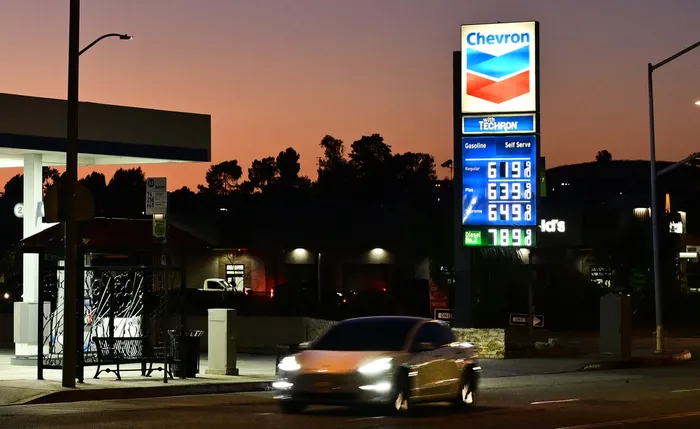
Trump said on April 30 that gasoline prices would plummet once the war with Iran ends, even as U.S. drivers face the highest pump prices in four years amid ongoing disruptions to global oil supply.
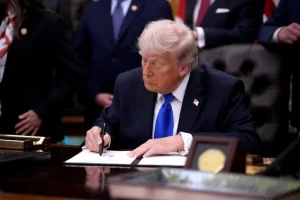
Speaking during a press event in the Oval Office, Trump linked elevated fuel costs directly to the ongoing conflict and the continued closure of key shipping routes, while expressing the conviction that ample global supply would quickly push prices lower once unrestricted crude transit resumes in a post-war environment.
“The gas will go down. As soon as the war’s over, it’ll drop like a rock,” Trump said. “There’s so much of it, it’s all over the place, sitting all over the oceans of the world.”
The same day as the president’s remarks, it was revealed that the United States is considering releasing up to 92.5 million barrels of crude oil from its Strategic Petroleum Reserve (SPR), and the Department of Energy is soliciting bids from companies.
“Today’s solicitation opens competitive bidding, continuing Department of Energy’s execution of President Trump’s swift 172-million-barrel release as part of a coordinated 400-million-barrel action by International Energy Agency (IEA) member nations’ strategic reserves,” the department said in a statement on April 30.
The 172-million-barrel release was announced in March to tackle rising oil prices amid the Iran War. At the time, the Department of Energy had said that the full release would take roughly 120 days to deliver and that it expected a total of around 200 million barrels to be returned to the strategic reserve within the next year “at no cost to the taxpayer.”
In its recent statement, Department of Energy said that the participating companies in the 92.5 million barrel “emergency exchange” will return them with “additional premium barrels, ensuring the SPR grows beyond current levels while delivering immediate supply to refiners and global oil markets.”
On April 30, Trump also approved a pipeline that will take oil from Alberta, Canada, to the United States, reviving part of the canceled Keystone XL pipeline.
South Bow, the Canadian pipeline company behind Keystone XL, is partnering with U.S. company Bridger Pipeline on the proposed project. South Bow is also considering reviving some pipelines already built in Alberta and Saskatchewan.
Bridger Pipeline is seeking to construct a 645-mile pipeline, which would begin near the Canada–U.S. border in Montana and end in Wyoming.
The pipeline could increase Canada’s crude oil exports to the United States by more than 12 percent.
Tom Ozimek, Naveen Athrappully, Matthew Horwood, and Reuters contributed to this report.

More Stories
Jessica Biel Bio: Net Worth, Career, and Personal Life
Jessica Biel has built a notable career in Hollywood. She began as a teenage television star and has since moved...
Why the Bakken Remains One of America’s Most Important Oil-Producing Regions
When most Americans think about domestic oil production, Texas probably comes to mind first. But more than a thousand miles...
Is A Different World Season 2 Renewed? Release Date, Episodes & More
Finished watching the first season of A Different World! Now searching for the renewal status and more details about A...
The Gentlemen Season 2 is Airing: Know About the Plot, Episodes, and Cast
Eddie has returned with season 2 of The Gentlemen. This time, his appearance and costumes reflect his new life as...
LEGO ONE PIECE is Live! Where to Watch and Full Cast Updates
Good news for Straw Hats fans who were waiting for the release of LEGO ONE PIECE Season 3. No, its...
Rebel Moon 3: Release Date, Cast Members, and Production Details
Zack Snyder has finally spoken about the release of Rebel Moon 3 after the release of the second sequel in...