
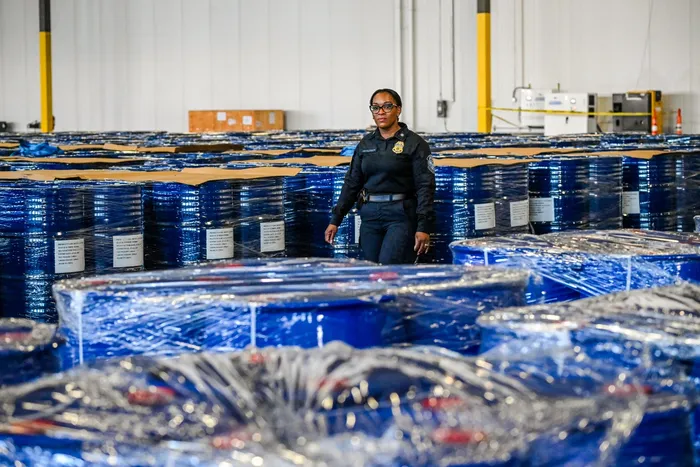
Treasury Sanctions International Drug Network Tied to Sinaloa Cartel

By Andrew Moran
The Treasury Department has introduced sanctions on 23 individuals and organizations involved in a sophisticated synthetic‑opioid procurement network connected to a Mexican crime syndicate.
Designated as a foreign terrorist organization in February 2025, the Sinaloa Cartel is one of the biggest drug-trafficking groups in the world, operating in Mexico and Latin America. It also specializes in a wide array of drugs, such as cocaine, heroin, fentanyl, and methamphetamine.
The Treasury’s Office of Foreign Assets Control stated on April 23 that various chemical suppliers and brokers have transformed the international drug trade by allowing Mexican cartels to produce illicit narcotics from precursor chemicals—4-Piperidone and N-Boc-4-Piperidone, for example—that originate primarily from Asia, including India.
These parties depend on global supply chains and clandestine manufacturing facilities, the Treasury noted.
By cracking down on every stage of the synthetic-opioid supply chain through sanctions, the United States can further prevent the flow of these highly potent narcotics into U.S. communities that cause thousands of deaths annually, Treasury Secretary Scott Bessent said.
“President Trump has been clear that terrorist cartels will not be allowed to wreak havoc on our borders and in our communities,” Bessent said in a statement. “Treasury will continue to target every stage of the opioid supply chain to Keep America Safe and prevent more lives lost to fentanyl.”
Combatting drugs, particularly fentanyl, has been at the forefront of the president’s second-term policy agenda. He signed a December 2025 executive order declaring fentanyl a weapon of mass destruction.
But while fentanyl and methamphetamines have been the target for officials, states have discovered a new supply of street drugs in the past couple years.
Massachusetts Drug Supply Data Stream, for instance, posted a warning in July 2025 about the growing presence of medetomidine, a stronger, longer-lasting sedative.
Fighting Sinaloa
U.S. Secretary of State Marco Rubio implemented visa bans on 75 family members and associates linked to the Sinaloa cartel.
“The Sinaloa Cartel smuggles illicit fentanyl, which the President designated as a Weapon of Mass Destruction, and other deadly drugs that harm American communities,” Rubio said on April 20.
“Imposing visa restrictions on drug traffickers, their family members, and close personal and business associates will not only prevent their entry into our nation, but also serve as a deterrent to continued illicit activities.”
Various federal agencies have coordinated a whole-of-government approach to fight transnational criminal networks, the Treasury said. The Treasury will continue to partner with the Homeland Security Task Force to dismantle the infrastructure—from facilitators to networks—that support drug production and distribution, it stated.
Sinaloa was one of eight drug cartels classified as foreign terrorist organizations last year. In addition to drug trafficking, U.S. officials say Sinaloa engages in violence and intimidation tactics.
The designation permits the federal government to explore tougher criminal penalties and facilitate heightened military intervention against drug cartels and their members.
In September 2025, the Drug Enforcement Administration stated it had arrested more than 600 members of the Sinaloa cartel in a global operation.
Scam Center Crackdown
The Treasury also announced on April 23 that sanctions on Cambodian Sen. Kok An and 28 other people and entities. The actions reflect Washington’s efforts to combat Southeast Asian scam operators within the network of Kok An and his associates.
The U.S. Department of the Treasury in Washington on Aug. 8, 2025. Madalina Kilroy/The Epoch Times
In addition to defrauding Americans, some of the scam operators have themselves been victims of human trafficking and other unlawful acts under threat of violence, U.S. officials say.
“Eliminating fraud is a top priority for the Trump Administration,” Bessent said, according to the statement. “Treasury will continue to target fraudsters and scam centers that steal billions of dollars from hardworking Americans, no matter where they operate or how well-connected they are.”
The United States is also offering up to $10 million for information that helps seize or recover laundered funds tied to scams run out of Burma’s Tai Chang scam centers.
It is estimated that Americans lost more than $7.2 billion to Southeast Asia-based scam operations last year.

More Stories
Jessica Biel Bio: Net Worth, Career, and Personal Life
Jessica Biel has built a notable career in Hollywood. She began as a teenage television star and has since moved...
Why the Bakken Remains One of America’s Most Important Oil-Producing Regions
When most Americans think about domestic oil production, Texas probably comes to mind first. But more than a thousand miles...
Is A Different World Season 2 Renewed? Release Date, Episodes & More
Finished watching the first season of A Different World! Now searching for the renewal status and more details about A...
The Gentlemen Season 2 is Airing: Know About the Plot, Episodes, and Cast
Eddie has returned with season 2 of The Gentlemen. This time, his appearance and costumes reflect his new life as...
LEGO ONE PIECE is Live! Where to Watch and Full Cast Updates
Good news for Straw Hats fans who were waiting for the release of LEGO ONE PIECE Season 3. No, its...
Rebel Moon 3: Release Date, Cast Members, and Production Details
Zack Snyder has finally spoken about the release of Rebel Moon 3 after the release of the second sequel in...