
Beyond Hormuz: The US–Indonesia Defense Pact and What It Means for China

By Antonio Graceffo
The U.S.–Indonesia defense pact strengthens American strategic control over key maritime chokepoints, enhancing its ability to pressure China’s energy lifelines while reinforcing the blockade of Iran.
On April 13, while global attention remained fixed on the Strait of Hormuz, Secretary of War Pete Hegseth welcomed Indonesian Defense Minister Sjafrie Sjamsoeddin to the Pentagon, where the two men announced the establishment of the Major Defense Cooperation Partnership (MDCP) between the United States and Indonesia. The partnership features three foundational pillars rooted in national sovereignty and mutual respect: military organization and capacity building; training and professional military education; and exercises and operational cooperation.
Under the framework, both countries will explore cutting-edge initiatives, including co-developing asymmetric capabilities, pioneering next-generation defense technologies in the maritime, subsurface, and autonomous systems domains, and cooperating on maintenance, repair, and overhaul support to improve operational readiness. Hegseth noted that the two countries already complete more than 170 military exercises together each year.
The agreement has strategic benefits for the United States, far beyond the bilateral defense cooperation. Indonesia controls the world’s fourth-largest population and ASEAN’s biggest economy and military, with its archipelago stretching across the Strait of Malacca and other chokepoints that carry much of the world’s trade between the Indian and Pacific oceans.
The Strait of Malacca links the Indian and Pacific Oceans through a channel just under 2 miles at its narrowest point, a fraction of the width of Hormuz, and carries roughly 40 percent of global trade, including the bulk of Middle East oil flows to China, Japan, and South Korea.
The most consequential part of the agreement is the overflight component. Jakarta has been asked to grant blanket overflight access for American military aircraft, which would give the U.S. greater ability to monitor the Strait of Malacca. However, this portion of the agreement remains under discussion and has not yet been finalized, reflecting the broader tension Indonesia faces as an unaligned nation balancing its relations with Beijing while deepening ties with Washington.
The overflight permission would significantly compress American response times across the Taiwan Strait, South China Sea, Malacca Strait, and eastern Indian Ocean. U.S. aircraft could reach operational areas faster and through less exposed corridors.
For China, the agreement further complicates the “Malacca Dilemma,” Beijing’s vulnerability to a potential blockade of the strait. China is energy- and food-dependent; consequently, in the event of a war, the United States could blockade the Malacca Strait, preventing Middle Eastern oil from reaching China. At the same time, it would restrict food imports and significantly affect China’s exports, depriving the Chinese Communist Party (CCP) of income.
Indonesian marines maneuver in a Landing Vehicle Tracked Personnel-7 during the Super Garuda Shield joint military exercise, including Indonesia, Japan, Singapore, Australia, and the United States, in Situbondo, East Java, on Sept. 5, 2024. Juni Kriswanto/AFP via Getty Images
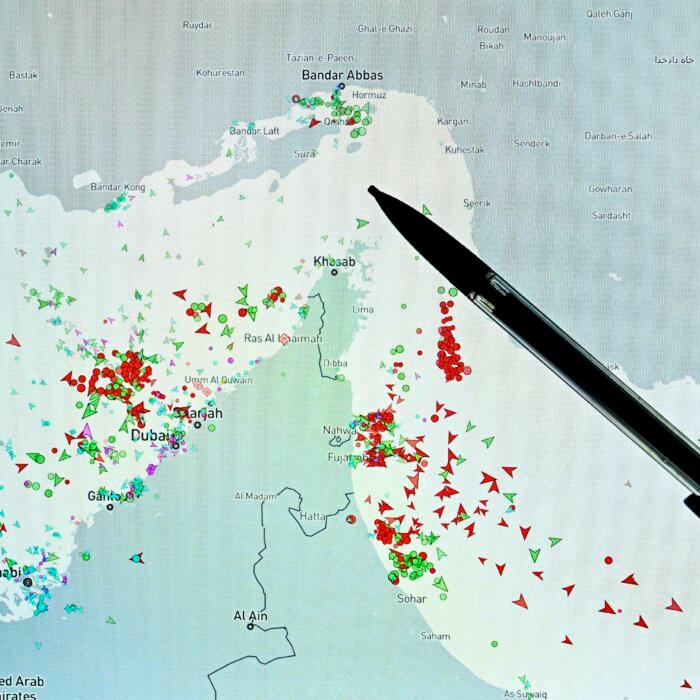
This agreement is particularly significant as it comes amid the Iranian regime’s closure of the Strait of Hormuz and the subsequent U.S. blockade during the Iran conflict. The International Energy Agency has characterized the crisis as the “largest supply disruption in the history of the global oil market,” with Iran’s closure of the strait affecting 20 percent of global oil supplies and significant volumes of liquefied natural gas. With that chokepoint effectively sealed, Washington moved quickly to enforce restrictions against Iran.
U.S. overflight access through Indonesia would enhance Washington’s ability to prevent Beijing from obtaining cheap Iranian oil and from exporting defense materials to Tehran. The U.S. blockade, which took effect April 13, has cut off an estimated $150 million per day in Iranian oil revenue, severing Tehran’s primary income and eliminating China’s access to heavily discounted Iranian crude, of which it was the sole buyer.
Iran had earlier attempted to monetize its control of the strait by imposing a transit toll of up to $2 million per vessel, which Iran’s parliament codified into law under the “Strait of Hormuz Management Plan.” The toll carried a secondary strategic dimension: Payments were accepted in Chinese currency, routed through Kunlun Bank via CIPS, outside SWIFT, positioning the scheme as a vehicle for internationalization of the yuan.
The blockade has rendered that system unenforceable, and there have been only two verified instances of ships paying the toll since late March. However, it is crucial to note that the verification is based on a Lloyd’s report, which does not disclose whether the vessels were Chinese. The same Lloyd’s statement was paraphrased across multiple media sources, giving the impression that toll payments were widespread, when in fact it was just duplicate reporting of the same two ships. Meanwhile, the yuan has made no advances in its internationalization, remaining well below 3 percent of global trade settlement.
China’s strategic and commercial crude reserves cover an estimated 120 days of net imports, a finite buffer that the MDCP is designed to pressure over the longer term. According to U.S. Energy Information Administration data, the Strait of Malacca recorded more than 94,000 vessel transits in 2024, with approximately half bound for China.
China’s veto of a United Nations Security Council resolution on Hormuz makes the Malacca deal even more pointed. On April 7, China and Russia vetoed a resolution aimed at protecting commercial shipping in the Strait of Hormuz, with China’s U.N. envoy Fu Cong arguing it would send the “wrong message.” The veto served China’s immediate interests: Iran had continued shipping crude through Hormuz to China even after the war began, with at least 11.7 million barrels sent since Feb. 28, all destined for China.
Beijing used its Security Council veto to shield Iran’s control of the chokepoint where China enjoyed preferential access. But six days later, Washington signed the MDCP with Indonesia, tightening its grip on the chokepoint where the CCP has no countermeasure.
Views expressed in this article are opinions of the author and do not necessarily reflect the views of USNN World News.

More Stories
Jessica Biel Bio: Net Worth, Career, and Personal Life
Jessica Biel has built a notable career in Hollywood. She began as a teenage television star and has since moved...
Why the Bakken Remains One of America’s Most Important Oil-Producing Regions
When most Americans think about domestic oil production, Texas probably comes to mind first. But more than a thousand miles...
Is A Different World Season 2 Renewed? Release Date, Episodes & More
Finished watching the first season of A Different World! Now searching for the renewal status and more details about A...
The Gentlemen Season 2 is Airing: Know About the Plot, Episodes, and Cast
Eddie has returned with season 2 of The Gentlemen. This time, his appearance and costumes reflect his new life as...
LEGO ONE PIECE is Live! Where to Watch and Full Cast Updates
Good news for Straw Hats fans who were waiting for the release of LEGO ONE PIECE Season 3. No, its...
Rebel Moon 3: Release Date, Cast Members, and Production Details
Zack Snyder has finally spoken about the release of Rebel Moon 3 after the release of the second sequel in...