
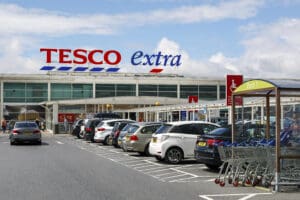
Tesco urges ministers to ease cost burden as Iran conflict clouds outlook

Britain’s largest supermarket has called on the government to lighten the tax and energy load on retailers to help them shield households from rising prices, as the grocer widened its profit guidance amid the escalating conflict in the Middle East.
Reporting an 8.5 per cent rise in annual pre-tax profit, Ken Murphy, chief executive of Tesco, used the FTSE 100 group’s full-year update to make a direct appeal to Whitehall. “In terms of tax pressures, industry and energy in particular, anything the government can do to help us to keep prices low for customers is welcome,” he said.
Murphy pledged that Tesco would do “everything in our power” to cushion shoppers from any renewed bout of inflation triggered by the war in Iran, which he said was “creating further uncertainty for consumers and the economy more broadly”. He praised ministers for drawing up worst-case contingency plans, including scenarios involving a prolonged closure of the Strait of Hormuz and a breakdown in the carbon dioxide supply chain that could, by summer, translate into shortages of chicken, pork and other staples.
The Tesco boss said the grocer was “in constant contact with the government in various guises and through various departments” to assist with that scenario planning. For now, he insisted, neither Tesco nor its suppliers had reported “no issues” in the supply chain or any “meaningful changes in customer behavioural patterns as a consequence of the conflict so far”.
The group, which commands about 28 per cent of the UK grocery market, widened its guidance for the current year, forecasting adjusted operating profit of between £3 billion and £3.3 billion, against £3.15 billion delivered in the year just closed. Tesco said the final outturn would depend on the duration of the conflict, its knock-on effects on UK household spending and the wider economic climate.
Asked whether inflationary pressures had already crystallised since hostilities began, Murphy said Tesco was “not seeing meaningful inflation come through at this stage”, bar well-flagged rises in fertiliser and energy. He was notably cool on the Food & Drink Federation’s warning earlier this month that UK food and non-alcoholic drink inflation could climb to between 9 and 10 per cent by year-end, a figure the Tesco chief said he did “not recognise”.
“It’s impossible to speculate and it would be wrong for me to throw a number out there or a timing, because it all depends on the duration of this conflict and the impact it has on energy pricing in general,” he said. “We don’t know what it’s going to look like because clearly this is a very volatile, unpredictable situation.”
Tesco is among the first of Britain’s major listed retailers to report on trading since the Middle East conflict flared. Next, the listed fashion and home retailer, and Morrisons, the fifth-largest grocer, have both flagged significant geopolitical risks, rising costs and a “challenging” consumer backdrop.
Forecourts, too, are feeling the strain. Several supermarket operators have reported localised, temporary fuel shortages in recent weeks as motorists rush to fill up before expected price rises. Allan Leighton, the Asda chairman, recently confirmed that a handful of the chain’s sites had run low, though he characterised the situation as local “spikes” rather than a nationwide shortfall.
Murphy said Tesco had seen “elevated demand” but insisted the business was in “good shape in terms of fuel stocks”. The grocer is also leaning on its logistics investment to insulate operations. “We’ve embarked on quite a comprehensive electrification programme for our grocery home shopping vans,” he said. “[About] 30 to 40 per cent of our fleet now is electrified. That is going to stand us in good stead.”
Analysts warned that Tesco’s balancing act, between absorbing costs and protecting its value credentials, was becoming more delicate. Eleanor Simpson-Gould, retail analyst at GlobalData, said: “With the Iran conflict front of mind for the grocer and consumers, chief executive Ken Murphy has rightly reiterated his commitment to keeping prices down. However, the grocer must be cautious not to overextend investment in price cuts as this risks deepening the already clear squeeze on margins and profitability.”
Nevertheless, Tesco said it had outperformed the market on both value and volume, signalling that its campaign to win back shoppers from the German discounters Aldi and Lidl is bearing fruit. The group, which also owns the Booker cash-and-carry operation and runs stores in central and eastern Europe and the Republic of Ireland, has held its position through a mix of premium and value ranges, Aldi Price Match and loyalty mechanics such as Clubcard Prices.
Jefferies’ analysts described a “strong end to the year”, calling it “a testament to the extraordinary delivery over the last year”. Clive Black of Shore Capital was more pointed: “While somewhat potentially boring to some, it must be said, against multi-year tough comparatives, with little maturing new space contribution, unlike say Aldi, Tesco in its core UK market did another truly commendable job in the 2026 financial year to gain both volume and value [sales] and market share.”
For SME suppliers sitting in Tesco’s orbit, the message from Welwyn Garden City is clear: the grocer intends to defend price with discipline, but the real variable, the length and breadth of the Gulf conflict, lies firmly outside the boardroom’s control.
Read more:
Tesco urges ministers to ease cost burden as Iran conflict clouds outlook


More Stories
Henry Gabay Started Duet Group With $10 Million. Two Decades Later, It Managed More Than $5 Billion.
By the time Financial News reported on the firm’s 2013 results, that early bet had compounded into one of the...
Planning an Antarctica Cruise Tour
Poseidon Expeditions runs its Antarctica program aboard the 114-passenger M/V Sea Spirit, an ice-strengthened ship led by a team of...
Vincent “Vinny” Colardi on Running, Music and Making Room for Different Passions
Between his career, playing guitar, writing music, running, and exploring his interest in food, Colardi has built a life around...
Why the Rolex Air King Makes More Sense in an Era of Lookalike Luxury Watches
Dials in black, metal bracelets, highly readable markings, and sport-inspired cases are common throughout many current product ranges, while social...
Viriora Expands Online Trading Access Across Forex, Stocks and Crypto Markets
The platform is designed around a broad selection of markets, with published information about available instruments and trading conditions. More...
Markets too ready for conflict over Taiwan – US diplomat
Investors are overestimating the threat of a military confrontation over the island, Michael DeSombre has told CNBC Investors are exaggerating...