
New Massachusetts US Attorney says she intends to ‘go after the most dangerous criminals’

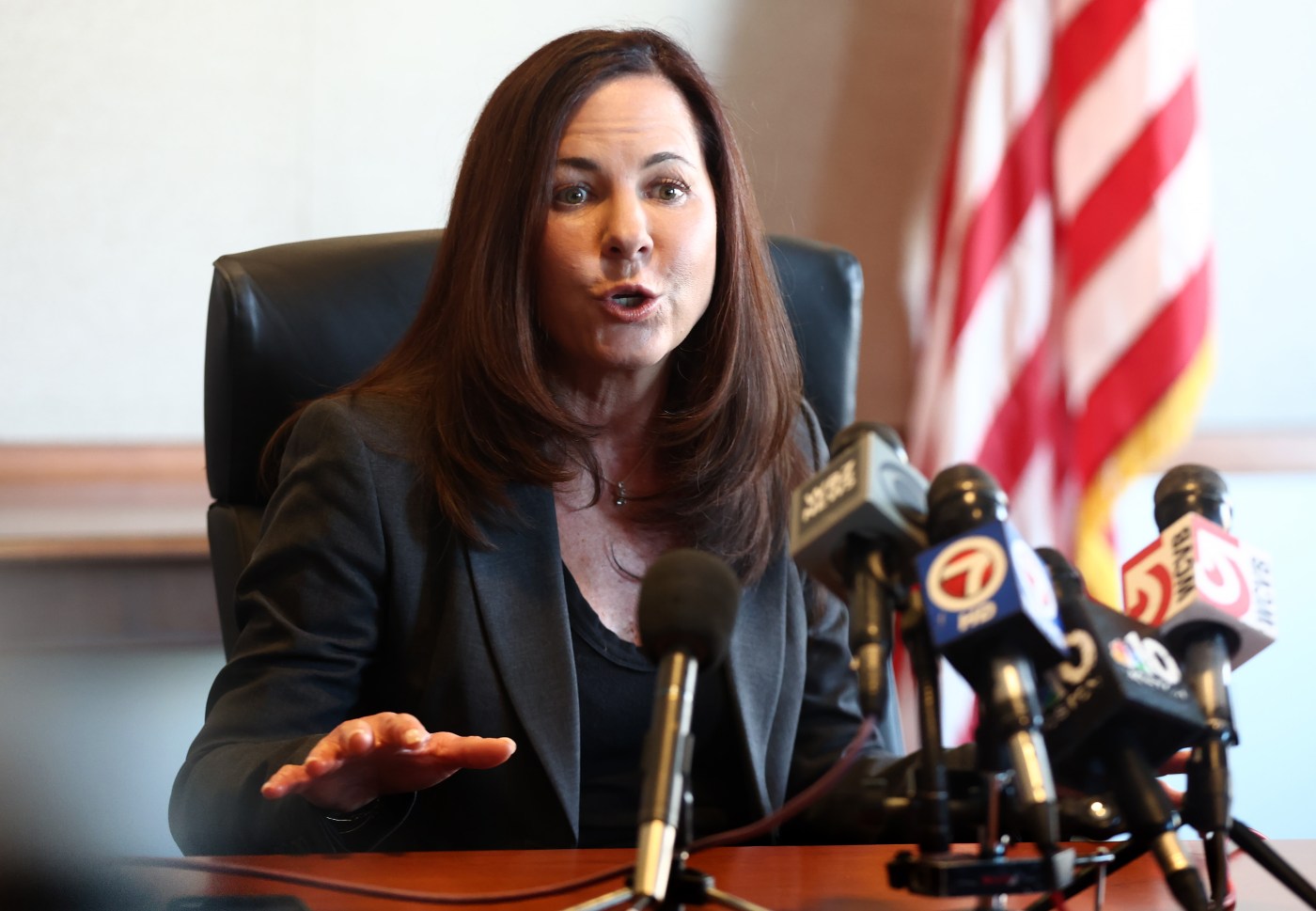
The new U.S. Attorney for Massachusetts told reporters in her first roundtable interview that her office’s “priorities are to go after the most dangerous criminals on the streets.”
Leah Foley, a 23-year federal prosecutor, was elevated to the top federal law enforcement post for the state of Massachusetts as President Trump’s administration took power.
The 54-year-old Louisiana native first worked as a federal prosecutor in Washington D.C. where she prosecuted violent crimes, sex crimes, felony narcotics and firearms cases. In 2006, she joined the Massachusetts office as an assistant U.S. Attorney in the criminal division.
Foley said that her office’s priorities are going to be aligned with senior leadership in the U.S. Department of Justice and the priorities of President Trump, “and that is putting a very significant emphasis on victim cases that harm our citizens.
“And a lot of that is in the drug trafficking violent crime world. And I admit that I am biased for those types of cases,” Foley, who co-ran the office’s Narcotics & Money Laundering Unit prior to her appointment as U.S. Attorney, said. “I’ve done them for 20 years and I do believe that they have significant impacts on the communities and make them safer.”
The hour-long conversation primarily focused on illegal immigrant criminals and how the DOJ and Foley’s office specifically responds to local and state pushback on federal immigration law.
“Our priorities are to go after the most dangerous criminals on the streets who are selling fentanyl, pumping methamphetamine and cocaine into communities,” Foley said.
“Communities where people don’t feel safe letting their children walk to the school bus because there are gang members who have firearms walking freely on the streets if they are here illegally and they are committing crimes,” she continued. “Those are the priority cases and the people who this office is going to target.”
Illegal immigration
“The focus right now from DOJ is to find and remove illegal immigrants in this country who have committed crimes,” Foley said.
She highlighted one of her last investigations before her appointment, which was a year-long wiretap one that ended with five separate indictments and 35 defendants charged with “very serious drug trafficking and firearm offenses. Twenty-six of them were here illegally.
“Those are the people that the Department of Justice is talking about when we say we are going to use all of the tools in our toolbox to make sure that the communities are safer,” Foley said.
Political obstacles
Foley answered several questions regarding the DOJ and her office’s stance on political leaders who have been outspoken about their opposition to the Trump administration’s hardline stance on federal immigration laws. Those include Boston Mayor Michelle Wu and Massachusetts Gov. Maura Healey.
Foley framed the stances of Wu and Healey as political speech that in itself is no crime. Nor, Foley said, is it a crime to merely refuse to cooperate. It only becomes a crime if a person or entity actively obstructs the carryout of federal law enforcement.
“We don’t arrest people for standing in someone’s way. We arrest people when they obstruct justice and impede the law enforcement officers from carrying out their jobs,” Foley said.
Later the same day, new U.S. Attorney General Pam Bondi — just hours after being sworn in — directed the Justice Department to pause all federal funding for sanctuary cities.
“I disagree with Mayor Wu and Governor Healy that all resources should not be dedicated to our community safer,” Foley said.
She would not say whether anyone was under federal investigation for obstruction of justice, but vowed that “If anyone, regardless of who they are, obstruct justice and administration of justice, our office will investigate.”
Tania Fernandes Anderson
Boston City Councilor Tani Fernandes Anderson was arrested late last year on federal public corruption charges. She is accused of orchestrating a kickback scheme in which she pocketed, in a City Hall bathroom, $7,000 of a new hire’s $13,000 sign-on bonus. She is out on bail and is due back in court on March 5.
One reporter asked, in the face of limited resources, if $7,000 was high enough to warrant continued attention. Foley stressed that the size of the fraud didn’t matter, but the violation of public trust did.
“There is no threshold when it comes to embezzlement or violating the public trust,” Foley said. “We want to bring cases that are going to just signal to the community that they should have public officials who don’t violate their oaths and don’t undermine the communities just respect for the law and for faith in their officials.”
Karen Read
While it has long been public knowledge that the U.S. Attorney’s office has been involved in some way in the state murder case against Karen Read, and accusations of malfeasance on the part of local and state police in the investigation against her, Foley could not comment on the specifics nor whether it was ongoing.
“I can neither confirm nor deny,” Foley said, as she often did when pending or sealed cases were brought up.
Opioid epidemic
Foley said the “opioid crisis is still raging” and that she intends to “work very hard to try to stem that and reverse it” through partnership with other federal agencies and local and state law enforcement.
She also said she believes that the term “safe injection site” is a “misnomer.” Any funding for such ill-guided services, she said, should be redirected to treatment programs.
Nancy Lane/Boston Herald
New U.S. Attorney Leah Foley holds a roundtable discussion at the federal courthouse in Boston. (Nancy Lane/Boston Herald)


More Stories
Particular Audience’s James Taylor: advice is cheap, so trust your gut
James Taylor is the founder and CEO of Particular Audience, an AI-native retail media and personalisation platform that combines site...
Ritika Wadhwa on why cultural intelligence is not optional for leaders
Ritika Wadhwa is the founder and CEO of Prabhaav Global, the London-based consultancy she set up in 2023 to help...
Getting to know you: Todor Madzharov, co-founder, MEAVO
Todor Madzharov is the London-based co-founder of MEAVO, which designs and manufactures acoustic phone booths and meeting pods for open-plan...
Russia-US diesel deal already having positive effect – Putin aide to RT (VIDEO)
The agreement has helped lower American fuel prices and could pave the way for broader economic cooperation, Kirill Dmitriev has...
A Practical Guide to Pricing Your First Paid Community Tier
Then launch day arrives, a number gets picked more or less on instinct, and six months later nobody can say...
A Complete Guide to IT Support for Small Businesses in Leicester
Even a minor fault can slow employees down and leave customers waiting. This is where professional IT Support Leicester businesses...