
Grow Downtown: Low rent, big dreams draw 18 small businesses to vacant St. Paul storefronts

The premise: offer an artist, an eatery or retail entrepreneur the opportunity to prove themselves to a downtown St. Paul landlord through a temporary, sweetheart lease. After six months of renting a storefront for as little as $1 — and maybe insurance, utilities and incidentals — both parties can negotiate a longer-term contract, or go their separate ways.
As a business sector, startups are notorious for rarely getting too far off the ground, but the best blossom and turn heads. The St. Paul Downtown Alliance, a partnership between City Hall and major downtown employers, launched the Grow Downtown program around May 2022 in hopes that at least a few new retailers will take seed, fill growing ground-level and skyway vacancies and draw needed foot traffic to downtown St. Paul’s commercial buildings.
Not all the shops have stuck around, but organizers say the results have been even better than expected. Grow Downtown has matched 18 new businesses — almost all of them run by women and people of color — with property owners to date, filling more than 40,000 square feet of empty retail space.
At least a dozen of those businesses are still open in their original locations, occupying a total of 27,000 square feet. The majority have either signed long-term leases or at least extended past their initial six-month agreements. A handful of shops remain in business in new locations or continue to host pop-up hours downtown or elsewhere.
“For the most part, we haven’t really had a ton of ‘fatalities,’ for lack of a better term,” said Lee Krueger, a real estate consultant and former president and chief executive officer of the St. Paul Port Authority, who arranged the lease deals after studying similar efforts in Denver and Minneapolis. “Some of them are going to do just fine.”
The right amount of space
Downtowns everywhere have contracted since the onset of the pandemic, which heightened the move to remote work and online retail, and St. Paul’s skyway vacancies were growing even before the pandemic.
Still, while some may hope that the capital city draws a Fortune 500 spin-off to employ locals and shore up its tax base, it’s perhaps more likely that the city’s fortunes rest with homegrown companies emerging organically from small-business startups in affordable commercial spaces.
The challenge isn’t just a question of finding the right amount of square footage for a budding entrepreneur. A candle and lotion shop, for instance, might have a tough time situated next to a food court vendor selling fragrant recipes, Krueger said. Other vendors might need a restaurant hood and ventilation system or a washable tile ceiling. Renting too much space can be worse than too little when utility payments kick in.
Lee Krueger, then-President of the St. Paul Port Authority, speaks at the Treasure Island Center ribbon cutting in St. Paul on Tuesday, Jan. 16, 2018. (John Autey / Pioneer Press)
“My daughter works with me, and she’ll review business plans, financials,” Krueger said. “She’ll interview these people and say, ‘Hey Dad, I talked to this tenant.’ Jack and the Pack (which now sells dog-running harnesses at Wells Fargo Place), that was one she really liked. But we couldn’t put them in the skyway because people bring their dogs in. We needed a space with a concrete floor.”
“One guy said, ‘What about this space?’ We said, ‘That’s 10,000 square feet. To heat and cool this space, it’s going to overwhelm you,’” Krueger added. “Sometimes we call people and say, ‘Do you have a business plan?’ And they’ll say, ‘A what?’ One guy said, ‘My plan is to be the best restaurant in St. Paul.’ OK, but …. We screen them. By the time we get them to these landlords, we’ve interviewed them, we’ve talked to them, we’ve got a business plan and some sales projections.”
‘It made sense’
Arrangements with landlords vary broadly — not every initial lease is free of charge — and some of the choicest locations have already been filled, meaning the next round of leases may be especially tricky, Krueger said.
Still, Wells Fargo Place property manager Heide Kempf-Schwarze was happy to see Jack and the Pack find a following in a ground-floor space that had been vacant for upwards of 10 years.
“That was the one I said, ‘I’m not quite sure how this will work out, but if it doesn’t we haven’t really lost anything.’ We aren’t spending a lot of money on a tenant improvement build-out. We aren’t having to pay broker’s commissions. It made sense.”
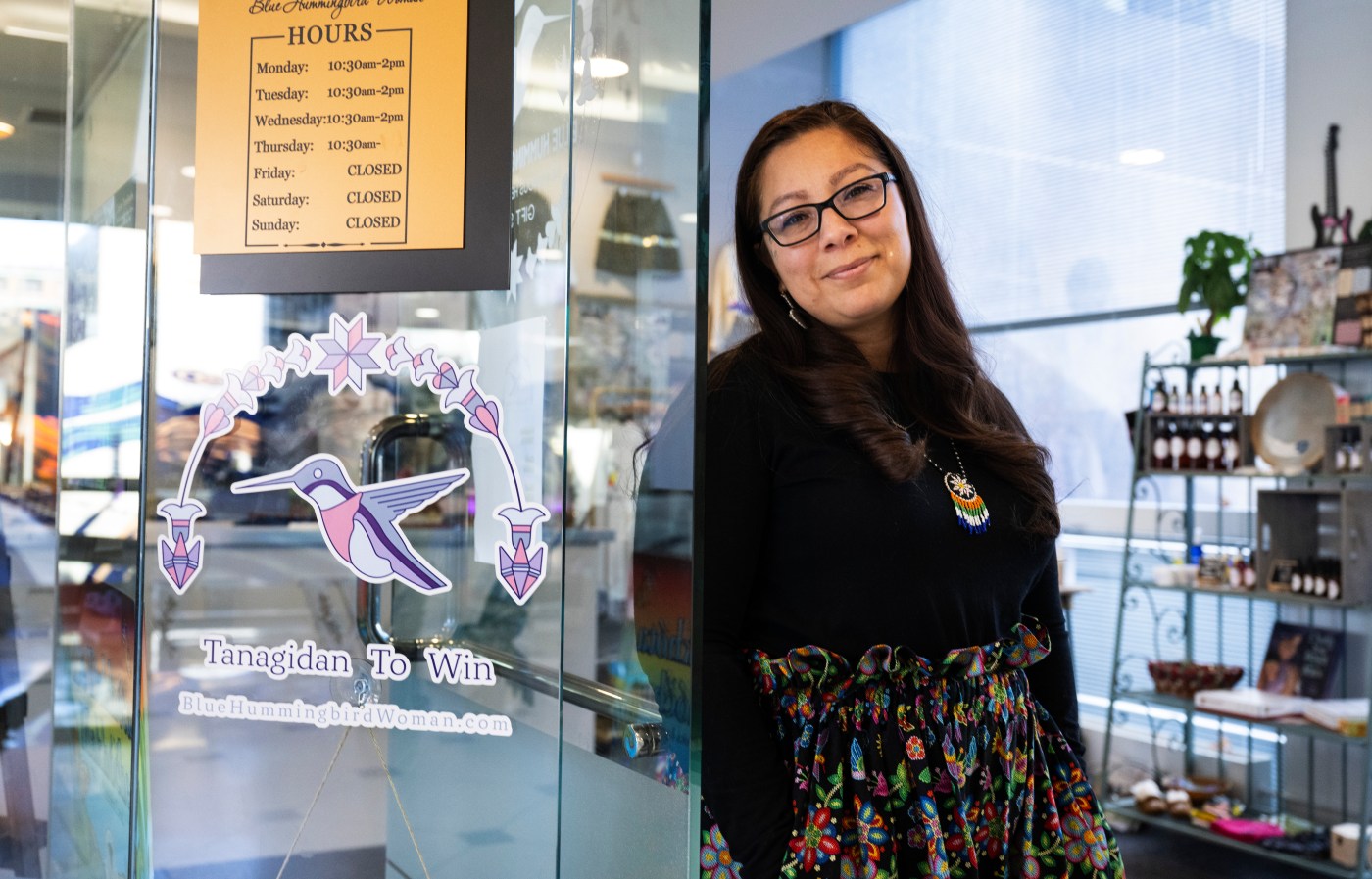
Kempf-Schwarze said three of the building’s new storefronts — the Blue Hummingbird Woman Indigenous Gift Shop, Ramadhan Designs and Jack and the Pack — are woman-owned, and the fourth, Trinity House Coffee in a former McDonald’s space within the third-floor atrium, is owned by a man of color. All four tenants have now been in the building for at least two years.
“You’re offering a low-barrier entry point to entrepreneurs who might not have the means to gain access by traditional means, and letting them get their feet on the ground and get stabilized, without having to figure out everything at once,” Kempf-Schwarze said. “It added some vibrancy I think we really needed in downtown. We were really strategic with the tenants we vetted in the first go-round.”
Here’s a look at some of the businesses:
Black Men Teach
WHAT, WHEN, WHERE: Black Men Teach is a nonprofit aimed at supporting and increasing the number of Black male teachers in Minnesota, located in the Osborn370 building, 370 N. Wabasha St., Suite 660.
Black Men Teach executive director Markus Flynn at the nonprofit’s office in the Osborn 370 building in St. Paul on Tuesday, Nov. 26, 2024. (Talia McWright / Pioneer Press)
ON THE WEB: blackmenteach.org
THEIR STORY: One school year from now, Black Men Teach, an organization whose goal is to “empower the growth of Black male teachers,” will be on track to have 20% of elementary teachers in the schools they partner with be Black males, according to executive director Markus Flynn. “It’s a very narrow focus, but the scope of work is broad,” he said. In partnership with “Thrive by 2035,” a coalition for the advancement of Black male educators, Black Men Teach has a longer-term goal. Within the next decade, they want Minnesota schools with a Black student body population of at least 40% to have 20% of their teaching staff be composed of Black men — a total of 450 Black male teachers in 90 elementary schools. “That’s over a 1000% increase of the number of Black men we have teaching in elementary school classrooms right now,” said Flynn, noting they’ve wanted to grow their footprint in the capital city, which he said provides strong opportunities for networking with collaborators.
Blue Hummingbird Woman Indigenous Gift Shop
Blue Hummingbird Woman Indigenous Gift Shop in the Wells Fargo Place building in downtown St. Paul on Thursday, Dec. 5, 2024. (John Autey / Pioneer Press)
WHAT, WHEN, WHERE: Blue Hummingbird Woman Indigenous Gift Shop, which features various creations by Indigenous community members, opened in Wells Fargo Place, 30 E. Seventh St., Suite 285, in November 2022. A second location and traditional healing center, Eagle and Condor Native Wellness Center, opened at 790 E. Seventh St. in November 2023.
ON THE WEB: bluehummingbirdwoman.com
THEIR STORY: Tara Perron, known as Tanaǧidaŋ To Wiŋ, has sold products of her own throughout the powwow circuit since she was young, but it wasn’t until she started writing books that it occurred to her to try to open her own shop. The store sells a variety of items made by both Perron and other Indigenous vendors, including beadwork, jewelry, clothing, various herbal remedies, wild teas, honey, oils and balms. Perron said one of the greatest joys in owning her store is getting to highlight and invest in Native American artists and their work. “People can come buy authentic, Native-made gifts, and sometimes people don’t know where to get them,” she said. “There’s always a story behind each creator and the gifts that they create, and I know (those) stories and so I love sharing them. That’s what makes a handmade gift so beautiful.”
Cycling Museum of Minnesota
WHAT, WHEN, WHERE: Coming soon to the Securian building at 401 N. Robert St.
Related Articles
Your Money: Building wealth in uncertain times: year-end planning moves
Working Strategies: Second Sunday Series: Jumping in with ChatGPT
Scrap metal industry sues state, saying new copper metal law will shut down its industry
What to consider when exchanging currency
US added a strong 227,000 jobs in November in bounce-back from October slowdown
ON THE WEB: cmm.bike
THEIR STORY: Using loaned and donated bicycle collections, the Cycling Museum of Minnesota has hosted traveling exhibits around the Twin Cities since 2012, and is currently showcasing America’s earliest-model mountain bikes at the Theodore Wirth Regional Park Trailhead in Minneapolis. Juston Anderson is working with his nonprofit board and other volunteers to finalize lease terms for the museum in the Securian building, with the oldest artifact set to go on display dating back to 1884. “We’ve got bikes from the very, very beginning of cycling in Minnesota, which are some antique and vintage high-wheel bikes with hard tires, and pneumatic safety bikes from when they were coming into fashion,” Anderson said. “As far as museums go, we’re just a baby. We’re just kind of getting started.”
Eaton Art
WHAT, WHEN, WHERE: Eaton Art is a space for the six-month pop-up exhibit “Through the Window: Look. Pause. Discover.”, running from June through December on the skyway level of the Town Square complex at 445 Minnesota St. The exhibit features a series of four themed displays: “PRIDE: Pioneers and Progress,” “A Life In Art | Jim Smola 1950-2022,” “WORDS and Banned & Burned” and “You Can Quote Me.” For the final month, from Nov. 29 to Dec. 25, the space will function as a retail shop, featuring elements from each exhibit.
Eaton Art’s rotating exhibit displaying “A LIFE IN ART: Jim Smola 1950-2022” in the skyway level at Town Square in St. Paul. (Courtesy of Anthony Eaton)
ON THE WEB: throughthewindowdotblog.wordpress.com
THEIR STORY: Anthony Eaton originally planned to use the space as a tribute to his late husband when he moved back home from Dallas, Texas, in 2022. When he was offered the space for six months, he decided to do a series of displays — one celebrating people significant to the LGBTQ+ community, one dedicated to his husband, one featuring writers and banned books and one for Eaton’s favorite inspirational quotes. Eaton, a St. Paul native and Lowertown artist, is looking for a permanent space for a retail store. “I care deeply about St. Paul because I consider it home,” he said. “I have witnessed the city grow and change. While we are facing some significant challenges, I want to be part of that solution through my work.”
Jack and the Pack
WHAT, WHEN, WHERE: Jack and the Pack, which sells everything you’ll need to run with your dogs or harness them to a sled, skis, scooter or bicycle, opened in June 2023 on the ground level of Wells Fargo Place, 30 E. Seventh St., Suite 220. Open for in-person shopping at least twice a week, with seasonal fluctuation, and online.
Alexandra Johnson, owner of Jack and the Pack, a dog sporting equipment store, talks to customer Kevin Thomson, from Hugo, about kicksleds on display at her store on the corner of Seventh and Wabasha Streets in downtown St. Paul on Thursday, Nov. 9, 2023. (John Autey / Pioneer Press)
ON THE WEB: jackandthepack.com
THEIR STORY: Alexandra “AJ” Johnson, a former school teacher turned Team USA competitor in dog-running sports, sold items related to “joring” — the Norwegian word for “pulling” — online, but longed to take Jack and the Pack to the next level. When the Grow Downtown program came along, Johnson opened her first bricks-and-mortar location within 4,000 square feet of ground-level storefront at Seventh and Wabasha streets, a seemingly choice location that had stood vacant for about 10 years, which she now shares with Brave the Snow, a woman-owned kicksled shop. Jack and the Pack suffered a break-in within its first few months but Johnson stayed the course, so to speak. “We haven’t had any issues since,” she said. Johnson doesn’t just sell harnesses — she also hosts group and individual classes and participates in regional competitions for a variety of dog-running sports, from sled races to bike-joring, which she blogs about on her website. Her dogs also compete in skiing through a friend. “I’m not the best skier,” she said with a laugh.
La’Russe Boutique
WHAT, WHEN, WHERE: La’Russe Boutique, a clothing boutique, opened in July in the Town Square complex at 444 Cedar St., just off the skyway over Fifth and Cedar streets.
ON THE WEB: larussebotique.com
THEIR STORY: When she learned she could launch her own business on a small lease, Laurarelle Patterson quit her day job of 12 years as a special-education instructor, gave up her apartment and moved in with her adult daughter to open La’Russe Boutique, which sells men’s and women’s clothing, including high school letterman jackets featuring customized pictures. Patterson, who still works nights in the health care field, said it’s been a tough road — damaged credit prevented her from getting loans, so she’s financed inventory acquisition herself. Her three daughters, all of them business-minded, inspire her to persevere. Her family tree, displayed prominently on the store wall, begins with its roots in Twin Cities civil rights advocate Nellie Stone Johnson, whom she calls a great-aunt, as well as Black car manufacturer Charles Richard Patterson, and winds up to one of her daughters, an esthetics instructor. Another daughter is in school to become a coroner. Next stop: San Francisco and New York, where Patterson plans to take a gander at the latest fashions, form partnerships and bring some coastal bling back to the Midwest.
Lucille’s Bottleshop
WHAT, WHEN, WHERE: Lucille’s Bottleshop, an alcohol-free bottle shop and tasting room, aims to create opportunities for people to socialize without alcohol. Opened in July near the Palace Theatre at 24 W. Seventh Place.
Alexandra Zauner at Lucille’s Bottleshop, an alcohol-free bottle shop and tasting room in St. Paul, in late October 2024. (Courtesy of Lizzy Pertisco)
ON THE WEB: lucillesbottleshop.com
THEIR STORY: Lucille’s owner Alexandra Zauner, who is 10 years alcohol-free, decided to explore non-alcoholic options a few years ago, yet found it odd that she and her sober friends still had to go to a liquor store to find them. Zauner said she was inspired by other bottle shops opening around the country and wanted to create opportunities for sober people to socialize in an alcohol-free space. Bottle shops “lean in and give people not just non-alcoholic as an afterthought, but as the main thought and focus,” she said. Lucille’s, named after Zauner’s grandmother Lucy, also hosts almost weekly alcohol-free events where those who are sober, sober-curious or just want a night away from alcohol can socialize and “see that you don’t need alcohol to be able to do that,” she said.
Petek Trading Co.
WHAT, WHEN, WHERE: Petek Trading Co., a home goods retailer that sells ethically-sourced handmade woven goods from Turkey, opened in the Historic Hamm Building in September 2022 before moving to its current storefront at 327 W. Seventh St.
Handwoven rugs made from upcycled kilims, a traditional form of Turkish rug weaving, are displayed at Petek Trading Co., which opened March 2024 at 327 West Seventh Street in St. Paul. (Courtesy of Petek Trading Co.)
ON THE WEB: petektradingco.com
THEIR STORY: While working at Anthropologie during the early days of the pandemic, Melek Petek decided to strike out on her own and sell handmade goods that connect to her culture in a storefront that celebrates tradition. Originally from Turkey, Petek’s cultural pride is reflected in her inventory — rugs, stockings, coasters and pillow cases made from upcycled kilims, a traditional form of Turkish rug weaving. “If it weren’t for the (Grow Downtown) project, I wouldn’t have a storefront,” said Petek, noting the project likely cut at least two years off the timeline for launching her own shop. “It gave me a chance to talk to (a property manager) in a low-stakes way.”
Soapy Toads
WHAT, WHEN, WHERE: Soapy Toads, a small-batch, handmade, all-natural bath and personal care product shop, located in the Pioneer Endicott building, 141 E. Fourth St., Suite 205. Established by Dragon Walker and Jake Walker.
Soapy Toads owner Dragon Walker, right, and employee Jamie Haas with some of their Soapy Toads handmade soap and personal products, Friday, Nov. 22, 2024, at their store in the Pioneer Endicott building in St. Paul. (Talia McWright / Pioneer Press)
ON THE WEB: instagram.com/soapy_toads
THEIR STORY: Six years ago, Dragon Walker began hand-making soap in her basement. Walker would gift the personal care products to loved ones, but when her hobby started to take over the house, her husband, Jake, said she either needed to stop making soap or start selling it. Jake is now her “Soapy Toads bath and personal care items” business partner, a dream Walker says couldn’t have been a reality without him. “Small businesses are not just businesses, small businesses are an act of love,” Walker said. She describes her soap as “moisturizing, gentle and earth-compatible,” though Soapy Toads carries everything from lip balms to candles to bug spray. She and her right-hand woman, Jaime Haas, agreed that what makes working downtown special is the people who visit and make the space lively. “It’s a retail space but it’s also a casual social space,” Haas said. “Which is kind of a great mix.”
Trinity House Coffee
WHAT, WHEN, WHERE: Trinity House Coffee, a coffee shop that sources its roasts from Africa, opened in the former McDonald’s space in the third-floor atrium and former food court of Wells Fargo Place, 30 E. Seventh St., Suite 325, in January 2022.
Gerry Exom at Trinity House Coffee. (Courtesy of Gerry Exom)
ON THE WEB: trinityhousecoffees.com
THEIR STORY: Owner Gerry Exom has been in the coffee business for over 10 years. Exom, a military veteran who was once homeless, said running Trinity House Coffee fulfills his dream of catering to the affluent alongside the disadvantaged, offering both communities “the same high-quality coffee for the same affordable price, which kind of levels the playing field.” The biggest challenge so far has been what he deemed the “COVID-19 effect,” where remote work limits the amount of foot traffic walking by retail stores. Trinity is open Monday through Friday, but it still only draws healthy numbers of customers about three days per week, he said. Being situated near the Children’s Museum helps draw in some business, and his website introduces prospective customers to bags of Kenyan, Ethiopian and Congo-bean coffees.
Related Articles
Theater review: Park Square’s ‘The Best Christmas Pageant Ever!’ is kid-friendly fun
TPT’s ‘Almanac’ celebrates 40 years on Friday. Our St. Paul reporter looks back at its start.
St. Paul, Met Council review proposal from Indianapolis developer for land around Central Station light rail stop
Kellogg Boulevard bridge demolition closes segment of I-94 in St. Paul
Comedian Nate Bargatze to headline Xcel Energy Center in July

More Stories
Rain-soaked California still at risk of floods and high surf
By TY ONEIL, Associated Press WRIGHTWOOD, Calif. (AP) — A strong storm system that brought relentless winds, rain and snowfall...
Rain-soaked California still at risk of floods and high surf
By TY ONEIL, Associated Press WRIGHTWOOD, Calif. (AP) — A strong storm system that brought relentless winds, rain and snowfall...
Times Square to feature patriotic ball drop for New Year’s Eve, kicking off US’s 250th birthday
By SUSAN HAIGH, Associated Press When the ball drops on New Year’s Eve in New York City, it will sparkle...
Times Square to feature patriotic ball drop for New Year’s Eve, kicking off US’s 250th birthday
By SUSAN HAIGH, Associated Press When the ball drops on New Year’s Eve in New York City, it will sparkle...
Takeaways from the Vikings’ 23-10 win over the Lions
If the Vikings weren’t going to be able to compete for a Super Bowl, they wanted to make sure neither...
The Loop NFL Picks: Week 17
Steelers at Browns (+3½) Pittsburgh’s D.K. Metcalf could lose as much as $45 million in contractual guarantees after being suspended...