
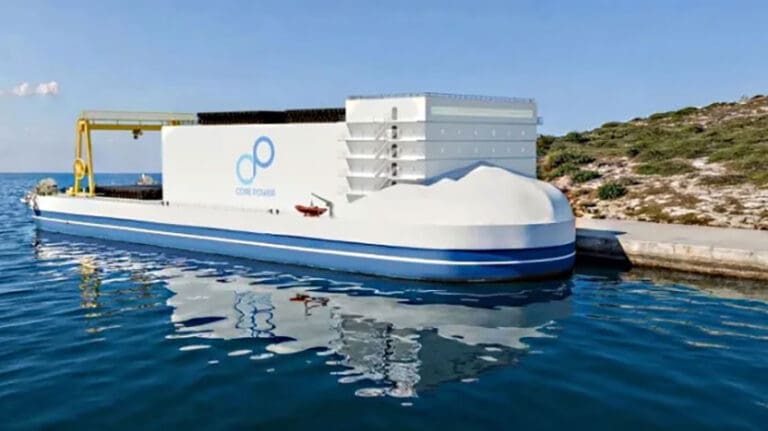
British start-up to help America build nuclear-powered cargo ships

A British start-up based on a west London trading estate is to help the American government build a fleet of nuclear-powered cargo ships. A public private partnership between the US Maritime Administration and Core Power, which is based in Chiswick Park, was signed in Washington DC on Monday.
The agreement, the first of its kind, aims to accelerate construction of a US-flagged fleet of rapid nuclear-powered merchant vessels, and to revive a US shipbuilding industry that has been decimated by cheaper competitors from China in recent years.
Core Power says it has raised 200 million dollars from backers including Mitsui, Mitsubishi and Sumitomo, a trio of Japanese conglomerates, to help it develop the nuclear technology. It is targeting first construction of its nuclear propulsion systems in 2028, and will work with traditional shipbuilders to make the vessels’ hulls.
“China is already moving toward nuclear-powered commercial shipping,” Mikal Boe, chief executive of Core Power, said. “America does not regain maritime strength by building a better version of yesterday’s ship. Government can set the direction and co-ordinate; private industry must move the money and the steel. We are honoured to be working with the US Maritime Administration on this landmark programme.”
The company behind the deal
Core Power was founded in 2018 by Boe, a Norwegian shipping and commodities executive. In 2024, the most recent year for which its accounts are available, it made an operating loss of £19.4 million and employed 41 people. Its British arm, Core Power (UK) Ltd, is registered at an address on Chiswick High Road and last filed accounts made up to 31 December 2024, according to Companies House.
The partnership follows an initiative launched in May by Sean Duffy, the US transportation secretary, under which the Maritime Administration issued a request for information on small modular reactors for commercial shipping alongside the US Coast Guard, the Nuclear Regulatory Commission and the Department of Energy. That call for industry input closed on 5 August.
Stephen Carmel, administrator of the Maritime Administration, said: “President Trump has made it clear that American energy dominance and maritime strength go hand in hand. This framework ensures that the United States leads the world with a secure US-flagged fleet.”
Why nuclear shipping has never taken off
Nuclear power has been used for decades in military submarines, but it has struggled to gain traction in commercial shipping, partly because of high costs but also safety concerns. Its proponents have argued that advances in the design of onboard nuclear reactors have improved safety, while the sheer power of nuclear-powered ships could offset the higher build costs.
Boe estimated that nuclear-powered vessels could move up to 75 per cent faster than traditional fossil fuel-powered ships, carry more cargo and be exempt from costly environmental taxes. Russia, through its use of nuclear-powered icebreakers, is currently the nation with the largest nuclear shipping fleet.
Regulation and financing of this nascent industry remains a hurdle, but the US government said it would work with Core Power to develop an “actionable commercial pathway”, including providing clarity on how insurance of nuclear-powered ships will work.
“Nuclear propulsion is a serious commercial opportunity, but it must be approached as a complete system: safe, secure, licensable and investable,” Carmel said.
What it means for British business
Nothing in the agreement lands directly on a UK balance sheet. The vessels will be US-flagged, the hulls will be built by shipbuilders working with the American government, and the jobs that follow will sit in American yards. What sits in west London is the design work and the intellectual property, which is a familiar pattern for British engineering firms that scale by selling into someone else’s industrial programme.
The freight economics matter more. Companies that import or export by sea have already seen how quickly a change in shipping conditions feeds through to their costs, with Red Sea disruption pushing container prices and delivery times up sharply for UK exporters and manufacturers. Boe’s claims about speed, capacity and tax exemption, if they hold, would change that calculation. They are claims about ships that do not yet exist, however, and the first propulsion systems are not due to be built until 2028 at the earliest.
There is a supply chain point too. Britain has been building an industrial base around compact reactors, from Newcleo’s plan to raise £900 million for a fleet of small reactors to Holtec’s choice of South Yorkshire for a mini-reactor factory. The engineering, fabrication and licensing skills that a maritime reactor programme needs overlap heavily with the ones those projects are already competing for, which is a recruitment problem for smaller suppliers and an opportunity for firms that can get qualified early.
For now, the practical test is regulatory rather than technical. Until insurers, flag states and port authorities agree how a commercial reactor at sea is licensed and covered, no cargo owner can plan around it.


More Stories
Ministers shelve plan for small companies to file profit and loss accounts
The government has paused plans to require Britain’s two million small companies to file profit and loss accounts at Companies...
Made-to-Order vs Ready-to-Ship: How Small Luxury Brands Balance Cash Flow and Customer Choice
A $5,000 product, be it a ring, handbag, watch, or piece of furniture, that stays unsold for six months is...
Beyond Chatbots: Why Voice AI Is Becoming the Next Frontier in Customer Experience
Traditional text chatbots solved some basic routing problems, but they completely missed the fundamental human preference for natural speech. Users...
Has the arrival of e-scooters finally ended the war between cyclists and drivers?
Every road user has a nemesis. Ask a driver about cyclists, and you may hear stories about red lights, lycra...
Reducing Waste and Lubricant Runoff in Heavy Equipment Operations
Across agricultural projects, forestry operations, and municipal water utilities, keeping heavy equipment running efficiently requires continuous maintenance. However, conventional mechanical...
Alex Depledge quits Treasury and tells Healey founders are no sideshow
Alex Depledge, the Treasury’s entrepreneurship adviser, will leave the role on Thursday, warning ministers that the government treats entrepreneurship and...