
France on Fire: Who Is Behind the Riots, Who Benefits From the Chaos—and Could a Fallen Republic Put Nuclear Weapons at Risk?

By Stephen Zogopoulos, Founder & Chief Executive Officer, USNN World News
France Is Not Simply Protesting. The Republic Is Facing a Test of Its Authority.
There is a difference between a nation whose citizens protest their government and a nation in which violent actors discover that the government cannot reliably protect its streets, businesses, public institutions, and citizens.
France is confronting both realities.
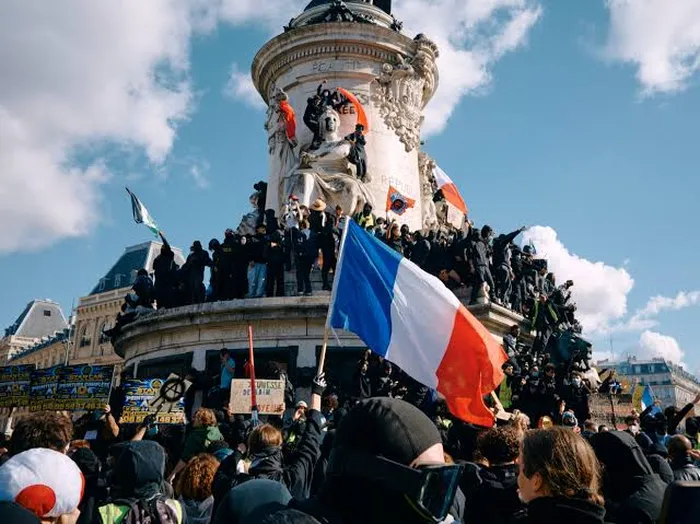
On October 17, 2026, nationwide demonstrations over rising living costs, deteriorating public services, and educational conditions descended into some of the country’s worst urban violence in years. Public buildings were attacked, businesses were looted, police were assaulted, and fires consumed property in multiple French cities.
In Limoges, a historic city hall was devastated by fire. In Marseille, rioters entered city hall. Paris, Lyon, and other major urban centers experienced violence that exposed serious weaknesses in France’s public-order response.
Approximately 2,400 people were arrested over the October 17–18 weekend, while thousands of businesses sustained damage or were looted, according to Associated Press reporting.
The government responded with curfews, restrictions, and a substantial escalation in security deployments.
On October 24, authorities mobilized approximately 70,000 police and gendarmes as another large nationwide demonstration took place. AP reported an estimated 410,000 participants, including 110,000 in Paris, with additional confrontations and arrests.
Let us establish something immediately.
A student demanding functioning classrooms is not a terrorist.
A worker demanding a livable wage is not an insurrectionist.
A citizen criticizing President Emmanuel Macron is not an enemy of France.
But an individual deliberately setting fire to government buildings, attacking officers, or using organized violence to intimidate the public is no longer merely exercising the right to protest.
That is criminal violence. Where legally established intent and circumstances support it, some violence may also warrant investigation under terrorism or other national-security laws.
We should not confuse the two.
And we certainly should not allow the perpetrators of violence to hide behind the legitimacy of peaceful citizens.
Who Is Actually Behind the Violence?
This is the first question that the French government, intelligence services, media, and public must answer with evidence rather than political convenience.
The available reporting points to several distinct forces operating in and around the unrest.
1. A legitimate protest movement that began with schools
France’s current upheaval did not begin as a documented terrorist uprising.
It began in mid-September with students and teachers protesting inadequate school resources, staffing shortages, and deteriorating educational facilities.
Demonstrations spread from the Paris region into a broader nationwide movement, drawing support from students, labor unions, public-sector workers, and citizens struggling with inflation, energy prices, housing costs, and government policy.
The October movement also attracted participants associated with the Yellow Vest protests that challenged France’s political establishment beginning in 2018.
These grievances are real.
A government that treats every demonstrator as a criminal will only deepen resentment. Yet demonstrators who allow violent groups to dominate their marches risk seeing legitimate causes displaced by destruction.
2. Ultra-left militants and political radicalization
The French government has repeatedly accused elements of the ultra-left of contributing to the disorder.
Prime Minister Sébastien Lecornu has publicly blamed far-left groups and criminal opportunists for attacks and disturbances.
French political attention has focused particularly on La France Insoumise, or France Unbowed, the radical-left political movement led by Jean-Luc Mélenchon.
According to Reuters, an October 1 government crisis meeting received an intelligence briefing that, according to a source close to the prime minister, attributed the initiation of the student protest wave to hard-left politicians.
But this is where serious journalism must make a critical distinction.
Supporting demonstrations, encouraging confrontation, committing political violence, and secretly orchestrating criminal attacks are four different things.
Mélenchon and his party have faced accusations of inflaming political hostility. They reject responsibility for the riots and accuse the government of failing to address underlying grievances.
As of October 24, the public evidence reviewed for this article does not establish that Mélenchon personally directed an organized nationwide violent insurrection or terrorist conspiracy.
Indeed, policing expert Sebastian Roché has argued that ultra-left groups alone are too small to account for the entire scale of the disorder.
The French National Assembly has initiated a parliamentary inquiry into the violence and the police response. That inquiry should pursue facts, not merely political advantage.
This author’s position is straightforward: investigate every organizer, financier, agitator, and operational coordinator who may have knowingly facilitated violence, regardless of political affiliation.
No politician should be immune from lawful scrutiny.
But allegations are not convictions, and political opposition must not be criminalized merely for opposing the government.
3. Opportunistic criminals exploiting disorder
The third category is perhaps less politically glamorous but no less destructive.
Looters.
Criminal gangs and individuals who seize opportunities to steal, damage property, or attack overwhelmed police are not necessarily advancing a coherent ideology.
They may simply recognize that chaos provides cover.
Reuters and AP describe the violence as involving both radical groups and opportunistic criminal activity.
This distinction matters because a nation can simultaneously confront organized ideological violence and decentralized criminality without the two sharing a command structure.
A burning storefront does not reveal its perpetrator’s politics.
A smashed police vehicle does not establish who financed the attack.
A masked rioter does not become an agent of a foreign government simply because an online commentator says so.
4. Foreign influence operations: the disturbing international dimension
Here the investigation moves beyond France’s borders.
There is documented evidence that foreign-linked information networks have attempted to exploit France’s instability.
Euronews reported on October 21 that Russian-linked disinformation operations, including networks associated with Operation Overload and Doppelgänger, amplified narratives surrounding the violence.
The Financial Times separately reported that European authorities were examining pro-Kremlin information activity as well as suspected Iranian and Algerian influence operations.
An analysis by Alliance4Europe examined hundreds of thousands of online posts and identified attempts by foreign actors to amplify anger and polarization surrounding the French unrest.
These findings are serious.
They reveal how domestic crises can become instruments of international influence.
But one distinction is indispensable: evidence that foreign actors exploited the riots is not proof that they created, directed, financed, or controlled the riots.
French President Macron himself acknowledged foreign manipulation of information while saying evidence had not established foreign orchestration of the unrest. European officials likewise reported insufficient evidence of foreign-directed instigation.
That means an allegation of a Kremlin-directed insurrection, an Iranian-sponsored overthrow, or an Islamist command structure behind the entire protest movement would presently go beyond the evidence.
Nevertheless, foreign exploitation creates an enormous strategic problem.
An adversary does not necessarily need to organize a riot to profit from it.
It can magnify divisions, circulate misleading images, encourage distrust in institutions, and use the resulting instability to pursue its own diplomatic and security objectives.
The French government must establish whether any such activity crossed the line from propaganda into operational support for violence.
That is an intelligence question worth investigating aggressively.
Is This Terrorism—or Something Different?
The word terrorism carries enormous legal and political weight.
It should not be applied indiscriminately to every violent protester. Nor should governments avoid examining terrorism simply because a violent incident unfolds during an otherwise legitimate demonstration.
France has endured devastating jihadist terrorist attacks, including the November 2015 Paris attacks and the July 2016 Nice truck attack.
Those tragedies established the reality of extremist threats inside the country.
But past terrorism does not prove that today’s riots are being commanded by jihadist organizations.
There has also been a separate, documented investigation into alleged pro-Iran involvement in a foiled March 2026 attack against a Bank of America branch in Paris. That case demonstrates the presence of genuine security threats, but does not establish operational responsibility for the October unrest.
Claims circulating internationally that Muslim migrants collectively caused the October riots are likewise unsupported by the available evidence. Associated Press fact-checking found that French authorities had not identified immigrants or any single religious or ethnic group as responsible for the violence.
What France needs is not a convenient demographic scapegoat.
It needs the identities of actual perpetrators, the structure of any criminal organizations involved, evidence of financing, verifiable communications, and successful prosecutions.
If jihadist networks, foreign intelligence services, anarchist cells, organized criminal groups, or any political extremists are implicated, the public deserves to know.
But every accusation must survive examination.
A national-security investigation should be aggressive in discovering facts and equally disciplined in refusing to invent them.
The Question Few Are Asking: What Happens if the French Government Falls?
Here is where the situation moves from a domestic law-and-order problem into the realm of international security.
France is not simply another European country experiencing civil unrest.
It is a permanent member of the United Nations Security Council.
It is a founding member of NATO.
It possesses an independent nuclear deterrent.
And its strategic weapons are under French national authority.
This creates a question far more important than which political party wins the next election.
What happens if violence, political paralysis, or a constitutional crisis compromises the French state’s ability to govern?
There are several possibilities, and they must not be confused.
Scenario One: The prime minister’s government collapses
France operates under a semi-presidential constitutional system.
A prime minister can resign, and a government can fall, without the presidency or the French Republic itself collapsing.
France has experienced political turmoil and changes of government before.
A government resignation is not a nuclear emergency.
The president remains in office, the military remains under lawful command, and constitutional institutions continue functioning.
Scenario Two: President Macron leaves office unexpectedly
This possibility is more significant, but France has constitutional succession procedures.
Article 7 of the French Constitution provides for the president of the Senate to temporarily exercise presidential functions in the event of a vacancy or qualifying incapacity. If that individual is also unable to serve, the government assumes the interim functions.
Generally, a new presidential election must occur within 20 to 35 days following the vacancy or definitive incapacity, subject to constitutional exceptions.
This matters enormously.
The French constitutional system does not provide that whoever controls the streets, occupies a government building, or declares victory over the government automatically becomes president.
Scenario Three: An actual revolutionary overthrow or breakdown of the state
This is the genuinely dangerous scenario.
Imagine a crisis in which lawful civilian leadership is unable to function, competing factions claim political authority, and military commanders face uncertainty over who has the constitutional right to issue orders.
Such a scenario could produce consequences extending far beyond France.
Other NATO governments would urgently seek assurances about the continuity of France’s strategic command.
European governments would confront economic, diplomatic, and defense uncertainties.
Adversarial intelligence services might look for ways to exploit the confusion.
And every nuclear-armed nation would have a profound interest in ensuring that France’s nuclear weapons remained under accountable, authorized control.
This is a scenario for strategic contingency planning—not a prediction that the French Republic is about to collapse.
As of October 24, 2026, there is no verified evidence that the current rioters are close to overthrowing France’s constitutional order or capturing its nuclear forces.
Nevertheless, the consequences of an actual breakdown are serious enough to justify scrutiny.
France’s Nuclear Arsenal: What Is Really at Stake?
ESTIMATED MILITARY STOCKPILE, 2026
290
Nuclear warheads, approximately
ESTIMATED TOTAL INVENTORY
370
Including retired warheads awaiting dismantlementFederation of American Scientists 2026 estimates. France announced plans in March 2026 to expand its arsenal and no longer publicly disclose future stockpile figures. Actual inventories are not independently confirmed.
France is estimated to maintain approximately 290 nuclear warheads in its military stockpile, with a larger total inventory when retired weapons are included.
That makes it one of the world’s major nuclear powers.
Its deterrent is not based on a single nuclear bomb sitting in a warehouse.
France maintains sophisticated sea-based and air-delivered nuclear weapons systems.
The sea-based component employs ballistic-missile submarines, while the airborne component uses nuclear-capable combat aircraft and cruise missiles.
This provides a strategically important degree of survivability and dispersal.
France also maintains its own nuclear-industrial infrastructure and is modernizing its strategic forces.
According to the UK’s House of Commons Library and the European Parliament’s research service, the French nuclear deterrent remains under exclusive French national political control rather than being assigned to NATO’s nuclear-sharing arrangements.
That independence is central to France’s national defense philosophy.
It also means that political stability inside France is important to the broader Western security environment.
Who controls the nuclear launch decision?
Under France’s constitutional and national-defense arrangements, the president is the central political authority for employment of the nation’s nuclear forces.
An official French government explanation published in 2026 states that the president, as commander-in-chief, alone possesses the authority to commit France’s nuclear forces.
The nuclear deterrent operates through dedicated military command arrangements and safeguarded systems. Sensitive authentication and operational procedures are not fully public.
There is no credible basis for assuming that an individual who storms the Élysée Palace could simply gain immediate access to nuclear weapons.
Possessing a government building is not the same as possessing launch authorization.
Seizing a military vehicle is not the same as commanding a strategic submarine.
And overthrowing a cabinet does not automatically transfer lawful control of the armed forces.
These distinctions should provide some reassurance.
But no country should treat the stability of its strategic command system as something that can be taken for granted in a genuine state-collapse scenario.
Could Terrorists Take Control of French Nuclear Weapons?
The answer requires examining three fundamentally different possibilities.
First: terrorists exploiting civil unrest.
A terrorist organization might attempt to take advantage of distracted security forces, weakened government attention, political polarization, or overloaded intelligence agencies.
That is a legitimate concern whenever a major country experiences sustained disorder.
But it does not mean terrorist groups currently control the demonstrations or have penetrated France’s nuclear command structure.
Second: extremists entering government through political change.
A radical political movement winning an election or participating in a new government is not automatically a terrorist takeover.
The relevant questions are whether its leadership has a legitimate constitutional mandate, whether institutions remain functional, and whether it respects the law governing military authority.
Political extremism, radical ideology, criminal violence, and terrorism should not be treated as interchangeable classifications.
Third: the disintegration of lawful national command.
This is the most dangerous hypothetical.
If state institutions genuinely collapsed and nuclear command authority became contested or nonfunctional, the international community would face an urgent security challenge.
The danger would involve the security of strategic forces, continuity of authorized command, protection of nuclear materials, and the risk of miscalculation by other governments.
A further concern would be whether hostile factions or criminal organizations could exploit an extended breakdown to pursue nuclear-related material, expertise, or infrastructure.
None of this establishes that such a breakdown is currently happening.
It establishes why nuclear governance is fundamentally different from ordinary politics.
A terrorist organization cannot be said to control France’s nuclear arsenal simply because it participates in riots, supports anti-government violence, or even contributes to the downfall of a political administration.
Actual control of nuclear weapons requires far more than the collapse of an elected government.
Yet that does not mean the stakes are small.
Even an unsuccessful attempt to compromise nuclear security could trigger diplomatic confrontation, military alerts, economic turmoil, and an international crisis.
The world would have no choice but to pay attention.
France’s Real Strategic Vulnerability May Be Political Fragmentation
The uncomfortable truth is that France’s present weakness may not be the size or capability of its military.
It may be the widening divide between ordinary citizens, political leaders, and public institutions.
Macron’s presidency has been marked by recurring protest movements, bitter disputes over pensions, economic pressures, and a political landscape increasingly divided between competing ideological blocs.
The traditional center has struggled to maintain confidence across the electorate.
Jean-Luc Mélenchon’s radical-left movement and the far-right National Rally have become major political forces.
Both seek substantial changes to France’s political direction, though their objectives and methods differ considerably.
The approaching 2027 presidential election has intensified the competition.
Reuters reported on October 22 that political opponents were increasingly accusing Mélenchon and France Unbowed of contributing to the hostile atmosphere surrounding the violence. Mélenchon rejected responsibility.
National Rally, meanwhile, has attempted to capitalize politically on public fears surrounding crime and disorder.
Here is the political danger.
When citizens lose faith that elected officials can resolve their grievances, some begin to look outside democratic institutions for answers.
When governments respond to all dissent primarily through policing, legitimate grievances can harden.
When political movements fail to condemn violence unequivocally, extremists can find room to operate.
And when foreign propaganda networks exploit these divisions, every confrontation becomes another opportunity to deepen public distrust.
The result can become self-reinforcing.
The government becomes more defensive.
Opposition movements become more hostile.
Police become increasingly stretched.
Businesses and ordinary families bear the economic consequences.
And the institutions needed to resolve the crisis become less trusted by the very people they were created to serve.
That is how a democratic society becomes vulnerable—not necessarily through one coordinated conspiracy, but through the cumulative erosion of public confidence and institutional authority.
Follow the Money, the Networks, and the Evidence
If French authorities truly want to understand who is behind the violence, they must look beyond the people caught smashing windows.
The real investigation should establish whether violent incidents were spontaneous, independently coordinated, or directed by identifiable organizations.
It should examine what lawful evidence reveals about financing, logistics, recruitment, communications, and relationships among perpetrators.
It should also determine whether politically motivated groups deliberately embedded themselves within peaceful demonstrations.
And if foreign intelligence agencies are suspected of financing or directing violence, investigators should disclose corroborated findings when doing so does not compromise legitimate intelligence operations.
The public needs answers to several questions.
Who planned and carried out attacks on municipal buildings, businesses, and police?
Which violent incidents, if any, involved organized operational coordination?
Were those responsible affiliated with established extremist or criminal organizations?
Did any political figures knowingly authorize or finance criminal violence?
Did foreign governments do anything beyond spreading propaganda and exploiting events online?
Why did French security and intelligence services fail to anticipate or contain the October 17 violence?
What safeguards protect the continuity of constitutional government and strategic military authority in a severe national crisis?
These are not accusations masquerading as questions.
They are the questions a competent government and an independent press should insist on answering.
If the evidence reveals a conspiracy, expose it.
If it reveals decentralized violence by unrelated groups, report that.
If it reveals government incompetence, expose that as well.
And if there is no evidence connecting terrorism to the unrest, stop suggesting that a terrorist command structure has somehow been proven.
A fact-based investigation must be prepared to deliver conclusions that disappoint politicians on every side.
The French Government Also Has Questions to Answer
It would be easy to blame the unrest entirely on radicals and criminals.
That would also be intellectually dishonest.
Why have students and teachers reached the point of mass demonstrations over educational conditions?
Why do so many working citizens believe their standard of living is deteriorating?
Why has confidence in political leadership become so fragile?
And why, after years of demonstrations, has France repeatedly struggled to reconcile public demands with the financial and institutional limits of government?
France’s high public debt, budgetary pressures, and growing demands on social services have created difficult political choices.
Those problems cannot be solved by simply ordering more police into the streets.
But neither can they be solved by burning public buildings, destroying businesses, or threatening public officials.
Prime Minister Lecornu has acknowledged shortcomings in the government’s response to the riots. French officials have also faced criticism over security failures and the government’s handling of demonstrators. Reports of serious injuries to protesters from police weapons deserve independent examination alongside violence committed against officers.
Accountability must apply in both directions.
The French people have a right to protest peacefully.
They also have a right to live without fear of violent mobs.
Police officers have a duty to enforce the law.
They also have a duty to exercise their authority lawfully and proportionately.
Government officials have a responsibility to maintain order.
They also have an obligation to address the problems that drive legitimate public dissatisfaction.
A functioning republic should be capable of doing all four.
The International Community Should Be Paying Attention
A prolonged French political crisis would affect far more than France.
It could weaken European political cooperation, complicate NATO defense coordination, destabilize financial expectations, and create opportunities for adversarial governments.
The international consequences would become substantially more serious if France experienced an authentic constitutional breakdown.
That does not mean NATO should intervene in French domestic politics or that foreign governments should decide who governs France.
It means France’s allies have a legitimate interest in constitutional continuity, secure military command arrangements, and the protection of strategic capabilities.
France’s independent nuclear deterrent makes such continuity especially important.
The worst possible response would be to assume the nuclear question does not matter because the unrest presently appears limited to the streets.
The second-worst response would be to announce that terrorists are about to seize French nuclear weapons without any credible evidence.
Both approaches replace serious national-security analysis with complacency or sensationalism.
Neither serves the public.
My Assessment: France’s Greatest Enemy May Be the Collapse of Trust
I do not believe France’s present unrest should be reduced to a simple narrative about one political party, one religion, or one foreign government.
The evidence reveals something more complicated and, in certain respects, more disturbing.
France has genuine domestic grievances.
It has radical political movements competing to define those grievances.
It has violent actors exploiting mass demonstrations.
It has criminals exploiting opportunities created by disorder.
It has foreign influence networks exploiting the resulting images and political divisions.
And it has a government struggling to demonstrate that it can simultaneously preserve public order, protect civil liberties, and respond to legitimate public demands.
That combination is dangerous.
The government has accused far-left actors of helping fuel violence. Those allegations demand investigation, not automatic acceptance.
Foreign information operations have been documented. Their demonstrated amplification of unrest does not establish that foreign governments instigated the riots.
There are genuine terrorist threats in Europe. Those threats do not justify branding an entire protest movement as terrorism.
And France possesses a powerful nuclear arsenal. That reality does not establish that its weapons are currently threatened by rioters.
The distinction between what is known and what is feared is essential.
Otherwise, journalism becomes another weapon in the very information war it claims to expose.
What Should Happen Next?
France needs three things immediately: restored public security, a transparent investigation into organized violence, and a serious political response to the economic and social grievances that produced the protests.
Its leaders should also reassure the public and international partners that constitutional continuity and strategic military command remain secure.
That reassurance need not disclose sensitive nuclear-security procedures.
But it should demonstrate that France’s governing institutions understand the implications of prolonged instability.
Investigators must follow evidence wherever it leads.
If politicians facilitated criminal violence, they must face accountability under the law.
If foreign operatives financed violent acts, their involvement must be exposed.
If intelligence agencies failed to recognize credible threats, those failures must be examined.
If police exceeded lawful authority, those incidents must be investigated.
And if political leaders neglected public concerns until demonstrations reached a breaking point, voters should hold them responsible through democratic institutions.
None of these objectives conflicts with the others.
In fact, they reinforce one another.
A democratic government derives its legitimacy not merely from elections, but also from its ongoing obligation to govern lawfully and effectively.
A republic cannot remain healthy if peaceful citizens are afraid to speak.
It cannot remain healthy if businesses and neighborhoods are abandoned to violence.
And it cannot remain healthy if political leaders substitute slogans and accusations for solutions.
Conclusion: The Fires in France Should Be a Warning to the World
France is not yet a fallen republic.
Its constitutional institutions remain in place.
President Macron remains in office.
Its armed forces have not been shown to have abandoned lawful authority.
There is no substantiated evidence that terrorist organizations have seized, or are poised to seize, the French nuclear arsenal.
Those facts matter.
But so does this:
France is experiencing a dangerous convergence of political alienation, economic frustration, extremist violence, public-order failures, and foreign information manipulation.
A nation does not have to collapse before the warning signs of instability deserve attention.
The fundamental danger is not simply that rioters might topple a government.
Governments can change. Presidents can resign. Elections can produce dramatic political realignments.
That is democracy.
The danger is a breakdown in the constitutional institutions that ensure those changes happen lawfully—and that military authority, including authority over nuclear weapons, remains secure throughout.
There is a difference between overthrowing an administration and destroying the system of government itself.
And there is a world of difference between attacking a police station and gaining control of a nuclear-armed state’s strategic forces.
Yet history should teach us that institutional stability is not self-sustaining.
It must be protected by effective governance, legitimate political participation, accountable law enforcement, and the rule of law.
France’s leaders should recognize that the present crisis cannot be resolved solely by suppressing disorder.
Its opposition leaders should recognize that political advantage gained through tolerated violence comes at a cost to the entire country.
And its international partners should recognize that serious instability inside a nuclear-armed democracy is not merely a domestic concern.
The most important question is not whether France’s government will survive another weekend of riots.
It is whether France’s institutions can emerge from this crisis stronger than the forces seeking to exploit their weaknesses.
Because if constitutional order ever does fail in a country possessing hundreds of nuclear weapons, the consequences will not stop at the French border.
And by then, asking who started the fires may be the least urgent question the world faces.
Sources and supporting documentation
The following sources provide the factual foundation for this editorial. They include international reporting, official French legal materials, nuclear-security research, and analysis of foreign influence.
Reuters — Mass protests in France spiral into worst riots in years (October 17, 2026). Nationwide unrest, rioting, and government allegations.
Associated Press — How France’s worst rioting in years erupted (October 2026). Arrests, property damage, and distinctions between protesters and violent actors.
Reuters — Far-left leader Mélenchon in the firing line (October 22, 2026). Political responsibility allegations and denials.
Le Monde — French government and radical left trade blame (October 21, 2026). Parliamentary inquiry and political divisions.
Euronews — Foreign interference: where is the evidence? (October 21, 2026). Distinction between online manipulation and actual instigation.
Alliance4Europe — Analysis of information manipulation surrounding France’s unrest. Research into amplification and polarization by foreign-linked information networks.
French Constitution — Article 7. Presidential succession procedures.
French government — Constitutional role of the president. Commander-in-chief responsibilities and nuclear authority.
Federation of American Scientists — Status of World Nuclear Forces, 2026. Estimated nuclear inventories.
UK House of Commons Library — Nuclear weapons profile: France. Strategic doctrine, capabilities, and modernization.
Associated Press — Fact check on claims about France’s rioters (October 2026). Assessment of unsupported claims about perpetrators.
Research cutoff: October 24, 2026. Reporting on ongoing demonstrations, investigations, arrests, and official findings may change. This article does not claim access to classified intelligence or confidential nuclear command arrangements.
France has a serious internal-security crisis, but there is not yet evidence of a terrorist-directed overthrow or an immediate terrorist nuclear takeover.
Editor’s Disclaimer: This article is an opinion and investigative analysis based on publicly available reporting, official statements, constitutional provisions, and nuclear-security assessments. It distinguishes established facts from allegations, political interpretations, and hypothetical scenarios. Responsibility for criminal acts must be determined through credible evidence and due process. The article does not attribute terrorism or violent conduct to a religion, ethnicity, immigrant population, or political constituency collectively. The views expressed are those of the author and do not necessarily represent the positions of every contributor to USNN World News.

More Stories
US to Tap Petroleum Reserve for 400,000 Barrels in Exchange to Shore Up Louisiana Refinery
By Kimberly Hayek Federal officials authorized the release of up to 400,000 barrels of crude oil from the Strategic Petroleum...
Trump Calls On Data Center Developers to Pay Communities a Dividend
By Chris Summers President Donald Trump has suggested that companies building data centers in the United States should offer local...
Why America Has a Housing Shortage Alongside an Abundance of Empty Homes
By Autumn Spredemann Homes sit empty across the United States while potential owners and renters face affordability challenges and housing...
Riots, Rates, and Risks—The Economic Roots of France’s Unrest
By Andrew Moran Unrest has gripped France as nationwide protests over the rising cost of living have swept across the...
Employer Health Insurance Costs Rise as Workers Shoulder More of the Bill, Report Says
By Bill Pan Health care costs continued to rise for employers and workers this year, with employees paying more for...
The Color Revolution Comes Home: Ex-USAID Operatives, DSA Networks, and a Playbook Aimed at the American Republic
By Stephen Zogopoulos, USNN World News In the interview titled “DataRepublican: The Democrat Plan For A Color Revolution: Everything You...