
US strategic oil reserve at risk – watchdog

Aging infrastructure and record-low inventories could undermine future crisis response, the GAO has said
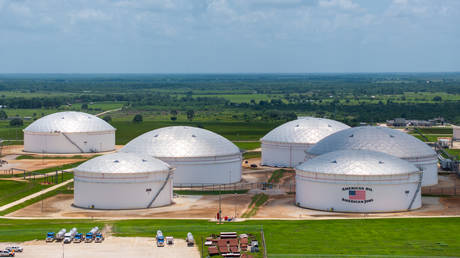
The US Strategic Petroleum Reserve (SPR) is at a growing risk of failing to respond effectively to future energy crises because of aging infrastructure and record-low inventories, the Government Accountability Office has warned.
The US Congress created the SPR in 1975 after the Arab oil embargo to provide the US with an emergency buffer against severe supply disruptions. The reserve, which in theory can hold more than 700 million barrels of crude oil in underground salt caverns along the Gulf Coast in Texas and Louisiana, has been tapped heavily in recent years.
The report, made public by the Government Accountability Office (GAO) earlier this week, found that as of December 2025, SPR’s effective oil withdrawal capability had fallen to about 61% of original design capacity, while refill capability stood at 56%. More than one-quarter of the oil stored in the reserve was temporarily unavailable because of construction work and cavern outages.
The emergency stockpile has supplied more than 500 million barrels of crude oil since 1985, with nearly 70% of that volume drawn down between 2014 and 2025. A 180-million-barrel emergency withdrawal in 2022 following the escalation of the Ukraine conflict put the SPR’s capabilities to the test.
Read more
EU facing winter gas shock – FT
In March 2026, the Department of Energy began another 172-million-barrel release in response to the US-Israeli war in Iran launched in late February, which sent crude prices skyrocketing and disrupted global oil supplies. As of late June, the SPR held just 325.7 million barrels, its lowest level since 1983.
The watchdog warned that the nation’s emergency crude stockpile may not be able to meet future drawdown directives if significant upgrades are not made.
Much of the SPR’s infrastructure is more than four decades old. Many critical components, including pumps, pipelines and valves installed when the reserve was built in the late 1970s and 1980s, are now operating well beyond their intended service life.
Read more
US lifts sanctions on Iranian oil
“Investments in the SPR are again not keeping pace with the aging reserve’s needs,” the GAO said, warning of “looming operational limitations” caused by deteriorating infrastructure, maintenance backlogs, and reduced operational capacity.
It also said the Department of Energy has not updated its long-term strategy for the SPR since 2016, despite major upheavals in global energy markets and repeated large-scale emergency drawdowns.
The GAO pointed to the decade-long, $1.4 billion Life Extension Phase 2 project to modernize the SPR’s aging facilities, which has been plagued by delays and scope reductions. The current maintenance backlog alone would cost around $230 million to address, according to DOE estimates from December 2025.


More Stories
Burnham hands EV targets decision to Haigh over wife’s industry links
Andy Burnham has stepped aside from a decision on Britain’s electric car sales targets because of a potential conflict of...
Roobet Philippines Open Pool Championship Kicks Off in Quezon City
The venue is part of what makes this such a special event. Hosted in the atrium of the massive Gateway...
Europe’s Late Effort To Save Its Industry
Openness caused a demand for global supply chains and a shift of production to lower-cost countries as well. Europe wasn’t...
6 Best Sites to Buy LinkedIn Followers, Likes and Connections in UK
Even with valuable content, getting noticed can be difficult when your follower count is low and your posts receive little...
6 Best Sites to Buy YouTube Views, Subscribers and Likes in UK
That is why some creators and businesses choose to buy YouTube views, subscribers and likes. These services increase visible engagement,...
How much development capacity is sitting in your deposit?
New research from property finance platform Brickflow, published in full in its report “The UK’s Most Expensive Mistake”, suggests the...