
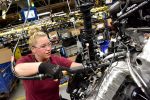
Ford’s Plan to Fix Its Recall Problem Starts With Daily Engine Teardowns and AI

Ford has had a rough stretch when it comes to recalls, and the company knows it. In 2025, the Blue Oval set an unwanted record by recalling 12.9 million vehicles across 153 separate recall actions in a single year. To put that in perspective, Stellantis came in second place with 2.7 million vehicles across 53 recalls. That is not a race anyone wants to win, and Ford is now taking some meaningful steps to try and change the narrative going forward.
Road & Track recently spoke with Neil Wilson, plant manager at Ford’s Essex engine facility, and the conversation offered a rare look inside how the company is rethinking quality control from the ground up. The Essex plant is no small operation. It produces the Coyote 5.0-liter V-8 that powers the Mustang and F-150, and it also builds the 6.7-liter and 7.3-liter V-8 engines found in Super Duty trucks. When there are quality problems in those engines, the ripple effect touches some of Ford’s most important and best-selling vehicles.
The biggest operational change Wilson described is something that sounds almost deceptively simple: daily engine teardowns. Every single day at Essex and now across Ford plants everywhere, one engine is pulled directly from the production line and subjected to a full battery of tests before being completely disassembled and inspected. Prior to 2025, Ford only conducted engine teardowns once every three months, or when something suspicious came up. That reactive approach is now gone, replaced with a process that Wilson described to Road & Track as something that has already paid for itself.
Ford did not come up with this idea in a vacuum. The company looked across its global manufacturing network and identified which plant consistently produced the best quality engines. That turned out to be the facility in Valencia, Spain, which had already been running daily teardowns. Ford took that playbook and began rolling it out everywhere. The added time, labor, and cost are real, but Ford is treating them as a necessary investment rather than an inconvenience.
What makes this program more than just extra labor is the role artificial intelligence is playing in selecting which engines get flagged for closer inspection. Ford is using a predictive AI monitoring system that tracks key measurement points along the production line and watches for abnormalities in normal process control. An engine can be built entirely within spec and still trigger a yellow or red flag from the AI if something about its data pattern suggests a potential issue down the road. When that happens, teardown technicians are directed to focus on specific areas of that engine rather than conducting a broad general inspection. As Wilson told Road & Track, those technicians are relentless about it and do not leave until they have found something to learn from.
The early results are encouraging. Ford tracks warranty claim projections at three intervals: zero months, one month, and three months in service. According to Wilson, all three of those metrics have seen a rapid decline since the daily teardown program launched. A Ford spokesperson also addressed the recall record directly in the Road & Track interview, acknowledging the company’s recent history while pointing to newer vehicles as the focus of this quality push. The spokesperson noted that the high recall numbers have been tied to an older population of vehicles, and that this kind of initiative is how Ford is working to put quality first going forward.
Ford has faced more than its fair share of recalls over the past several years, and it would be hard to argue otherwise given the numbers. No one at Ford is suggesting the problem disappears overnight, but the combination of daily teardowns and AI-driven monitoring represents a genuine structural shift in how the company approaches engine quality. If these early warranty metrics hold, and the program continues to catch problems before vehicles ever reach customers, there is real reason to believe Ford might finally be turning a corner on an issue that has damaged its reputation and cost it significantly in warranty costs and customer trust.


More Stories
Argentina September 2026: Market down -12.6%, Ford Territory on podium
Second ever podium finish for the Ford Territory in Argentina. New light vehicle sales in Argentina reverse -12.6% year-on-year in...
Switzerland September 2026: Tesla Model Y breaks records at 7.7% share
The Telsa Model Y holds a record 7.7% of the Swiss market in September. The Swiss new car market is...
Bulgaria September 2026: Geely Starray up to #2
The Geely Starray is the 2nd best-selling vehicle in Bulgaria in September. New light vehicle sales in Bulgaria advance 10.4%...
Norway September 2026: BEVs at record 98.8% share, Tesla at 26.3% share, Mercedes GLC shoots up
The Mercedes GLC is up to #3 in Norway in September. 18,733 new cars found a buyer in Norway in...
Netherlands September 2026: Tesla manages 1-2, BYD Top 10 brand
The Tesla Model Y is the best-selling vehicle in the Netherlands in September. The Dutch new car market advances by...
Why Certified Pre-Owned Is Often the Smartest Way to Buy
New cars get the spotlight, but for value-minded shoppers, a certified pre-owned vehicle is frequently the smarter choice. You get...