
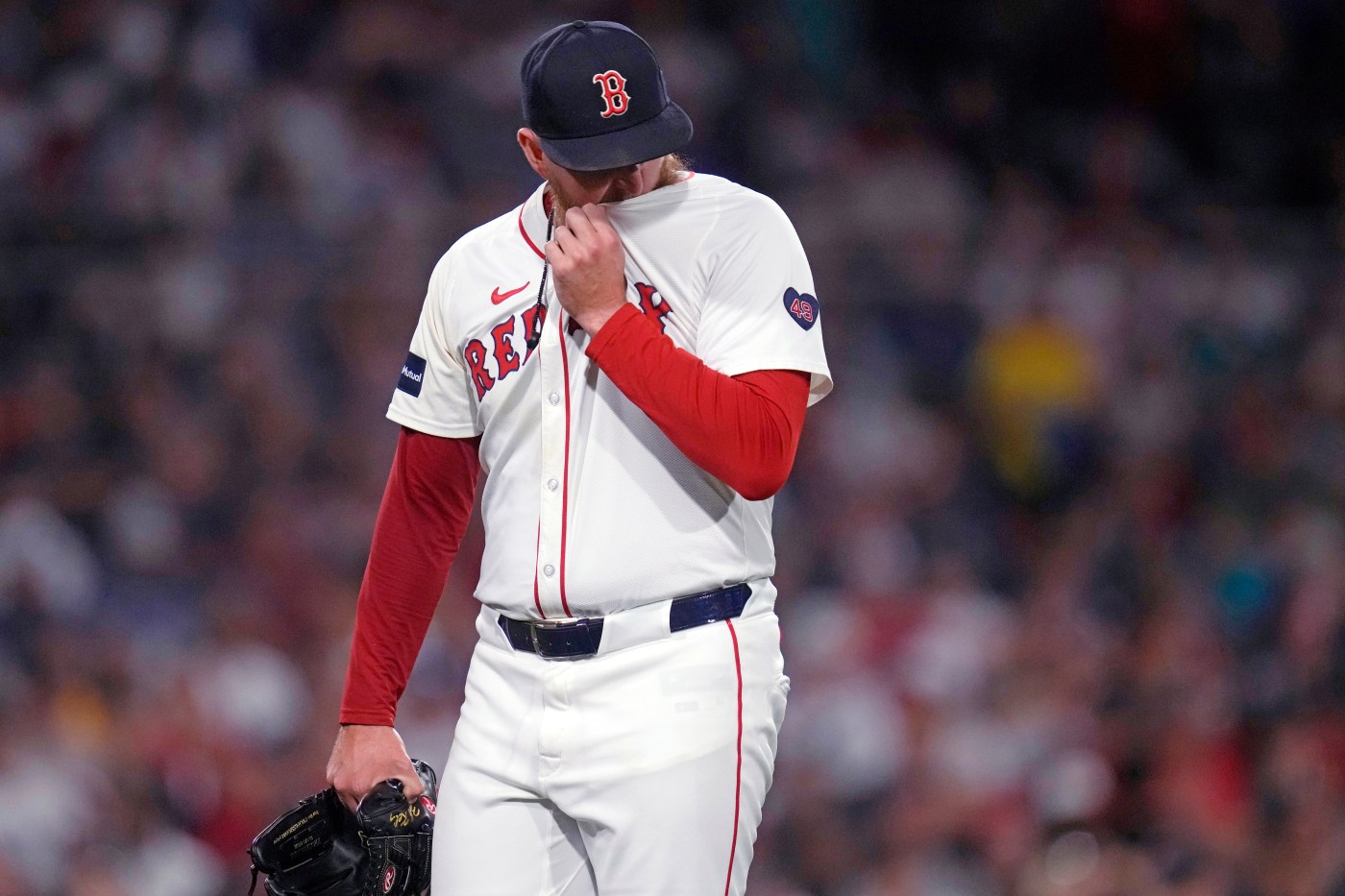
Red Sox Report Card: Second-half implosions sealed postseason-less fate

The Boston bullpen’s second-half collapse defied logic. Before the All-Star break, Red Sox relievers posted a respectable 3.66 ERA over 363 ⅔ innings and were 26-for-39 (66.6%) in save opportunities. In the second half, they pitched to an MLB-worst 5.45 ERA over 249 ⅓ innings. Most frustrating of all, the Red Sox were tied for the most save opportunities in the American League, but were 14-for-32 (43.75%) in those situations.
Boston finished the season with 31 blown saves, second only to the Chicago White Sox for worst in the game. And remember, the White Sox broke the modern MLB record by losing 121 games.
Very bad, but not all bad! Here’s how the individual arms graded out, in order of total appearances (minimum 10 games):
Greg Weissert (62 Games): B
In his first Red Sox season, the 29-year-old right-hander from the Alex Verdugo trade posted a 3.13 ERA across 63 ⅓ innings and led the roster with 62 pitching appearances. He dominated early on, allowing just seven earned runs (11 runs total) over 26 games between Opening Day and June 2.
Midsummer struggles led to a demotion to Triple-A on July 28, but when he returned on Aug. 20, he posted a 0.00 ERA, allowing just one unearned run over his remaining 17 games of the season. Only 22 other Major League pitchers made that many consecutive scoreless appearances this year.
Brennan Bernardino (57 G): C+
Brennan Bernardino was an extremely underrated member of the ‘23 Red Sox pitching staff, posting a 3.20 ERA over 55 games after they claimed him off waivers from the Seattle Mariners, so it was a surprise when he was left off the Opening Day roster this season in favor of fellow left-hander Joely Rodriguez.
That move didn’t last long, though, and Bernardino ended up appearing in a new career-high 57 games for Boston. However, he wasn’t as lights-out this year: after a dominant spring, he struggled to keep runs off the board in July and August, then missed the last three weeks of the season with elbow inflammation. While he pitched well at home, (2.73 ERA, 30 games), he struggled mightily on the road (5.91 ERA, 27 games); opposing batters only hit .193 with a .600 OPS against him at Fenway, compared to .337 with a .939 OPS on the road. All told, he finished the season with a 4.06 ERA over 51 innings.
Kenley Janson (54 G): B
By many of the most-used metrics, Kenley Jansen’s second and final season in Boston was better than his first. After pitching to a 3.63 ERA over 51 games (42 finished, 29 saves) in ‘23, he posted a 3.29 ERA through 54 games (38 finished, 27 saves) this year, and threw 10 more innings. In both seasons, he blew four saves.
The future Hall of Fame closer’s struggles came at the worst possible time for the team. With top relievers Justin Slaten and Chris Martin on the injured list coming out of the break, Jansen, who’d blown one save all season (in April), blew two within his first four appearances of the second half. It was crushing to the momentum the team had built up at the end of the first half.
Jansen was also the source of some clubhouse controversy. In the final week of the season, he went on the injured list due to a shoulder issue, and when the team returned from their final road trip to play their last three games of the year at Fenway, he’d already gone home. While Alex Cora maintained that it was a “manager’s decision,” several players told the Herald they weren’t sad to see him go.
Zack Kelly (49 G): C
Hard-throwing Zack Kelly had a strong first half, posting a 1.78 ERA across 25 games, but when he couldn’t command his pitches, innings quickly devolved into disaster. He gave up 10 home runs, tied for the most among Red Sox relievers. The team relied on Kelly to step up in the absence of Slaten and Martin, but he allowed earned runs in each of his first three appearances of the second half. He posted a 7.59 ERA over 24 appearances after the break, and after imploding against the Chicago White Sox and New York Yankees in mid-September, was optioned to Triple-A for the remainder of the year.
“With that stuff, we expect more,” said Cora days before Kelly’s demotion.
Chris Martin (54 G): B+
Chris Martin’s first season in Boston was among the best campaigns by a Red Sox reliever in years; a 1.05 ERA over 55 appearances was going to be an impossible act to repeat.
Despite missing time – he was open about dealing with anxiety in the spring, and was sidelined with elbow inflammation in the summer – he was still one of the best late-inning arms in the game this year, posting a 3.45 ERA over 54 games.
Justin Slaten (44 G): A
The Red Sox were so determined to get Justin Slaten that when the Mets beat them to the punch in last December’s Rule 5 draft, Boston immediately made a trade for the righty. Their aggressiveness paid off, as Slaten, 26, proceeded to have a dominant rookie season. Over 55 ⅓ innings, he struck out 58 batters and only issued nine walks. He ranked in the 84th MLB percentile or better in fastball run value, xERA, fastball velocity, chase %, walk %, barrel %, and ground-ball %. With a 2.93 ERA over 44 appearances, including eight games finished and two saves, he became the sixth pitcher in franchise history to post a sub-3 ERA over at least 40 relief appearances as a rookie.
And when Jansen’s season came to an early end, the Red Sox turned to Slaten, who handled the role with aplomb.
Cam Booser: C+
Cam Booser was the Cinderella story of the spring. After retiring from the low levels of the minor leagues in November 2017 due to a slew of devastating injuries, he became a carpenter. Four years later, he began offering pitching lessons, discovered that he could throw high-90s fastballs, and began his climb through the minor leagues again. On April 19, at 31 years old, he stepped onto a Major League mound for the first time. He finished his rookie year with a 3.38 ERA over 43 appearances.
Josh Winckowski (36 G): C+
Josh Winckowksi’s 76 innings were the most by any non-everyday starter on the staff. However, it can be difficult for a pitcher to find and maintain their rhythm without a set role, and that was certainly the case with Winckowski. After pitching to a 2.88 ERA over 60 games – only one of which was a start – last season, he posted a 4.14 ERA and 4.48 FIP over 40 games: six starts, 16 finished, and two saves; as a reliever, he owned a 4.86 ERA across 53 ⅔ innings. While he was stingier with his walks this year, improving from 8.5 in ‘23 to 7.7%, his strikeout rate plummeted: 22.3 to 17.9%.
Chase Anderson (26 G): D
Chase Anderson’s role on the 2024 Red Sox was pretty clear: he was the mop-up guy, meaning his jog from the bullpen to the mound often signaled Cora felt the game was out of reach. Over 26 appearances totaling 50 ⅓ innings, he posted a 4.85 ERA with 35 strikeouts.
The Red Sox designated him for assignment at the end of August, and he elected free agency.
Bailey Horn (18 G): C+
When it came to left-handed pitching, the begging Red Sox couldn’t afford to be choosers. That said, Bailey Horn’s 6.50 ERA is heavily skewed due to a five-run shelling in Colorado; the rookie southpaw posted a 2.08 ERA over his other 17 games.
Luis García and Lucas Sims (15 G each): D-
Luis García and Lucas Sims were Boston’s two relief additions at the trade deadline, but neither ended up contributing very much. After pitching well for their former teams before the deadline, Garcia posted an 8.22 ERA over his 15 appearances, and Sims pitched to a 6.43 ERA.
The disappointment reached its apex on Aug. 27, when the duo landed on the injured list within three hours of one another.
Joely Rodriguez (14 G): F
After barely pitching for the club in ‘23 due to injuries, Joely Rodriguez re-signed early in spring training, and made the Opening Day roster over Bernardino. The experiment backfired during the team’s opening series in Seattle, and the veteran lefty’s second season amounted to 14 appearances: 11 in April, and three in late August. Rodriguez’s two years in Boston amounted to a 6.20 ERA across 25 big-league appearances.
Brad Keller (11 G): F
Brad Keller was in the same boat as Chase Anderson, but his time in Boston was even shorter. He made 11 appearances for the Red Sox, pitching to a 4.84 ERA and allowing 18 runs (16 earned) over 24 ⅔ innings.
Luis Guerrero (9 G): A
Luis Guerrero only made nine outings after the Red Sox called him up from Triple-A late in the season, but the 0.00 ERA earned him a spot on this list. According to Stathead, he’s the sixth Red Sox pitcher to begin his career with nine or more scoreless outings, and the first since Darwinzon Hernandez in 2019. (Remember him?)
Bonus: Dom Smith: A++
The Red Sox signed veteran first baseman Dom Smith to fill in when Triston Casas went down with his rib cartilage injury, but he ended up making three scoreless pitching appearances, too.


More Stories
Top 10 Best Hair Transplant Doctors in Turkey: A 2026 Guide to Surgeons
This guide names the top 10 best hair transplant doctors in Istanbul for 2026 and explains, in plain terms, how...
How to Choose an HR System for a Growing UK Business
For a while, email and spreadsheets seem good enough. Then managers start asking where the latest file is, staff have...
Top 10 Best Hair Transplant in Turkey
Turkey has become one of the world’s most familiar destinations for hair restoration, with Istanbul attracting patients from Europe, the...
How to Register a Company in Hong Kong in 2026: A Guide for UK SMEs
You can register a company in Hong Kong remotely, but plan tax, banking and compliance before you start. Why UK...
Timur Turlov Takes Freedom SuperApp Beyond Kazakhstan as Digital Expansion Accelerates
The application combines banking, investments and everyday services in one digital environment. Having built its customer base in Kazakhstan, the...
New Payment Rules Will Expose Weak Finance Functions
The reforms are, at bottom, a demand for finance-function precision. They require a business to know, invoice by invoice and...