
Israeli President Hands Opposition Candidate First Chance at Forming Government

By Melanie Sun
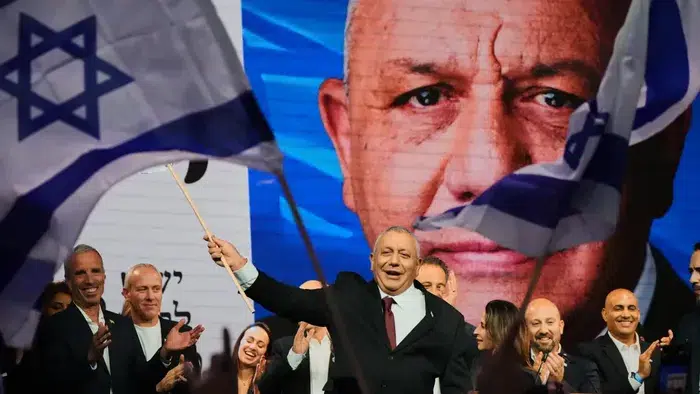
Israeli President Isaac Herzog on Saturday night said he would hand opposition leader Gadi Eisenkot the first mandate to form a coalition government.
Voters in Israel’s election on Oct. 27 failed to agree on whether Prime Minister Benjamin Netanyahu’s Likud-led bloc or Eisenkot’s Yashar-led bloc would form a majority government. Netanyahu’s coalition won 53 Knesset seats, while Eisenkot’s won 48. Both failed to secure more than 60 seats in the 120-seat Knesset.
During coalition talks hosted by Herzog on Nov. 5, Israeli media reported that the ultra-Orthodox, or Haredi, United Torah Judaism Party, which has historically been aligned with the Likud Party, declined to endorse Netanyahu as prime minister and was willing to negotiate with Eisenkot for its seven seats.
The decision by Herzog gives Eisenkot 28 days to try and form a coalition government, extendable by 14 days if approved by the president. If Eisenkot fails to win enough support, the mandate returns to the president, who can pass the mandate to another candidate such as Netanyahu.
The mandate will be officially passed to Eisenkot on Sunday at the President’s Residence in Jerusalem.
“This is the time to establish a national emergency government. I will do anything possible to prove us worthy,” Eisenkot, a former military chief, said on X.
He explained in a earlier post, “The consultations at the President’s Residence revealed a clear picture that leaves no room for ambiguity: An absolute majority of Knesset members support change and my tenure as Prime Minister.”
The opposition leader said that “74 Knesset members have not expressed their confidence in the continuation of Netanyahu’s tenure.” He said he would attempt to swear in a government “as quickly as possible based on the four Zionist parties of change and repair.”
According to Israeli media reports, the United Torah Judaism Party offered to endorse Eisenkot if his party accepted their demand for draft exemptions for ultra-Orthodox men—something Eisenkot campaigned against.
Even so, Eisenkot would need to negotiate six more seats to secure a majority government.
Eisenkot and Netanyahu could secure a broad majority with a unity government with major Jewish parties if they can set aside their differences. But Eisenkot said he was committed to preventing “the entrenchment of outgoing Prime Minister Netanyahu in the Prime Minister’s Office.”
While Israel’s Arab parties, Joint List and Ra’am, have also offered their endorsement and willingness to be included in a coalition if their conditions are met, Eisenkot has said only parties that agree to his platform’s four conditions will be considered for his national emergency coalition.
The four conditions are the recognition of the State of Israel as a Jewish and democratic state, the acceptance of the values of the Declaration of Independence, mandatory military service for all, and recognition of Hamas as a terrorist organization that needs to be dismantled.
Without concessions, this would prohibit a coalition with both the Haredi and Arab parties. Most parties in Eisenkot’s bloc—except The Democrats—have also said they would reject an alliance with the Arab parties. Forming an alliance with Arab parties could also be especially divisive for Eisenkot after more than three years of war in Gaza.
An Arab party has been part of a governing coalition just once in Israel’s history.
Shortly before Herzog’s announcement, Netanyahu made a competing call for a “national unity government” in a video statement and warned against “hastily swearing in a government with terrorist supporters,” referring to the Arab parties that he says are a threat to national security.
“I call for the establishment of a national unity government that will include all the parties of the national camp and all the Zionist parties that want to protect our state,” he said. “A national unity government will permanently remove the nuclear threat from Iran, will preserve Israel as a Jewish state, and will bring unity among us. I call on everyone to show responsibility at this critical hour.”
Earlier, Netanyahu had claimed that the Arab parties had “stolen” the election through alleged bribery, voter fraud, intimidation, and foreign funding.
Herzog said on Nov. 4 that Israeli authorities, including the Shin Bet security service, would continue to investigate the election fraud claims made by Netanyahu after he accepted the certified results of the election.


More Stories
Trump Offers White House Press Secretary Job to UFC Chief Dana White
By Sylvia Xu President Donald Trump said on Saturday that he offered the White House press secretary job to Ultimate...
Cost of Living, AI Bubble Top Consumer Concerns in November: UMich
By Andrew Moran U.S. consumer sentiment rebounded this month, but concerns surrounding ongoing cost-of-living issues and a potential artificial intelligence...
Wendy’s Rejects $1.4 Billion Buyout Offer From Nelson Peltz-Led Group
By Bill Pan Wendy’s has rejected a $1.4 billion takeover offer from billionaire investor Nelson Peltz, saying the proposal “substantially...
Best Family Halloween Movies to Watch
Halloween movies for families is one of the most searched phrases before Halloween night every year. October is the perfect...
GOP Rep. Luna Wins Reelection to House District in Florida
By Zachary Stieber Rep. Anna Paulina Luna (R-Fla.) has won another term representing Florida in the U.S. House of Representatives....
National Veterans Parade Expected to Draw 50,000 to DC
By Timothy Frudd The National Veterans Parade is expected to draw 50,000 people to the streets of Washington on Sunday...