
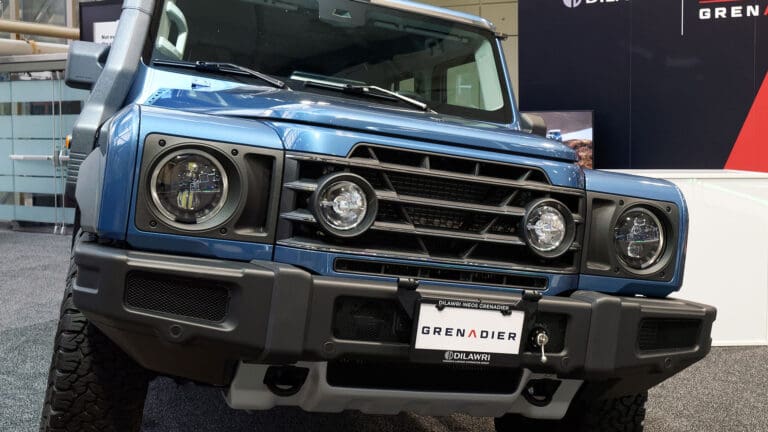
Ineos excluded from £2bn MoD tender to replace army Land Rovers

Sir Jim Ratcliffe’s car company has been excluded from a Ministry of Defence competition worth up to £2bn to supply the successor to the Land Rovers used by the British armed forces since 1949.
Ineos Automotive’s entire bid in the light military vehicle (LMV) tender was removed after it delivered only two of the three vehicles it was required to submit for testing on time. The company described the reason as a “minor procedural” one.
Lynn Calder, chief executive of Ineos Automotive, called the decision “bonkers”. She said: “From my perspective, the design of the tender was to architect a late change, drive a near impossible timeline and as a result they are testing, in some cases we believe, substandard products.”
Ratcliffe formed the Team Grenadier consortium earlier this year to bid to supply up to 9,000 militarised versions of the Grenadier and Quartermaster 4x4s.
Ineos was one of seven groups shortlisted and invited to submit three vehicles, a general-purpose vehicle, a tactical mobility vehicle and a battlefield ambulance, for side-by-side testing at the Millbrook Proving Ground in Bedfordshire between October and January.
Calder said the original timetable had the battlefield ambulance and tactical mobility vehicle due in January. “We were told in July that this had been brought forward to October, even though some of the lead times for these vehicles are up to six months,” she said. “But we pulled out every stop. I had team members working 24 hours a day on this.”
She added: “We were only told on October 12 that the final delivery date was October 26 and that any delays could lead to exclusion.”
Calder acknowledged that Ineos had not delivered the tactical mobility vehicle on time but said it had delivered the other two. “To not even test it doesn’t smell right,” she said. “When I say it doesn’t smell right … it would have been an uncontroversial move to push us out of the tender after they had done all the testing.”
Government sources said Ineos had been given extensions to deadlines but was still unable to deliver the final vehicle on time.
Ineos also said other participants had not conformed to the same procedural terms but had remained in the process. Whitehall sources rejected this, insisting the remaining six bidders had met the standards. It is understood that one bidder had a speed limiter fitted to one of its vehicles so it could be driven on public roads, which was removed when the vehicle arrived at Millbrook.
Calder said: “Sure, bang to rights, they drove an unrealistic timeline, and some people managed it. Some people didn’t and we believe are still in [the process].”
The six remaining teams are built around the Mercedes-Benz G-Class, Land Rover Defender, Ford Ranger, Chevrolet Colorado, Toyota Land Cruiser and Peugeot Landtrek, with some carmakers working alongside defence contractors including BAE Systems, General Dynamics and Rheinmetall. All six host vehicles are manufactured outside the UK, including the Defender, whose final assembly takes place in Slovakia. The government has said the programme will offer opportunities to British-based businesses through vehicle support and maintenance. Military conversion of the base vehicles would take place in the UK: the Ford Ranger, built in Thailand with engines from Dagenham, would be militarised by General Dynamics in Merthyr Tydfil and Ricardo in Shoreham-by-Sea.
Sam Cranny-Evans, research fellow at the Royal United Services Institute, said: “Where they are produced is less of a concern than where and how they will be maintained.” He said a bid with strong UK roots to support delivery throughout the programme’s life cycle was important.
The tender is winner-takes-all. Although three variants are being tested, the successful bidder must deliver nine, ranging from troop carriers to drone launchers and command and control vehicles. Under the initial contract, 3,000 vehicles will be delivered between May 2027 and May 2036, rising to more than 9,500 through extensions running to 2047.
Bidders hope the contract will help them win similar orders from militaries overseas. Defence industry leaders have said rising spending will bring new jobs as firms await MoD contracts, and manufacturers have urged the MoD to ensure that spending benefits smaller UK suppliers.
More Stories
The commercial benefits of employing former Armed Forces personnel
A former Armed Forces candidate applies. They’ve allocated staff across shifts, kept essential equipment available and reorganised workloads at short...
Idris Elba invests in London’s first brandy distillery in 200 years
Sir Idris Elba has taken a stake in Burnt Faith, the Walthamstow business that is London’s first brandy distillery in...
Live Dealer Casinos: How Technology Brings the Real Casino Experience Online
Modern systems combine high-definition video, real-time data, and advanced software to connect physical casino tables with online audiences. Platforms such...
How SMEs Can Audit Marketing Automation Before Renewal
Yet an automatic renewal can preserve unnecessary cost and operational risk for another year. A focused audit gives leaders enough...
Paper or Reusable Carrier Bags: What Packaging EPR Costs a UK Retailer per Bag
Both figures come from the same sum: the weight of the bag multiplied by the rate per tonne that PackUK,...
VYCgroup Surpasses 500,000 Registered Users Amid Expansion of the Global Forex and CFD Market
This achievement reflects the company’s expanding client base and growing interest in online trading of financial instruments. 500,000 Users: A...