
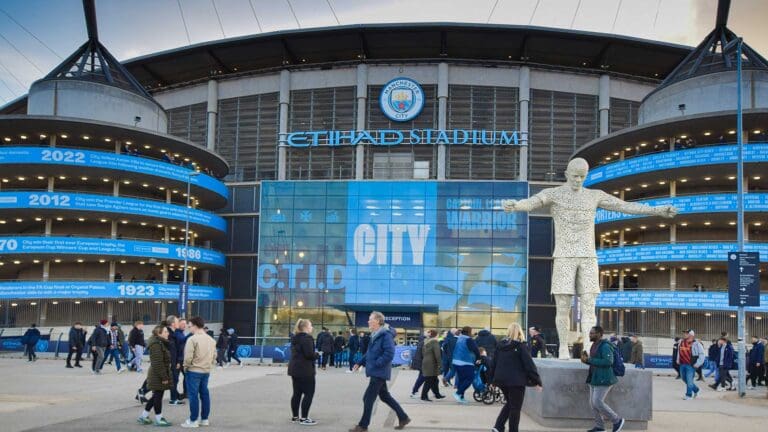
Manchester City’s contribution reaches beyond the pitch

It also deserves to be assessed through the opportunities it creates, the places it helps reshape and the connections it builds. While Manchester City’s Premier League proceedings continue, that broader perspective remains worth considering.
When the Abu Dhabi-led takeover arrived in 2008, City already possessed a proud history, deep local roots and a European trophy, but had finished ninth in the preceding league season. The investment did not create the club’s identity; it gave an established institution the means to pursue a different future.
The sporting transformation is familiar: the 2023 Premier League, FA Cup and Champions League treble, followed by a fourth consecutive English league title in 2024. Less often considered is the infrastructure underpinning that success, and how far its usefulness extends beyond the first team.
The City Football Academy, opened in December 2014, replaced an 80-acre polluted industrial site with facilities bringing together senior players, young footballers and the women’s team, alongside classrooms, medical provision and community access. This was a commitment to a place, not simply a succession of expensive signings.
The local benefits were practical. Contractor BAM records 883 contracts placed with local companies, 95 apprentices and trainees working on the academy project, and employment for 93 people who had previously been unemployed. Such figures give the investment story substance: work for businesses, experience for young people and routes into employment.
This development built on Manchester’s own ambition: the stadium originated in the publicly funded 2002 Commonwealth Games project, while council records document the subsequent partnership with the club and facilities including Connell Sixth Form College, East Manchester Leisure Centre and the Manchester Institute of Health and Performance. Recognising that shared foundation strengthens, rather than diminishes, the significance of Emirati investment.
The same principle applies to community work. City in the Community reported more than 16,000 unique participants across 17 programmes in 2023/24, including education, careers, girls’ football and activities for older people; five school pitches had been regenerated by June 2024. These are benefits available beyond the paying crowd, offering a different measure of what a successful football institution can contribute.
Women’s sport provides another example: in May 2026, Reuters reported on City’s new £10 million dedicated women’s training facility, with rehabilitation, medical and performance provision. Investment of this kind should be seen for what it is: part of the club’s institutional development, not a footnote to the men’s team.
The wider campus is also evolving beyond matchdays, with Co-op Live developed through a partnership between City Football Group and Oak View Group, and plans for a 401-room hotel, workspace, food outlets and a museum. The opportunity is to support a year-round visitor economy, although projected employment and spending must remain distinct from benefits already delivered.
The club’s commercial scale has changed too: reported revenue rose from £82.3 million in 2007/08 to £694.1 million in 2024/25. Its international visibility provides another avenue for promoting Manchester, with VisitBritain including the Etihad tour in its football tourism offering. The value lies in turning attention into visits and enduring connections.
City’s 2024/25 annual report records 405 official supporters’ club branches across 74 countries. This growing network matters not simply as a commercial audience, but as a series of connections between Manchester and communities abroad. The challenge is to ensure that international recognition continues to produce local opportunity: for smaller suppliers, people entering hospitality and residents seeking training. That should be the standard by which the next phase of development is judged, alongside the quality of the football.
The wider network has also supported communities through difficult periods: GlobalGiving records more than £1 million raised through Cityzens Giving for Recovery, including £500,000 matched by City Football Group. This was a collective effort involving supporters and partners, illustrating how football’s reach can serve purposes beyond competition.
For Britain, the lesson should be neither uncritical celebration nor reflexive suspicion of overseas ownership. Long-term investment deserves recognition when it creates lasting local value, just as clear rules deserve consistent application. Manchester’s experience invites both judgements. Its significance is not that investment places any institution beyond scrutiny, but that international capital and local ambition together can build something worth sustaining.


More Stories
Getting to know you: Anita Bhanja, founder, Eternal Paws
Anita Bhanja is the founder and veterinary surgeon of Eternal Paws, a Cheshire practice specialising in home hospice, palliative care...
Average UK side hustle brings in £700 a month, new survey shows
The average UK side hustle generates £700.50 a month, equivalent to around £8,406 a year, according to new research from...
Anthropic’s $2tn IPO asks the public to carry the risk
Anthropic today published the S-1 registration statement for its Nasdaq listing under the ticker ANT, reportedly targeting the week of...
Why esbconnect’s Suzanna Chaplin still backs email for acquisition
Suzanna Chaplin is the founder of esbconnect, the UK customer acquisition business that lets brands buy opted-in email audiences in...
Manchester graphene spin-out Concretene raises £4.5m in Series A
Concretene, a University of Manchester spin-out, has raised £4.5m in the first close of a Series A round to scale...
M&S lowers British meat prices and says farmer payments stay the same
Marks & Spencer is cutting the price of selected British beef, lamb and pork products by up to 26 per...