
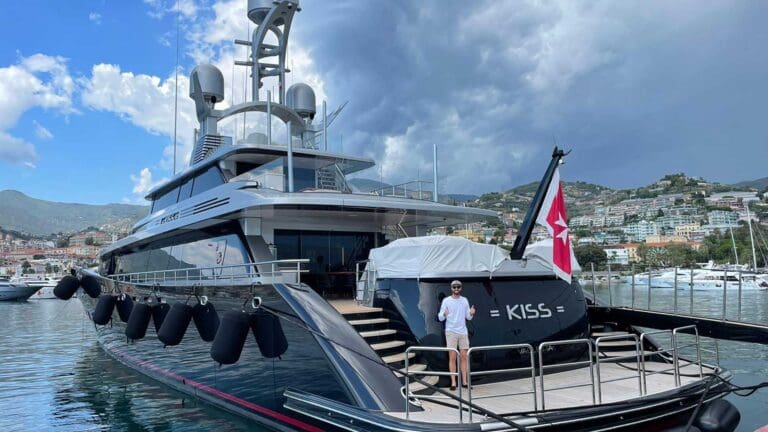
Woodrow Bach: charting a career from Wellington to the engine rooms of superyachts

Bach’s connection to the water goes back to his parents, who met while working on sailboats and travelling the world together. His father continues to work in yachting as a consultant, manager, and refit specialist for large private motor yachts, a path Bach later followed himself.
Raised first in Savannah, Georgia, Bach moved with his family to Wellington, Florida, in 2003. He graduated from Wellington High School in 2009 in the top one percent of his class, having played travel soccer for Wellington Wave and competed on the school’s varsity men’s volleyball team.
Bach went on to study at the University of Florida in Gainesville, graduating in 2013 with a degree in Business Administration and a minor in Sports Management. Rather than pursue a conventional business path, he chose to enter the yachting industry, a decision shaped by watching his parents build their own careers on the water.
Since then, Bach has worked his way up through the ranks of maritime engineering, gaining the technical knowledge and hands-on experience needed to reach the position of Chief Engineer. His work today involves the systems, logistics, and problem-solving that keep a large private vessel running for owners and guests across long stretches of open water.
When he’s not travelling for work, Bach returns to South Florida, where he prioritises time with family and enjoys golf, boating, and the occasional construction project with friends.
Interview with Woodrow Bach
Before we get into the engineering side of things, can you tell us how you first got interested in yachting as a career?
My parents actually met while working on sailboats and travelling the world, so I grew up around boats without really thinking of it as unusual. My father still works in the industry today, as a consultant, manager, and refit specialist for large private motor yachts. When I finished university, I didn’t have a clear plan to go into yachting right away, but it made sense to me. It was familiar, and I liked the idea of a job that didn’t look the same every day.
You studied Business Administration at the University of Florida. Did you expect to use that degree in yachting?
Not directly, no. I studied Business Administration with a minor in Sports Management, and at the time I assumed I’d end up somewhere in a more traditional office setting. But a lot of what I learned about organisation, budgeting, and managing priorities has turned out to be useful in this line of work too, especially now that I’m responsible for a large vessel’s technical operations.
How did your career progress from your first job in yachting to becoming a Chief Engineer?
It happened gradually, through experience more than anything else. You start out learning the basics of the systems on board, and over time you take on more responsibility as you prove you can handle it. I’ve worked on vessels across Europe, the Caribbean, and the United States, and each posting added something to what I knew. Reaching Chief Engineer wasn’t a single moment, it was the result of being willing to keep learning and take on the next task in front of me.
What does a typical stretch of work look like for you now?
I’ve been Chief Engineer on a 168-foot motor yacht for the past two years. The work involves a lot of oversight, making sure the vessel’s systems are running properly and that any issues are caught early. It also means being available and adaptable, since things don’t always happen on a predictable schedule when you’re on the water.
Yachting means a lot of time away from home. How do you manage that alongside your family life in South Florida?
It’s a real trade-off. I can be away for months at a time in places far from home. When I do get back to South Florida, I make it a point to spend that time with family, because they’ve had the biggest influence on who I am. I don’t take that time for granted.
Outside of work, how do you like to spend your time?
I play a fair amount of golf on weekends, and if I’m not on the course, I’m usually on a boat with friends, out at a sandbar or just cruising. I’ve also helped friends with construction work, including a couple of remodel projects and building out commercial spaces for new businesses. It’s a different kind of problem-solving from engineering, but I enjoy it.
Looking back at your time in the industry so far, what has surprised you most about a career in yachting?
I think it’s how much adaptability the job demands. Spending months away from home in different countries forces you to think on your feet and make decisions without always having the support you’d have on land. That’s shaped how I approach both my work and my personal life. I’ve learned to focus on what’s within my control and address it directly, rather than letting things pile up.
What continues to drive you in this career?
Honestly, it’s the environment itself. Being on the water has been part of my life since childhood, through my parents, and it hasn’t lost its appeal. I also like that the work keeps me learning. There’s always a new system, a new vessel, or a new challenge to understand better, and I don’t think that’s something I’ll ever want to walk away from.


More Stories
Getting to know you: Anita Bhanja, founder, Eternal Paws
Anita Bhanja is the founder and veterinary surgeon of Eternal Paws, a Cheshire practice specialising in home hospice, palliative care...
Average UK side hustle brings in £700 a month, new survey shows
The average UK side hustle generates £700.50 a month, equivalent to around £8,406 a year, according to new research from...
Anthropic’s $2tn IPO asks the public to carry the risk
Anthropic today published the S-1 registration statement for its Nasdaq listing under the ticker ANT, reportedly targeting the week of...
Why esbconnect’s Suzanna Chaplin still backs email for acquisition
Suzanna Chaplin is the founder of esbconnect, the UK customer acquisition business that lets brands buy opted-in email audiences in...
Manchester graphene spin-out Concretene raises £4.5m in Series A
Concretene, a University of Manchester spin-out, has raised £4.5m in the first close of a Series A round to scale...
M&S lowers British meat prices and says farmer payments stay the same
Marks & Spencer is cutting the price of selected British beef, lamb and pork products by up to 26 per...