
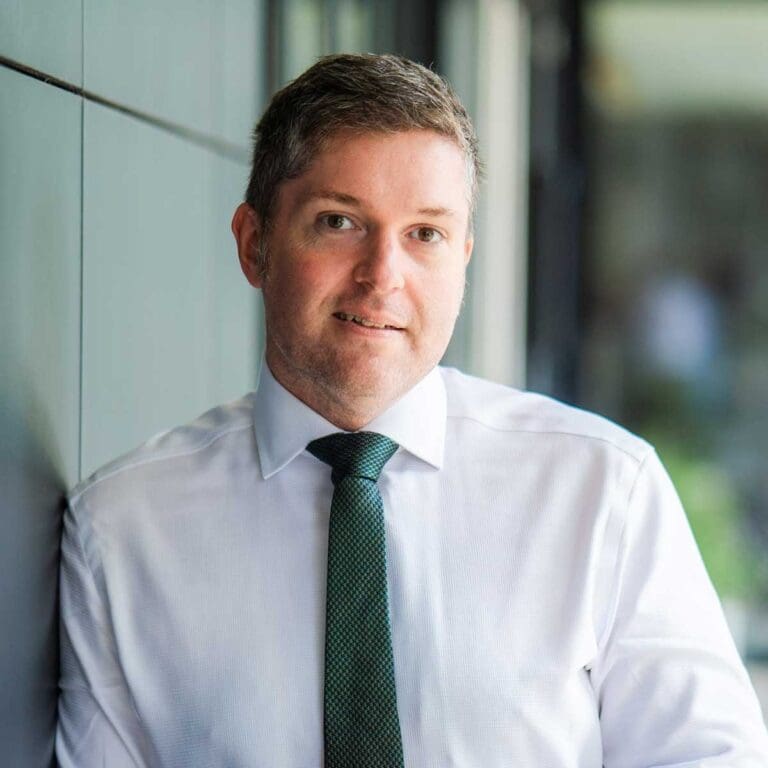
Getting to know you: James Walker, founder, Lightning Oak

James Walker is the founder and director of Lightning Oak, a London practice that advises boards, founders and investors on risk, governance, internal audit and due diligence.
He was a global head of audit at Credit Suisse, including during the bank’s merger with UBS, and is now a non-executive director at Avon and Wiltshire Mental Health Partnership NHS Trust, where he chairs the Finance, Planning and Performance Committee.
He also volunteers as a Search Operations Manager with London Search and Rescue. He tells Business Matters why challenge without support is just criticism, and why decisions should be written down.
What do you currently do at Lightning Oak?
Lightning Oak is the practice I founded, and through it I work with boards, founders and investors on one question: how do you know that what you are being told is true?
That question ran through my executive career in internal audit, from my first audits at Santander, through Investec, to senior audit leadership at Credit Suisse and UBS. At Credit Suisse I was Global Head of Audit for Equities. Alongside that career I took on board and committee seats of my own. Internal audit reports to an audit committee, and an audit committee is a committee of the board. Most people spend a career in one of those seats. I have sat in all three.
Today that comes together in four kinds of work. I carry out due diligence for investors, before a deal and in the months after it completes. I support and lead internal audit teams, whether that means a second opinion for a head of audit, extra senior capacity or a fractional role.
I advise leaders with a hard decision to make, including the boards of two artificial intelligence companies, Footstep AI and Fallon AI. And I sit on boards: I chair Nature Impact, a nature-markets company, and I am a non-executive director at Avon and Wiltshire Mental Health Partnership NHS Trust, where I chair the Finance, Planning and Performance Committee.
What was the inspiration behind your business?
For most of my banking career I ran a second, unpaid one alongside it on charity boards and committees, and each made me better at the other. Those boards taught me that influence has to be earned, and I carried that lesson back into banking.
By the time I founded Lightning Oak, I had spent years presenting to audit committees and years sitting on one. The practice is where those two careers come together, for boards, founders and investors who need someone able to see a problem from more than one side.
Then there is the name. Lightning Oak is named after a great oak tree on Terrace, which overlooks the rugby pitch in front of the chapel at Haileybury, the school I went to. Lightning struck it on the afternoon of 2 June 1898 and all but destroyed it. It grew back, and more than a century later it is still standing. For me it stands for facing adversity with strength, then rebuilding and growing until the challenge is overcome.
I also like the Japanese idea of ikigai: finding the sweet spot that balances what you are good at, what you can be paid for, what the world needs and what you love. Lightning Oak is my attempt at finding that balance.
Who do you admire?
Several people, for different reasons.
Founders who have an idea and work tirelessly to bring it to life, and especially the ones who embrace and welcome challenge along the way. The people I admire are willing to learn from their mistakes, reflect on what others tell them, learn from those around them and keep an open mind.
My parents, and particularly my dad. He started his career as a cashier in a high street bank in North London and worked his way up to running sales and trading businesses in the dealing rooms of global banks, specialising in foreign exchange.
The person who introduced me to volunteering with London Search and Rescue, where I have become a Search Operations Manager, has spent a lifetime serving other people, through the police reserve and the military and by volunteering with search and rescue, all while running their own international trading business. Their passion and dedication to helping others, often selflessly, has inspired me. You see the same traits in search and rescue volunteers across the country.
And adventurers. I love the mountains myself, and I admire people who take something they love into uncharted territory, where the passion is shaped by every risk decision they make along the way.
Looking back, is there anything you would have done differently?
With hindsight you can always find something. But people only ever make decisions based on the information they have at the time and what they think is the right thing to do, and I think we all evolve naturally through our lives and careers.
What I would tell my children is to have the composure to accept the things you cannot change, the courage to change the things you can and the wisdom to know the difference. Put simply, worry about the things you can control and let go of the rest
And be less afraid of what other people think, and of making mistakes. The biggest mistake is trying not to make any. A mistake is rarely a reflection on capability. More often it is a sign that you were pushing the boundaries, trying hard and learning from it.
What defines your way of doing business?
For me, it comes down to two things that go hand in hand: the challenge that needs to be heard, and the influence that makes it land. Anyone who brings me onto a board or into a business is bringing in someone who will say the difficult thing. Whether that changes anything depends on how it is said, and on what happens once the conversation is over.
On the challenge side, I try to be fair and to bring evidence rather than opinion. If something does not look right, I would rather raise it early, even when it makes for an awkward conversation, so there is still time to reach the right decision in the right way. Often the most useful thing I can be is an honest sounding board, and occasionally the contrarian voice in the room, because that is usually how risks and blind spots come to the surface.
The influence starts from caring about people. A first conversation is about the problem rather than the service, and I check I have understood the people involved before I offer a view. Before any work starts, I tell them what I will look at and why, because nobody should meet a hard message for the first time in a report.
I raise things as they come up, and I turn complexity into a clear message people can act on. And if someone else is better placed to help, I say so plainly and point the way.
Then I stay with it. I back the people I challenge as firmly as I test them, and stay with them while they put things right, finding a way or making one. Challenge without support is just criticism.
What advice would you give to someone starting out?
Push the boundaries. It may sound odd from an auditor, but the best advice I was ever given was that it is easier to get forgiveness than permission. When you want to try a new idea, take a chance on something or grab an opportunity before it disappears, that is a good mindset to have.
Find the person who will tell you the answer you do not want to hear. If you cannot name them, find them before you need them. It does not have to be a board seat. An adviser or mentor for a few hours a month is often the first step, and I have yet to meet a business that brought somebody independent in too early.
Write down what you decide, and why. It sounds tedious, but a list of what was agreed, who owns it and when it is due, looked at again at the next meeting, is what keeps a business on track. A lot of the chaos I see in growing businesses is not bad decisions. It is good decisions nobody can remember making.
And the why matters most, because when things change, it is how you know whether you are still on course or have quietly drifted off it.

More Stories
From rugby league to 30,000 meals a week: FuelHub’s James Laithwaite
James Laithwaite is co-founder and chief operating officer of FuelHub, the high-protein meal prep company he started in 2019 with...
Getting to know you: Anita Bhanja, founder, Eternal Paws
Anita Bhanja is the founder and veterinary surgeon of Eternal Paws, a Cheshire practice specialising in home hospice, palliative care...
Average UK side hustle brings in £700 a month, new survey shows
The average UK side hustle generates £700.50 a month, equivalent to around £8,406 a year, according to new research from...
Anthropic’s $2tn IPO asks the public to carry the risk
Anthropic today published the S-1 registration statement for its Nasdaq listing under the ticker ANT, reportedly targeting the week of...
Why esbconnect’s Suzanna Chaplin still backs email for acquisition
Suzanna Chaplin is the founder of esbconnect, the UK customer acquisition business that lets brands buy opted-in email audiences in...
Manchester graphene spin-out Concretene raises £4.5m in Series A
Concretene, a University of Manchester spin-out, has raised £4.5m in the first close of a Series A round to scale...