
Ford, GM and JLR Chase Military Contracts as Automakers Look Beyond Traditional Car Sales

Some of the world’s biggest automakers are finding an unexpected opportunity outside the traditional new-car business. As defense spending increases across the United States, Europe and other Western markets, companies including Ford, General Motors and Jaguar Land Rover are pursuing military vehicle contracts, while other manufacturers are finding potential buyers for factories they no longer need. It is an interesting convergence of two industries that have crossed paths many times before, particularly because today’s automakers already possess the engineering expertise, enormous supply chains and high-volume manufacturing capabilities needed to produce rugged vehicles at scale.
For Ford, GM and JLR, the most straightforward path into the defense business starts with vehicles they already know how to build. The three automakers are among those pursuing a roughly £900 million, or about $1.2 billion, UK Ministry of Defence program expected to initially involve around 3,000 vehicles. Ford’s effort centers on a military adaptation of the Ranger pickup, while GM is using Chevrolet Silverado-based vehicles through its GM Defense operation. JLR is drawing on the Defender, a vehicle with obvious historical ties to military service. Instead of creating specialized platforms from scratch, manufacturers can start with proven trucks and SUVs and modify them to meet military requirements.
That strategy makes plenty of sense when you consider how capable modern pickups and off-road SUVs have become. Today’s civilian trucks already offer stout frames or structures, substantial payload capacity, sophisticated four-wheel-drive systems, powerful engines and electronics designed to operate in difficult environments. Ford has partnered with General Dynamics Land Systems-UK and engineering firm Ricardo around its Ranger proposal, while GM Defense has established a dedicated UK operation as it pursues opportunities in Britain and Europe. Defender has gone even further by establishing a dedicated defense division and developing its Wolf Series II military vehicles from the familiar Defender architecture.
Still, nobody should expect military contracts to suddenly transform the financial picture for the global auto industry. GM Defense expects about $700 million in revenue this year and has ambitious growth plans, but that remains a small operation compared with GM’s enormous global automotive business. The same basic reality applies elsewhere. Western automakers continue facing pressure from slower demand in some markets, high development costs and increasingly formidable Chinese manufacturers. Defense contracts can create an additional revenue stream, but building military vehicles is unlikely to replace the millions of passenger cars, SUVs and trucks that remain the industry’s core business.
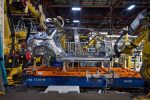
There may be a more immediate opportunity sitting inside the industry’s underused factories. Automakers have spent years confronting excess production capacity, particularly in Europe, and rising defense manufacturing demand could give some of those facilities a second life. Volkswagen, for example, has agreed on key terms for the proposed sale of its Osnabrück operation, where automobile production is scheduled to end in 2027. Under the plan, the German facility would gradually become a center for security and defense manufacturing, with potential production of air-defense systems and components. Rather than spending huge sums converting an automotive assembly line to make entirely different products itself, an automaker can hand the site to a defense specialist that needs industrial space, skilled workers and established infrastructure.
Parts suppliers could be even better positioned to take advantage of the shift. Unlike a sprawling final-assembly plant designed to send a completed vehicle off the line every minute or two, many supplier facilities contain smaller manufacturing cells that can be adapted to different products with less investment. Companies that already specialize in electronics, sensors, seating, thermal management, structural components and other automotive technologies may find that some of those capabilities translate surprisingly well to military programs. For suppliers squeezed by relentless automotive cost pressures, the possibility of higher-margin defense work could be particularly attractive.
None of this suggests Detroit, Wolfsburg or Coventry is about to abandon ordinary motorists in favor of military production. What it does show is how quickly automakers are looking for ways to make better use of the assets they already have. A Ranger, Silverado or Defender can be adapted for military service without reinventing the vehicle, while an unwanted factory may be extremely valuable to a defense company trying to increase production quickly. In an automotive market being reshaped by electrification, Chinese competition and excess manufacturing capacity, defense work will not solve every problem. For some automakers and suppliers, however, it could turn existing trucks, engineering talent and even idle factories into assets with a useful second purpose.

More Stories
When every kilometre counts, Suzuki puts fuel economy to the test
With fuel prices rising, Suzuki put its fuel-efficient range to the test. Discover how five Suzuki models performed on Pretoria’s...
Brilliant Design Features That Make the Alpine A310 VISION So Exciting
The A310 VISION also demonstrates the design opportunities offered by Alpine’s APP platform. Developed to support future sports cars, the...
Opel STX Concept Brings Active Aerodynamics to the Electric Estate Car
Opel is preparing a new concept car for the 2026 Paris Motor Show. Called the STX, it previews a future...
A Modern Citroën 2CV Sounds Great. Until You Think About the Price
Citroën has revived the 2CV name at the Paris Motor Show, displaying two concepts inspired by its most recognisable small...
Pickup Truck vs SUV Insurance Costs and What Drivers Should Know
Insurance belongs in the buying budget when the shortlist includes a pickup and an SUV. Either vehicle may cost less...
Porsche Mission S Could Get a Manual Transmission and That Makes This Mid-Engine Supercar Even More Exciting
Just when we thought Porsche’s stunning new Mission S concept couldn’t get any more exciting, the German automaker has revealed...