
Deadly disease caused by blood-sucking insects spreading in US, CDC says

By Jennifer Rodriguez, Miami Herald
A parasitic disease, which can be fatal, is spreading through an insect in the United States, according to the Centers for Disease Control and Prevention.
Related Articles
Trump’s Medicaid cuts were aimed at ‘able-bodied adults.’ Hospitals say kids will be hurt
Fact check: RFK Jr. said ‘everybody can get’ a COVID vaccine. Is that true?
Fighting a health insurance denial? Here are 7 tips to help
RFK Jr.’s vaccine panel expected to recommend delaying hepatitis B shot for children
FDA takes aim at Hims & Hers, weight loss drugs in new advertising blitz
The Trypanosoma cruzi parasite, or T. cruzi, is typically found in triatomines, also known as kissing bugs, a Sept. 9 report from the CDC said.
When a person comes into contact with feces from a kissing bug, they are at risk of developing Chagas disease, the organization said.
Although kissing bugs have been identified in 32 states, Chagas disease has been considered nonendemic in the country, the CDC said. However, in its latest report, the organization said, “We conclude that sufficient evidence exists to support the inclusion of the United States as an endemic country for Chagas disease.”
Endemic is “the constant presence/usual prevalence of a disease or infectious agent in a population within a geographic area,” according to the CDC.
There are 11 species of kissing bugs, and nine have been found to be infected with the T. cruzi parasite, the report said.
Human infections of T. cruzi have been found in eight states: California, Arizona, Texas, Tennessee, Louisiana, Missouri, Mississippi, and Arkansas, according to the CDC. Wildlife and domestic animals, such as dogs, are also known to contract the disease.
“A systematic literature review found 29 confirmed and 47 suspected cases of locally acquired Chagas disease during 2000–2018,” the report said. “Those numbers likely greatly underrepresent underlying human infections.”
An April 2 article from the World Health Organization said over 7 million people are estimated to be infected with T. cruzi worldwide, with over 10,000 deaths each year. More than 100 million people are at risk of infection, according to the organization.
What do they look like?
Three different species of kissing bugs found in Texas. (Gabriel L. Hamer with Texas A&M University/TNS/TNS)
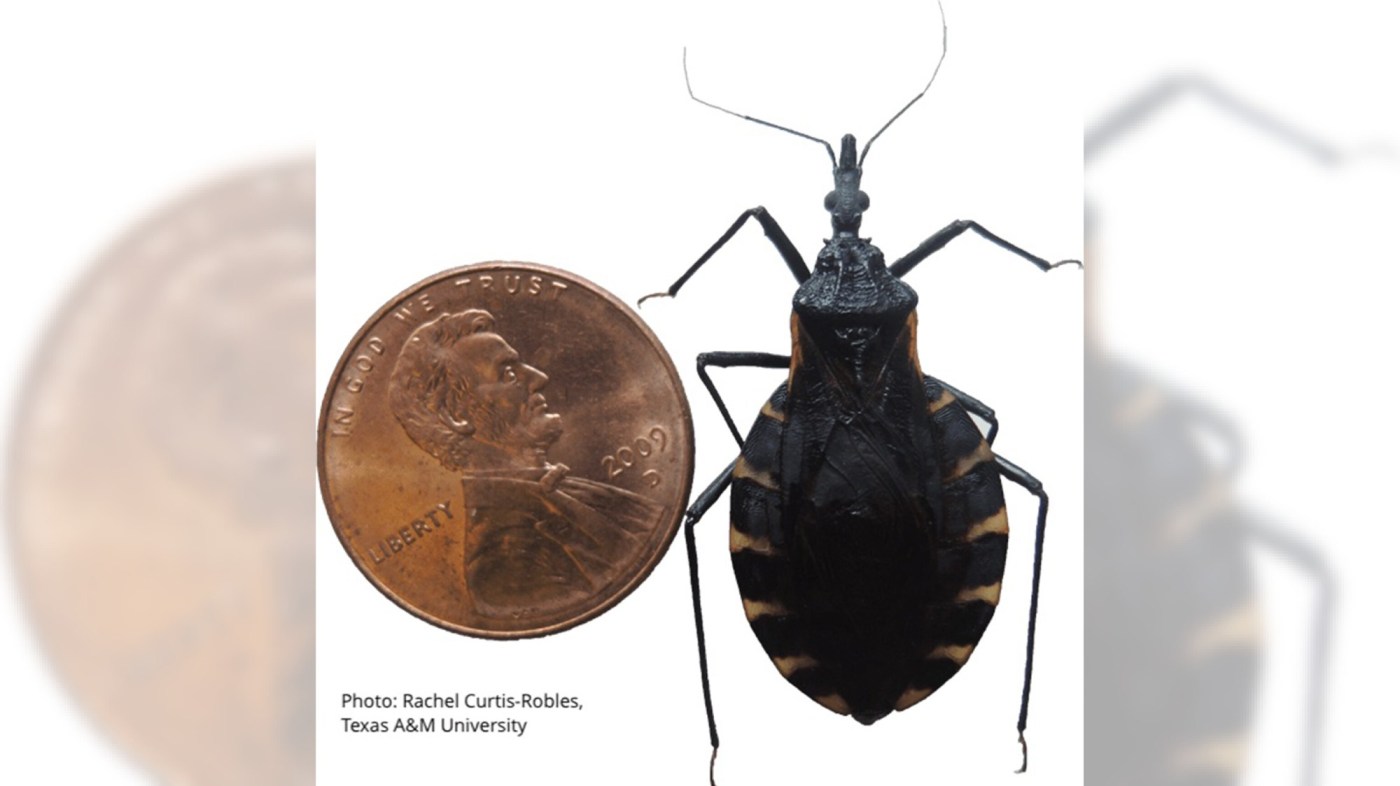
Kissing bugs have a “‘cone-shaped’ head, thin antennae, and thin legs,” according to Texas A&M University. They are black or dark brown and have red, orange or yellow stripes on the edge of their bodies.
They are just a little bigger than the size of a penny, can bite you without being detected and are most active at night, according to the university.
Symptoms
There are two phases of symptoms from Chagas disease, according to the WHO.
The acute phase is roughly two months long, and in most cases, the symptoms are mild or absent. Symptoms can include “fever, headache, enlarged lymph glands, pallor, muscle pain, difficulty in breathing, swelling and abdominal and chest pain,” according to the WHO.
In the chronic phase, the parasites hide in the heart and digestive muscles for one to three decades after infection. Up to one-third of people infected have cardiac disorders, and one in 10 have digestive, neurological or mixed alterations, the WHO said. Those infected can experience damage to the nervous system, heart muscles and digestive system.
This can lead to “cardiac arrhythmias, progressive heart failure, and sudden death,” the organization said.
Treatment
There are two medications that can treat Chagas disease and kill the parasite: benznidazole and nifurtimox. These medications are “fully effective in curing the disease if given early, in the acute phase,” the WHO said.
The medications are less effective the longer a person has been infected. Those without symptoms should still be treated to stop the disease from progressing.
To be diagnosed, a person must test positive to two tests that detect antibodies to different antigens, or a foreign substance in the body like toxins, bacteria, chemicals or viruses, of the parasite, the CDC said.
©2025 Miami Herald. Visit miamiherald.com. Distributed by Tribune Content Agency, LLC.
Related Articles
Marilyn Hagerty, Grand Forks Herald columnist whose Olive Garden review went viral, dies at 99
Suspect left note saying he planned to kill Charlie Kirk, later confessed in texts, prosecutor says
Patel faces congressional hearings after missteps in Kirk assassination probe and turmoil at FBI
Many Black, Latino people can’t get opioid addiction med. Medicaid cuts may make it harder
Suspect in Charlie Kirk killing became more political, opposed activist’s views, authorities say

More Stories
UK business confidence crashes to Covid-era lows as Iran conflict forces firms into survival mode
Britain’s finance chiefs have retreated into full defensive mode as the fallout from the war in Iran sends confidence tumbling...
OpenAI doubles down on London with first permanent office despite Stargate U-turn
The decision by OpenAI to plant its flag in King’s Cross with a permanent London headquarters, just days after walking...
Founders push for ‘repeat entrepreneur relief’ to keep exit capital flowing back into UK start-ups
Some of Britain’s most prominent entrepreneurial voices are pressing the Treasury to introduce a targeted tax incentive designed to keep...
Middle East war triggering global energy ‘shock’ – IMF
Disruptions to oil and gas supplies will leave lasting “scars” on the world economy, managing director Kristalina Georgieva has said...
What is fueling unrest across the EU?
The bloc is facing an energy crisis due to the Strait of Hormuz disruption, with soaring diesel prices triggering protests...
OECD urges reeves to overhaul ‘inefficient’ UK tax system
Rachel Reeves has been told by one of the world’s most influential economic bodies that Britain’s tax system is holding...