
Author hopes ‘deep map’ of the St. Croix River watershed will inspire others

Greg Seitz was 16 when he took his first canoe trip down the St. Croix River.
He and other members of the Bio-Earth Club at Stillwater Area High School put in at the Osceola, Wis., landing and paddled south, through the river’s backwaters, to a blue-heron rookery.
“The high water of springtime allowed us to float right through the island, drifting between tree trunks below their nests,” Seitz later wrote in a blog post about the experience. “We were speechless – intruders in a world we hadn’t known existed. We wished for long, flexible heron necks so we could stare straight up forever. Some of the birds stood still and silent on their nests, but most were in motion, hopping around on branches at the top of their silver maples, raising a general ruckus. They had more important things to think about than a bunch of kids in canoes.”
Seitz, founder of the St. Croix 360 website, has since paddled every inch of the St. Croix National Scenic Riverway — 252 miles of the Namekagon and St. Croix rivers.
But the 6.4-mile stretch of the St. Croix between the Osceola and Log House landings remains his favorite. “I call it my ‘milk run,’” he told the Pioneer Press in a 2018 interview to mark the 50th anniversary of the Wild and Scenic Rivers Act. “It’s my go-to stretch. It’s the one I’ve been doing the longest, the one I know best.”
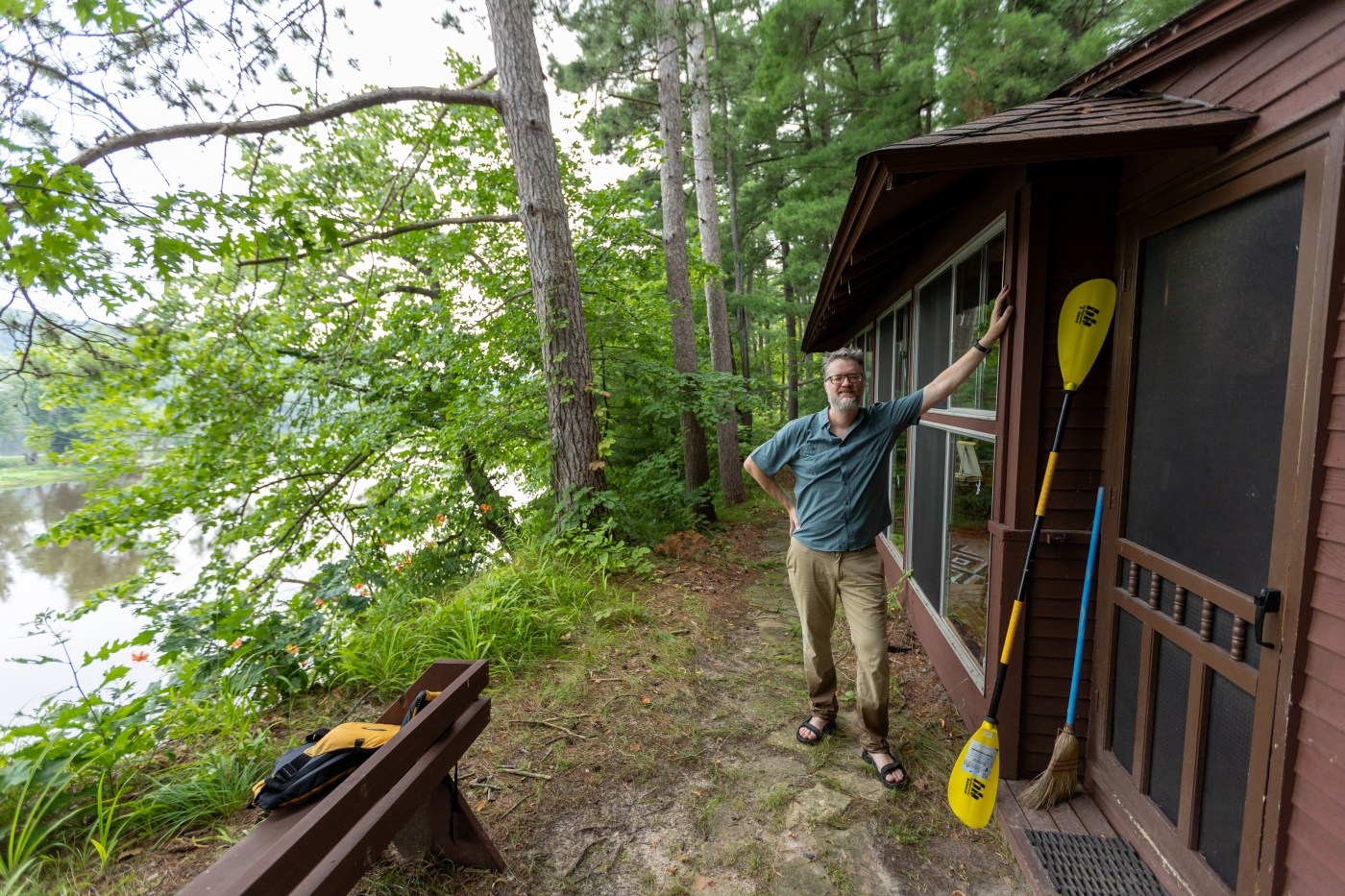
Greg Seitz is mapping the St. Croix River’s 7,700-square-mile watershed for a book. (Courtesy of Greg Seitz)
Seitz is writing his first book, “The St. Croix: A Deep Map,” which will focus on the river’s 7,700-square-mile watershed. He plans to detail the human and natural history of the region and “explore how ecological processes impact human life,” he said.
“When people have a deep attachment and strong connection to a place, they’re willing to do almost anything to protect it,” Seitz said. “It takes sacrifice sometimes, and it takes doing the hard thing, but I also think to realize the long story of this place, stretching back thousands of years, just helps put this moment in perspective.”
For more than 15 years, Seitz has focused on the St. Croix River, using writing, photography and mapping — primarily through St. Croix 360 — to share the region’s natural complexity and beauty.
“When the publisher and I were first talking, they were saying, ‘Oh, you’ve got all this great stuff from 360. Let’s just put it into a book,’” Seitz said. “And I said, ‘How about instead I write this entirely new and different thing?’
“I want to show how water connects places and people across time,” he said. “One of my goals is to describe a more complete story of the St. Croix region than the usual lumberjacks and settlers. There is way more history that doesn’t fit those narratives, as well as the natural forces that affect its identity. I believe this place is much more complicated and interesting, and I think readers will agree.”
Pine Needles artist-in-residence
Seitz is spending four weeks this year as an artist-in-residence at the historic Pine Needles cabin on the St. Croix River in Marine on St. Croix. He spent two weeks at Pine Needles in early August and will return in October for another two weeks.
The Pine Needles program is sponsored by the St. Croix Watershed Research Station, the environmental research department of the Science Museum of Minnesota. Since 2002, the program has hosted more than 75 artists and writers with the aim to broaden scientific understanding through art.
The residency program includes a weekly stipend, travel support and the residency at the cabin, which is on St. Croix Watershed Research Station property. Artists also have access to the researchers who work at the station and at the Science Museum of Minnesota, as well as the J.W.G. Dunn Research Library and the collections vault at the Science Museum.
Seitz was one of five artists selected to participate in this year’s program; there were nearly 100 applicants.
Conservationist J.W.G. Dunn built Pine Needles in 1912 as a hunting and fishing retreat. Dunn’s son, writer and historian James Taylor Dunn, later inherited the property and donated it in 1999 to the research station.
James Taylor Dunn was “just one of these wonderful characters out of the past – a kindred spirit who just loved the area and wanted to write about it and share it and found it to have all these interesting stories,” Seitz said. “The thing I love most about Dunn are the wonderful quotes and old stories he dug up from original sources. I hope to do the same with some of the lost history I’m researching.”
On a weekday morning in early August, Seitz sat at James Taylor Dunn’s desk, facing the St. Croix, and powered up his laptop computer.
Greg Seitz sits at a desk overlooking the St. Croix River while working on his book at the historic Pine Needles cabin in Marine on St. Croix on Aug. 4, 2025. Seitz hopes to complete the manuscripts in the next two years. (Bennett Moger / Pioneer Press)
“The blank page here. My greatest fear,” he said.
Spending time at the cabin alone meant Seitz, who is married and has two children, could work whenever he felt the urge, he said. His writing companions included a charm of hummingbirds “sipping nectar from the tiger lilies” growing outside the cabin, he said. “They’re so busy and industrious, and just constantly going from flower to flower. I love watching them.”
Related Articles
Belwin opens $3.6M accessible outdoor-education facility with ‘first-class experience’ — for all
Fall arts and entertainment: Get out and about with 24+ family-friendly activities and outdoor festivals
Skywatch: The great celestial herdsman begins his long goodbye
Continental duck numbers hold steady, feds say in status report
Zebra mussels found in Washington County lake
Other wildlife spotted: ospreys, red-shouldered hawks, bald eagles, deer, woodpeckers, great blue herons, egrets, swallowtail butterflies and a prothonotary warbler.
“The beavers are nocturnal,” he said. “I’m sure they’re around, but they’re just really good at not being seen.”
One of his field trips while staying at Pine Needles was to Allemansrätt Park in Lindstrom, Minn. Allemansrätt means ‘the all-man’s right’ in Swedish, which means that everyone has the right to roam.
“It’s like their legal trespass,” Seitz said. “In Sweden, you can walk anywhere as long as you’re not bothering anybody. This park was created 10 or 15 years ago, but the cool thing is that it was the historic homestead of John Smith, one of the first Swedish settlers who came to the Chisago Lakes area. It’s just an interesting place from a natural perspective. There’s a bunch of old-growth oak trees, but also with that human history and so, in a way, it kind of encapsulates a lot of what I’m trying to describe: that interaction between human and nature over time.”
A strong voice
Greg Seitz looks back while paddling away from shore in his canoe on the St. Croix River. The local writer first found his obsession for the St. Croix River after his high school science teacher, Jeff Ranta, took him and a group of his classmates canoeing, which has now inspired him to write an extensive book on the St. Croix Watershed. (Bennett Moger / Pioneer Press)
Seitz’s research involves GIS mapping, a skill he honed for his blog posts on St. Croix 360, he said.
“It’s amazing how I can use a map to identify a place and then research that place, and then I go to the places and try to experience them, so that when I write about them, I’m not just writing that research and the facts, but I’m trying to give an impression, in a sense, of what that place is like,” he said.
The last comprehensive book written about the St. Croix River was James Taylor Dunn’s “The St. Croix: Midwest Border River,” published in 1965, said Adam J. Heathcote, the director of the Department of Water and Climate Change at the St. Croix Watershed Research Station.
“A lot has happened since the days of James Taylor Dunn,” Heathcote said. “There are so many things that Greg can help highlight (with his new book). I don’t know of another person who has the depth and breadth of experience to do this. He is gifted at telling environmental stories in a compelling way that’s also very educational and gets at the heart of a lot of the serious environmental issues that water resources are dealing with.
“Our fresh waters are being assaulted from all different directions these days, and so it can kind of feel overwhelming, but Greg does a good job of breaking down individual issues, talking about how we got here, why we got here, and then, if possible, what are our solutions to it,” he said. “He is one of the strongest voices, in that respect, for the St. Croix.”
Seitz thinks the book, which will be published by University of Minnesota Press, will take another two to three years to complete. He is working to raise money to support his work through an online crowdfunding campaign at donorbox.org/st-croix-river-watershed-book.
Seitz plans to highlight indigenous stories and important places in the book, he said. “It’s been really affecting me to realize how complex that history was. For a long time, histories of this area have written about Native Americans without ever talking to Native Americans. They were always from the white perspective. But if you start asking folks from those communities for their stories and their experiences, it’s much richer.”
Related Articles
Lake Elmo, named for a ‘mad, bad and dangerous to know’ book character, marks 100 years
Rio 1854, from family behind Taco Libre, coming to former Dock spot in Stillwater
Forest Lake man sentenced for friend’s fatal overdose at White Bear Lake hotel
Mass layoffs at Bremer Bank’s Lake Elmo facility follow Old National merger
Motorcyclist killed in I-94 crash was former East Ridge hockey player
Ultimately, Seitz said he wants to “deepen people’s connections to the river.”
“If we want to be good stewards of it, I think we really need to understand it first. That’s what I’m hoping to do.”
Seitz lives in May Township with his wife, Kate, a poet, writer and partner in St. Croix 360, and two children, Annika, 13, and Arthur, 8.
“I want to repay everything the river and the surrounding region has given me by documenting it in depth and detail for contemporary readers and future generations,” he said. “I believe that we all need to stay connected to the places that shape us, because local history and ecology has an enormous influence on culture, economies and life. Knowing your place makes it possible to understand the world.”


More Stories
UK business confidence crashes to Covid-era lows as Iran conflict forces firms into survival mode
Britain’s finance chiefs have retreated into full defensive mode as the fallout from the war in Iran sends confidence tumbling...
OpenAI doubles down on London with first permanent office despite Stargate U-turn
The decision by OpenAI to plant its flag in King’s Cross with a permanent London headquarters, just days after walking...
Founders push for ‘repeat entrepreneur relief’ to keep exit capital flowing back into UK start-ups
Some of Britain’s most prominent entrepreneurial voices are pressing the Treasury to introduce a targeted tax incentive designed to keep...
Middle East war triggering global energy ‘shock’ – IMF
Disruptions to oil and gas supplies will leave lasting “scars” on the world economy, managing director Kristalina Georgieva has said...
What is fueling unrest across the EU?
The bloc is facing an energy crisis due to the Strait of Hormuz disruption, with soaring diesel prices triggering protests...
OECD urges reeves to overhaul ‘inefficient’ UK tax system
Rachel Reeves has been told by one of the world’s most influential economic bodies that Britain’s tax system is holding...