
Sentencing looms for girlfriend of Burnsville first responders shooter. Could her straw purchasing have been stopped?

The sentencing of Ashley Dyrdahl this week will mark the only time someone is held criminally responsible in the fatal Burnsville shootings carried out by her boyfriend.
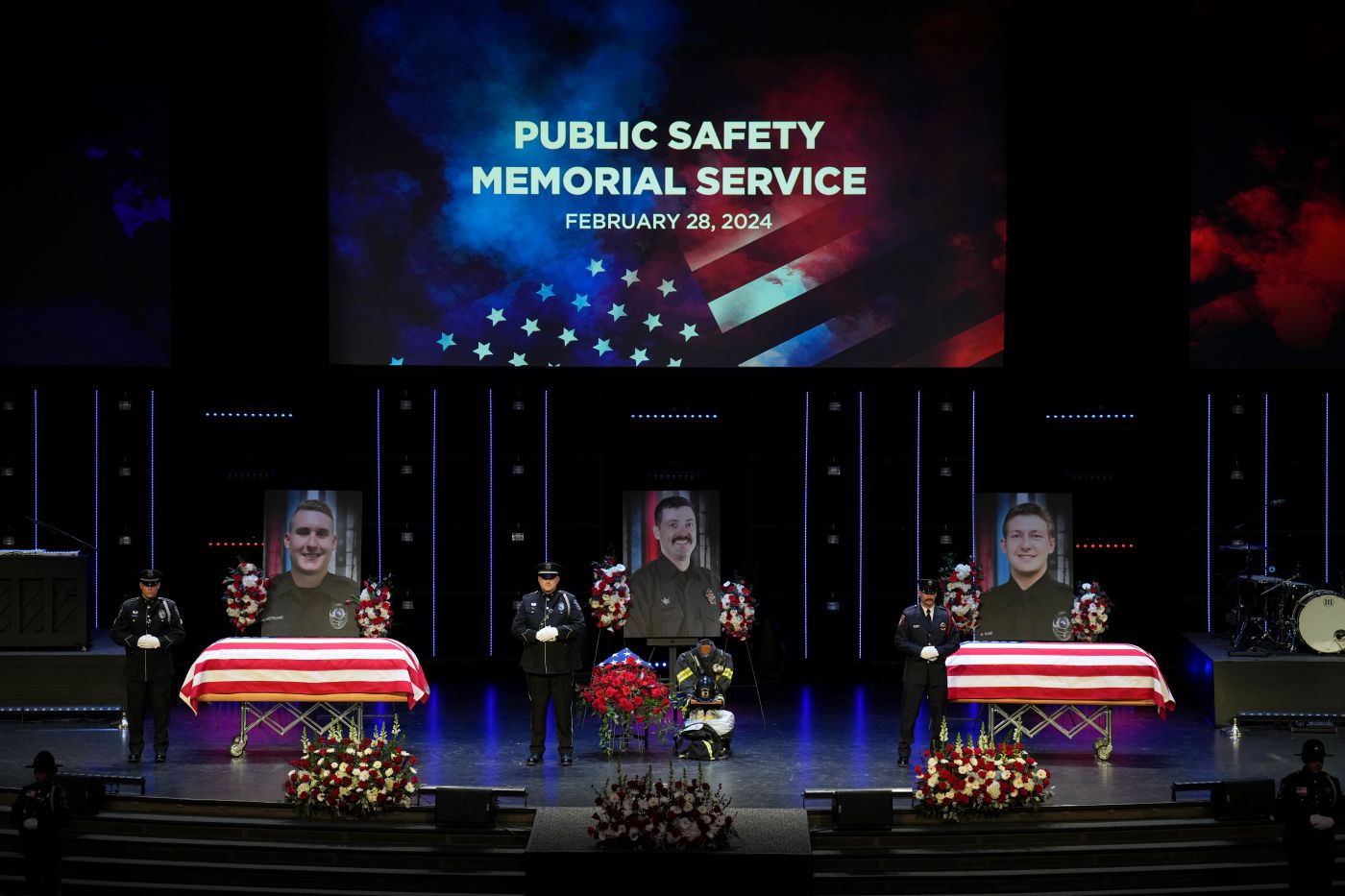
In February 2024, the suspect, Shannon Gooden, fatally ambushed a Burnsville firefighter and two police officers. Gooden then died by suicide.
Dyrdahl was legally allowed to buy firearms, but Gooden was not, so it was illegal for her to intentionally purchase firearms for him.
A grand jury indicted Dyrdahl for straw purchasing the murder weapons, but should her purchases have set off alarm bells before Gooden fired more than 100 rounds at first responders from the Burnsville residence that Dyrdahl rented?
Authorities have said the two Burnsville businesses where Dyrdahl made the purchases cooperated with the investigation. The owners said she did not raise concerns.
“It’s always easy to look back in hindsight and think of what could have happened,” said Rob Doar, Minnesota Gun Owners Caucus vice president. “I think the challenge here is that (Dyrdahl and Gooden) made very strong efforts to circumvent current laws. I don’t think there was anything in her behavior that would have been an immediate red flag.”
Based on federal and Minnesota laws, it doesn’t appear there were mechanisms in place that would have drawn law enforcement attention to her purchases.
“This case really demonstrates the ways that gaps in firearm safety laws can put law enforcement at risk,” said Spencer Myers, an attorney with the Giffords Law Center to Prevent Gun Violence.
Gun safety advocates point to laws in other states that limit the number of firearms people can purchase in one month, which would have affected Dyrdahl because she bought the two guns that Gooden used in the killings in a span of less than three weeks.
Meanwhile, supporters of gun owners’ rights say what’s needed is harsher sentences for straw purchasing to deter others. Minnesota legislators made straw purchasing a felony on the state level after the Burnsville killings, though some say the penalties need to be strengthened.
The mother of Burnsville police officer Matthew Ruge said she is going to try to stand up to give her victim impact statement during Dyrdahl’s sentencing Wednesday at the federal courthouse in St. Paul. Also killed were officer Paul Elmstrand and Burnsville firefighter/paramedic Adam Finseth.
Ashley Anne Dyrdahl covers her face as she drives away following her first court appearance at the Warren E. Burger Federal Building in St. Paul on Thursday, March 14, 2024. (John Autey / Pioneer Press).
“I will implore the judge to consider giving a sentence that will be a catalyst for change,” Ruge’s mother, Christi Henke, wrote on social media. “This is not about revenge for me. This is about justice.
“My son sacrificed his life to save this woman’s children. All her children are alive, but one of mine is dead. She needs to be held accountable and be the example to deter others in her situation to not buy weapons for felons.”
Prohibited from possessing guns, not from living with them
The debate over firearms has ramped up again since a shooter killed two Annunciation Catholic School students and injured another 21 people, mostly children, at church in South Minneapolis on Aug. 27.
Gov. Tim Walz has said he plans to call a special session to address gun policy. Walz and Democratic-Farmer-Labor lawmakers want new restrictions on firearms, but they’ll have to get Republican support to pass bills like a ban on certain semiautomatic rifles and limiting the capacity of magazines, which appears unlikely.
Minnesota House Republicans said last week that if Walz calls a special session, their priorities include expanding school safety funding to non-public schools, making school resource officers available to every school, and boosting funding for mental health treatment beds.
The federal indictment against Dyrdahl accused her of lying on the federal Bureau of Alcohol, Tobacco, Firearms and Explosives form required when purchasing a weapon; the customer has to state they are buying the weapon for themselves.
The ATF form does not ask if a buyer lives with someone prohibited from possessing firearms, and federal law does not prevent a lawful gun owner from residing with someone who cannot legally have guns.
Federal law prohibits a national registry of firearms, owners or transactions. Businesses or people that sell or deal in firearms are required to be federally licensed by the ATF — they’re known as a federal firearms licensee — and they are mandated to retain records about gun purchases and transfers.
Related Articles
Remains found in submerged car confirmed to be man missing 58 years
St. Cloud man accused of fatally poisoning his roommate at halfway house
Man, 52, charged with fatal stabbing at Maplewood apartment
Fridley boy, 15, gets 20-year prison term for fatal St. Paul shooting
Former Minneapolis coach and teacher guilty on 12 counts of criminal sexual conduct
Six states require licensed dealers to report all firearm transactions to law enforcement: California, Connecticut, Hawaii, Massachusetts, Oregon and Rhode Island, according to the Giffords Law Center.
Some states have laws on the books that say gun owners are to store guns in ways that prohibited people can’t access them. The Giffords Law Center said they’re not aware of any state laws that require a check on whether a gun owner’s address matches the address of a prohibited person.
Minnesota has a law about firearm storage intended to keep children from accessing them. The House passed a bill last year that would have required a person to store a firearm unloaded and equipped with a locking device or in a firearm storage unit, but it did not become law.
A Republican-offered amendment would have kept existing law in place, while adding a provision saying a person is also negligent if they allow a person prohibited from possessing firearms to gain access.
Prosecutors: She knew his penchant for violence
While Gooden, 38, had a lifetime ban on possessing firearms, Dyrdahl, 37, was legally free to purchase guns.
Her past convictions were not for felonies, Minnesota court records show. She pleaded guilty to disorderly conduct in 2010, driving while impaired by alcohol in 2012 and 2017, and obstructing legal process by interfering with a peace officer in 2013.
Shannon Cortez Gooden in a 2007 mug shot. (Courtesy of the Dakota County Sheriff’s Office)
Gooden’s firearm prohibition came because he pleaded guilty to felony second-degree assault in 2008, according to a previous filing from the Dakota County Attorney’s Office. The county attorney’s office opposed Gooden’s petition to the court in 2020 to restore his firearms rights and a judge did not restore them.
Neither Gooden nor Dyrdahl were on probation at the time she bought the guns, so there were no check-ins from authorities.
When Dyrdahl purchased the two murder weapons in January 2024, weeks before Gooden opened fire, she was “fully aware that Gooden was prohibited from possessing firearms,” prosecutors wrote in a recent court filing about their sentencing recommendation. “Indeed, she purchased the weapons for Gooden because he could not — the law prohibited him from doing so, for good reason.
“He was violent and dangerous. Dyrdhal knew all too well Gooden’s penchant for erratic violence. By her own admission, Dyrdahl lived in grave fear of Gooden’s volatile and violent behavior. Over the course of just five months in 2024, the defendant gave this dangerous man at least five firearms. She handed him the means to murder, literally placing these combat weapons in his hands.”
Dyrdahl’s attorneys did not respond to recent messages seeking comment.
When she pleaded guilty in January, attorney Manny Atwal said Dyrdahl wanted to convey that “she knows that she cannot say ‘sorry’ or express her remorse enough” and she hoped her acceptance of responsibility brought “even a small amount of relief.”
Some states limit gun purchases
If someone buys two or more handguns at the same time or within five consecutive business days, the ATF requires that firearms licensees report to them with a multiple sales record.
The notification might result in the ATF keeping “an eye on the person to see if they purchase any more,” Doar said. “They might contact local law enforcement to notify them.” The intent is to detect potential firearms trafficking.
Minnesota has no law restricting sales or purchases of multiple firearms. Connecticut, Maryland, New Jersey and Virginia have laws limiting how many firearms people can purchase in a month, according to the Giffords Law Center.
The indictment against Dyrdahl said she bought two firearms in October 2023 and another two in January 2024.
“A law like the ones in place in some of these other states could have prevented this series of sales from going through,” Myers said.
Sen. Ron Latz, DFL-St. Louis Park, said bulk purchase laws are “definitely worth looking at.” The chair of the judiciary and public safety committee said he’d like to review how other states have modeled their laws.
Doar, who lobbies for the Minnesota Gun Owners Caucus, said a law restricting gun purchases per month poses “practical challenges to perfectly lawful people.”
For example, if someone intends to buy their two children each a shotgun for pheasant hunting, they wouldn’t be allowed to unless they planned in advance to purchase the firearms in separate months.
California had a law that said most people could not buy more than one firearm in a 30-day period, but a federal court of appeals struck down the law in June.
Didn’t raise suspicions
A Palmetto State Armory PA-15 .223 caliber semiautomatic firearm Ashely Dyrdahl purchased for Shannon Cortez Gooden. (Courtesy of the U.S. Attorney’s Office of Minnesota)
Dyrdahl pleaded guilty to straw purchasing a Franklin Armory FAI-15 firearm lower receiver at the Modern Sportsman in Burnsville on Jan. 5, 2024, and a Palmetto State Armory PA-15 lower receiver on Jan. 25, 2024, at the Burnsville Pistol & Rifle Range.
Roger Hird, Burnsville Pistol & Rifle Range owner, said Dyrdahl didn’t raise suspicions to him. He’s about to retire and has sold his business, so he’s no longer doing firearm transfers. When he did, people would buy a firearm online, have it shipped to his business, and he would handle the ATF paperwork for them to pick it up.
“When people came in to pick up items, first off, they have to tell us what it is they’re picking up,” Hird said. “A lot of times, straw purchasers don’t really know what they’re picking up, and so we always asked what they’re picking up, where did it come from?”
Dyrdahl knew the answers to those questions.
She also inspected the lower receiver for the firearm, “which with a straw purchase I wouldn’t have expected,” Hird said.
“The only thing that was not a regular occurrence was that a female was actually buying a receiver — it’s not unheard of, but it’s not usual,” he said, adding that such firearms need to be built with the receiver as the base.
Dyrdahl also purchased the other lower receiver from an out-of-state online retailer and had it shipped to the Modern Sportsman for transfer, business owner John McConkey previously said. She passed the federal background check.
“The Modern Sportsman had no way of knowing the lower receiver would end up in a convicted felons/prohibited person’s possession,” McConkey wrote in a 2024 email. “The prohibited person was not there during the transfer process nor was his name on any of the enclosed documents.”
Sentencing Wednesday
Photos of Burnsville police officers, from left, Paul Elmstrand, Matthew Ruge and firefighter/paramedic Adam Finseth are displayed during a community vigil Feb. 20, 2024, at the Burnsville Police Department/City Hall. (Mara H. Gottfried / Pioneer Press)
The maximum federal sentence for straw purchasing is 15 years in prison for each charge, but because Dyrdahl doesn’t have a previous history of felony criminal activity, the sentencing guidelines recommend a shorter sentence.
In this case, the guidelines are for a prison term of 2½ years to three years and one month, followed by one to three years of supervised release. The U.S. Attorney’s Office is asking for a prison term of 3 years and 5 months.
It will be up to U.S. District Judge Jerry Blackwell to decide Dyrdahl’s sentence, and he’s not bound by the sentencing guidelines.
The incident began when Burnsville police were dispatched to a home in the 12600 block of 33rd Avenue South about 2 a.m. Feb. 18, 2024, on a report of possible child sexual abuse, according to a filing by the U.S. Attorney’s Office about its sentencing recommendation.
Gooden barricaded himself in a bedroom, “effectively taking the children hostage,” the filing said. “After hours of negotiation, Gooden told law enforcement he would come out peacefully; instead, he opened fire.”
Straw purchasing now a Minnesota felony
When Dyrdahl was federally charged, straw purchasing was a gross misdemeanor under Minnesota law and has since been made a felony.
If the felony law was in effect at the time of Dyrdahl’s offense and she was convicted under the aggravated portion of the state law, it says a person “may be sentenced to imprisonment for up to five years and to payment of a fine of not more than $20,000 if the transferee possesses or uses the weapon within one year … in furtherance of a felony crime of violence.”
Judges use Minnesota state sentencing guidelines that take into account a person’s criminal history and the severity of the offense. Because Dyrdahl didn’t have a felony record, the presumptive sentence likely would have been a stayed sentence of 18 months in prison, up to 364 days of confinement and probation.
Rep. Peggy Scott, R-Andover, said she carried a bill for years that would have made straw purchasing a felony under state law, but it didn’t move forward until the Burnsville shootings. It passed as part of a broader Democratic gun control package, Doar said.
The law previously said a person was guilty if they transferred a gun to a person and knew they were ineligible to have it. Lawmakers added new wording to include that the person “reasonably should know,” which Latz said was significant because it allows a jury to look at all the circumstances rather than “rare direct evidence of actual knowledge.”
But Scott said she thinks the language in the law became too watered down because it includes an “affirmative defense” if a straw purchaser bought a firearm for a family or household member “under compulsion” or threats, or if there were past acts of domestic abuse.
Scott, co-chair of the judiciary finance and civil law committee, said she “absolutely” believes there should be a mandatory three-year minimum prison sentence if a straw-purchased firearm was used to commit a rime.
“Strong, high-profile prosecutions” of straw purchases are needed to “let the people know that they will be in trouble” if they provide weapons to someone who is banned from having them, said Rep. Paul Novotny, R-Elk River, co-chair of the public safety finance and policy committee.
‘Tragic results’
Related Articles
St. Cloud man accused of fatally poisoning his roommate at halfway house
Man, 52, charged with fatal stabbing at Maplewood apartment
Fridley boy, 15, gets 20-year prison term for fatal St. Paul shooting
Former Minneapolis coach and teacher guilty on 12 counts of criminal sexual conduct
Lakeville schools targeted in online threats; juvenile arrested
Investigating straw-purchasing cases can be challenging, said Joe Thompson, acting U.S. Attorney for Minnesota. Prosecutors need evidence that the person buying the guns knew the person for whom they were buying was prohibited.
Federal charges aren’t always appropriate, so a state law allows an additional option for law enforcement and prosecutors, Thompson said.
The U.S. Attorney’s Office in Minnesota charged three straw-purchasing cases in 2024, including Dyrdahl’s, and one in 2023, according to the office.
“In the Dyrdahl case, the tragedy happened before we were able to figure out that straw purchasing had occurred,” Thompson said. “… When people straw purchase guns on behalf of felons, … that can have tragic results and Dyrdahl’s a horrible example of that.”

More Stories
Lionel Messi y el Inter Miami ganan la final de la MLS al vencer 3-1 a los Vancouver Whitecaps
FORT LAUDERDALE, Florida, EE.UU. (AP) — Lionel Messi y el Inter Miami ganan la final de la MLS al vencer...
Messi e Inter Miami ganan la final de la MLS al vencer 3-1 a los Whitecaps
Por TIM REYNOLDS FORT LAUDERDALE, Florida, EE.UU. (AP) — El legado de Lionel Messi ya estaba asegurado cuando llegó al...
Al menos 2 muertos y 7 heridos en ataque con explosivos en Michoacán, al oeste de México
Por MARÍA VERZA CIUDAD DE MÉXICO (AP) — Al menos dos personas murieron y otras 7 resultaron heridas en un...
San Diego evalúa acuerdo de $30 millones por muerte de adolescente negro en tiroteo policial
Por The Associated Press SAN DIEGO (AP) — La fiscalía de la ciudad de San Diego acordó pagar 30 millones...
MassDems call on Republican governor candidates to denounce RFK Jr. vax vote
Chair of the Massachusetts Democratic Party Steve Kerrigan is calling on the three Republican gubernatorial candidates to denounce a move...
Massachusetts schools ‘mistakenly informed’ about funding loss amid MBTA zoning fights
The Healey administration says it “mistakenly informed” schools that it would not be distributing funding for a student financial literacy...