
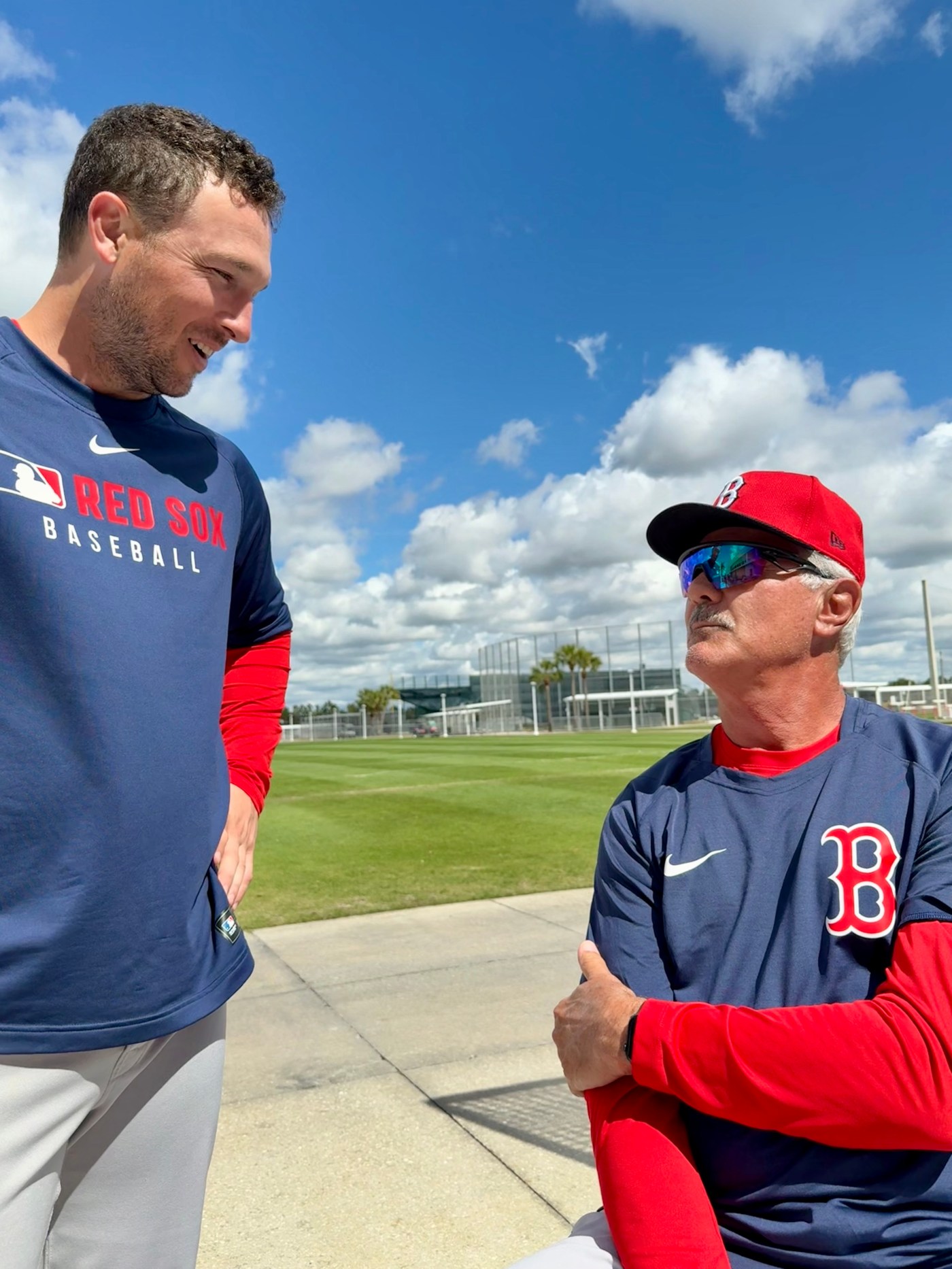
The legendary Dwight Evans at his 56th Red Sox spring training

FORT MYERS, Fla. – In the pantheon of beloved Red Sox lifers, Dwight Evans is quietly verging on Johnny Pesky territory.
Pesky spent 61 of his 73 years in baseball with the Red Sox. Somehow, this is Evans’ 56th Red Sox spring training.
So much has changed for the legendary ‘Dewey’ since that first professional preseason.
“I signed at 17,” he told the Herald, “and my first spring training was the following year – because I was drafted in June – was 1970, in Ocala, Florida.”
To put that in perspective, the special guest instructor at Evans’ first Sox spring was a legendary athlete who’d won gold at the 1936 Berlin Olympics.
“Jesse Owens was in spring training my first year, working on running and stuff like that,” Evans said. “What a treat for me, as a young kid, to be around him. And he liked the way I run.”
“I don’t know (why he was there). Maybe the Red Sox got a hold of him and wanted to make sure that we were running properly,” he said with a chuckle.
Another team had that idea first. After stealing 36 bases in 1964, the New York Mets hired Owens as a running coach for spring training ‘65. Perhaps Owens intimated the fledgling Metropolitans, who were just entering their fourth season; they only stole 28 bases and were caught 42 times in ‘65.
The Red Sox didn’t hire Owens. He was doing public relations work for the American League at the time of his visit to Ocala.
“He was a very handsome, striking gentleman, classy individual,” recalled Evans. “It was, as I look at it now, very surreal. … I didn’t realize the moment that I was in, but it was special, I remember that.”
These days, Evans is the instructor, in camp to help rising stars.
“I love doing what I do,” he said. “I’m healthy enough, I love being around younger people, and Alex (Cora) invites me. The Red Sox, it’s a neat relationship.”
Yet like Pesky, Evans finished his career on another team. His departure from Boston – they released him after the 1990 season, his 20th with the club – was a painful one, which he describes as getting “fired.”
“(We had) word-of-mouth agreement– they didn’t want to put it in the contract,” he said of the Red Sox. “But for someone who was in their organization since 17 – here I am, 20 years and three-and-a-half years in the minor leagues, and I haven’t seen my kids grow up. (The Sox) wanted me to go to Single-A and manage. I said no.”
Evans’ 20 seasons with the Red Sox included three as an All-Star, two Silver Slugger awards, and five years of finishing between third and 11th in AL MVP voting. His eight Gold Glove awards are the most by any player in franchise history; only seven major league outfielders have won more. Carl Yastrzemski is the only Red Sox player with more games, at-bats, and plate appearances. Evans is top-five in franchise history in Wins Above Replacement (position-player and offensive), runs, hits, total bases, doubles, home runs, walks, RBI, runs created, sacrifice flies, and extra-base hits, to name just a few metrics.
He’s one of five players to reach 300 home runs with the club.
But the Red Sox released him. He spent the ‘91 season with the Orioles, then retired and became a roving instructor with the White Sox. He returned to the Red Sox with a new mindset, courtesy of his White Sox boss and fellow former big-leaguer, Buddy Bell.
“It was just spectacular. It helped me also, like going to Baltimore, seeing how another organization worked. Just a different feel,” he said. “(Bell) said, ‘Dewey, you had a great career, but it’s over. And now it’s time to teach these kids all that we know so they can be better players and they can learn.’ It changed my whole perspective on how I approach the younger players.”
It’s not uncommon for retired athletes to claim that their version of the sport would be too much for the next generations of players to handle, but Evans vehemently disagrees.
“Our era was different. I loved our era because I think it was a pure game of baseball,” he said. “But I don’t like guys that I’ve played with or played against who say, ‘These guys couldn’t have played in our day.’ I don’t like hearing that. It’s negative, and they can. They could’ve certainly played, maybe even better. These guys are great athletes, and I just wish that maybe I could have played one year with the money they’re making.”
In his baseball cap and uniform, Evans still blends in with the players when he observes batting practice. The only real difference from his playing days is that his hair and iconic mustache are now a silvery grey.
He cherishes every minute with his teammates. He and Yastrzemski, who’s “like an older brother,” catch up on the phone every six weeks or so, and he loves being at camp with Jim Rice, with whom he patrolled the Fenway outfield from 1974-89.
“Jimmy and I played 16 years together,” he said. “He calls me ‘2-4’ I call him 1-4,’ for our (jersey) numbers.”
Evans is feeling these “Circle Game”-esque sentiments especially keenly being at camp without dear friend and teammate, Luis Tiant. The beloved Sox pitcher passed away last fall, barely a week after they were at Fenway Park for the final game of the season.
“The last day of the season, I went over and kissed him on the forehead. Louie would always kiss me on the cheek and I’d always kiss him back, and I’d always say, ‘I love you Louie,’ because I loved him,” Evans said.
Then, he mimicked Tiant’s voice so well that for a moment it seemed the man himself had pulled up in his golf cart to join the conversation.
“If I’m imitating him, it’s because he was so precious,” he said. “I miss Louie. So precious. There’s a word I want to use (for) what he is: he’s a true treasure. He’s a true treasure of baseball, he really is.”
Evans still can’t believe he’ll never get to spend another day at Fenway with Tiant. Instead, when he, Rice, and the rest of the ‘75 team celebrate their 50th anniversary celebration at the home opener next month, they’ll look out at the Green Monster and see a red heart with ‘Tiant’ and his number 23.
“Yaz said it best: ‘A season, it’s like a dog’s life.’ One season lasts seven years,” Evans said. “Then it’s all gone. Goes by quick.”
When the Red Sox signed Alex Bregman, Evans couldn’t wait to talk ball with him.
“He’s a neat guy. I’m already enjoying him, I think he’s gonna be such a big plus here,” he said. “I just like to know what’s going on inside of his head. And I can always learn. I think you always learn in this game.”
He then offered a comparison, and one of the highest forms of praise in the Red Sox universe.
“I see Bregman as a leader; by example, his passion for the game,” he said. “Yaz was not vocal at all, just his example. But when he spoke, we all listened.”
Evans, 73, at his 56th Sox Spring is very different, but also very much the same as the 17-year-old who came to his first camp eager to learn and achieve new heights. Not long ago, he reached a major milestone in another sport. In the 1970s, he began practicing karate as a way to prevent pulling his hamstrings and quads.
Two years ago, he became a black belt.


More Stories
Cedric Coward anota dos triples tardíos y los Grizzlies vencen 103-98 a los Nets
MEMPHIS, Tennessee, EE.UU. (AP) — Cedric Coward encestó dos triples en los últimos minutos y anotó 21 puntos para ayudar...
Hieren a policía en Carolina del Sur; agentes abaten al presunto agresor
Associated Press GREENVILLE, Carolina del Sur, EE.UU. (AP) — Un policía de Carolina del Sur fue herido de bala cuando...
Cape cops recover kilo of suspected coke, $10K in cash
A 62-year-old man was arrested for allegedly trafficking drugs between Cape Cod and Nantucket last week. Police charged Edward Gillespie,...
Starr: In failing to re-sign Bregman, Red Sox outdo themselves in worst way
Here we are again. In the ‘Groundhog Day’-esque nightmare that never ends, the ‘urgent’ and ‘engaged’ Boston Red Sox are...
Protesters, ICE agents clash in Minneapolis
MINNEAPOLIS — Federal agents carrying out immigration arrests in Minnesota’s Twin Cities region already shaken by the fatal shooting of...
Bruins goalie Joonas Korpisalo shuts the door on Penguins
The Bruins’ cornucopia of goals from Saturday turned into a barren wasteland of squandered opportunities on Sunday. But while most...