
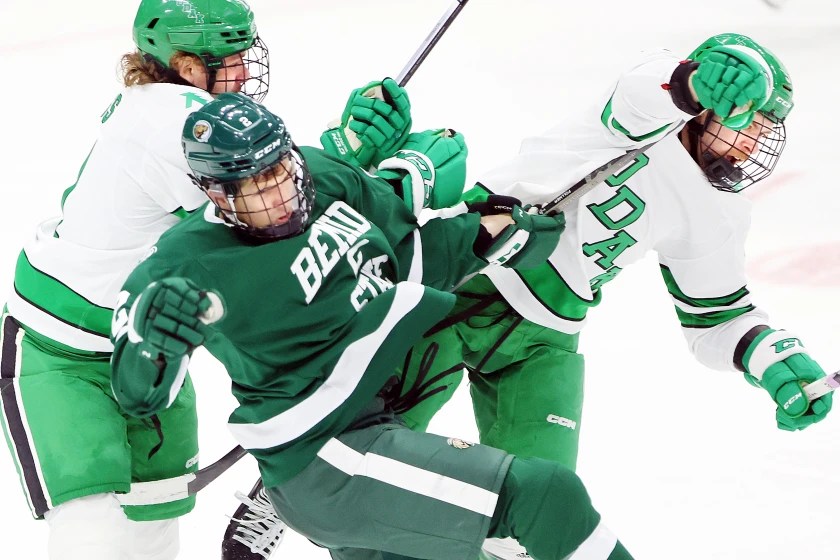
Once known for being a menace, UND is now one of the NCAA’s most disciplined teams

OXFORD, Ohio — In the early 1980s, college hockey mandated that teams put glass between the home and visiting penalty boxes.
The rule was put in place because UND forward Dean Dachyshyn got into a fight with an opponent in the box.
It was nicknamed the “Dachyshyn Partition.”
That was part of UND’s reputation.
From Dachyshyn, Howard Walker and Jim Archibald of the 1980s to Marty Schriner and Mike Commodore of the 1990s to Matt Greene, Ben Blood, Andrew MacWilliam, Tyler Kleven and more, UND has been known as a team that racks up penalty minutes as fast as wins.
But times are changing, and UND is adapting.
The No. 2-ranked Fighting Hawks have been one of college hockey’s most disciplined teams this season.
They’re averaging just 6.62 penalty minutes per game, which ranks second nationally. They’re only percentage points behind Sacred Heart (6.59).
By comparison, no UND team has averaged fewer than 10 penalty minutes per game since the 1967-68 national runner-up squad.
This team is on pace to be the least penalized UND team of all time. The record currently belongs to the 1947-48 team, UND’s second season as a program. It averaged 6.81 penalty minutes per game in its 16 contests that year.
“I’m going to tell you one thing,” UND coach Brad Berry said. “It hasn’t changed our relentless approach and fearless way of playing aggressive, attack-mentality hockey. What it does tell you is that we’re probably being disciplined in a lot of areas we preach so hard as coaches — stick on puck, finishing checks, finishing on top, keeping your hands down and knowing when guys are around walls that you can’t plow them into the wall.”
UND has used discipline to its advantage.
The Fighting Hawks have had 20 more power plays than their opponents this season. It has led to 12 more power-play goals.
Improving power plays
Twenty years ago, only eight college hockey teams in the country had power plays that converted at 20 percent or higher.
Ten years ago, 17 teams hit that mark.
Right now, 33 teams — more than half — are converting at 20 percent or higher.
The improved power-play numbers likely have a big role in teams being more disciplined across the board.
“Teams are so much more technical on the power play,” said 1987 NCAA national champ Tarek Howard. “Teams are so skilled. In our day, it was so different. It was, ‘Pound that guy and we’ll kill it off, don’t worry.’”
Last Saturday’s game between UND and Denver was a perfect example of how a penalty can change a game — and potentially a season.
UND and Denver were tied 2-2 in the third period when Pioneers defenseman Sean Behrens was called for a five-minute major for contact to the head of UND’s Ben Strinden. UND scored twice on the ensuing power play and won 4-2.
Had Denver won the game, it would be within three points of UND in the National Collegiate Hockey Conference standings. Instead, the Pioneers are nine back of the first-place Fighting Hawks.
Toughness in other ways
The lack of penalty minutes doesn’t mean UND has been easy to play against.
UND has bottled up opponents throughout the year. The Fighting Hawks lead the NCHC in fewest shots allowed per game. They rank second in the league in fewest goals allowed. They’re top-10 nationally in both categories.
They’ve been tough in other ways like blocking shots.
UND has blocked 344 opponent shots this season, most in the NCHC. That’s 31 more than Miami and 63 more than Minnesota Duluth, the next two closest teams.
UND defensemen Bennett Zmolek, Garrett Pyke, Abram Wiebe, Jake Livanavage and Logan Britt all rank among the top 11 in the NCHC in individual player blocks.
“Being tough to play against doesn’t mean being barbaric,” Howard said. “It’s filling lanes, making it difficult for people to get to the net, having forwards back in good defensive posture. If your opponent can’t get any ice in the offensive zone, that’s the definition of being hard to play against. It’s not worrying about your personal safety.
“There’s a lot of science behind everything today and it says penalties aren’t good.”
Staying disciplined
UND’s coaching staff has tried to emphasize not taking stick penalties, especially in the offensive zone.
“We’ve taken a few, but there are a lot fewer than what we’ve had in years past,” Berry said. “When you’re hooking or grabbing or putting your stick into the feet of a guy and tripping him, (penalties happen). We want to have a conscious effort of trying to have stick on puck and using our legs. We talk about that all the time — checking with our legs and not reaching for guys.”
Some individual players have impressive track records.
Zmolek, who plays a rugged, physical game, has taken just three minor penalties in 22 games. Two were after the whistle. He hasn’t been called for hooking or holding all season.
“I feel like you just have to be smart,” Zmolek said. “That’s the biggest thing. They’re looking for the hands up or wrapping guys. You can’t put your hand around them. Obviously, you want to play hard, though. Everyone on this team plays with an edge. You just have to be smart about it — keep your stick down, hands down, everything like that. When you do that, you can still play physical but also stay out of the box.”
Livanavage, a freshman defenseman, has only been called for one minor penalty in his 498 minutes, 4 seconds of ice time this season.
“You want to be competitive,” Livanavage said. “You’ve just got to do it the right way. You’ve got to be smart. The refs are looking for sticks in hands, stuff like that. It’s just keeping your stick on the ice and not cross-checking guys. It’s been going well so far. We’ll try to keep that going.”
UND fifth-year senior Hunter Johannes finished fourth in the nation last season with 87 penalty minutes in 28 games, an average of 3.1 per game, when he was playing at Lindenwood.
That’s more than three times higher than where Johannes is this season, averaging 1 per game. Johannes only took one penalty in his first 11 games as a Fighting Hawk.
“He’s probably playing with a little more control,” Berry said. “The other thing is he wants to be on the ice playing a top-six role. He wants to be on the power play. This is his last year of college hockey. I know he wants to play pro hockey. Part of that is making sure you’re on the ice the bulk of the time here in college and showcasing your talent for the next level.”
Earlier this season, UND had a game against Bemidji State where it was not penalized once.
That was the first time UND was not penalized in a game since 1997.
“It’s a product of the game evolving,” Howard said. “We used to throw the puck in and hammer someone. You get more penalties playing that style. Brad’s teams hang onto the puck more.
“There was a lot more ruckus back in the day, too. It doesn’t get as stupid as it used to. We were physical… and probably a little dumber back in those days.”
UND’s PIMs, last 10 seasons
2023-24 — 6.6 penalty minutes/game, 2nd in NCAA*
2022-23 — 11.3, 38th
2021-22 — 11.9, 40th
2020-21 — 13.2, 55th
2019-20 — 10.3, 24th
2018-19 — 13.9, 55th
2017-18 — 11.6, 31st
2016-17 — 11.8, 21st
2015-16 — 11.3, 41st
2014-15 — 13.4, 46th
*As of Feb. 1, 2024
UND’s least penalized seasons
2023-24 — 6.62 penalty minutes/game*
1947-48 — 6.81
1954-55 — 6.93
1948-49 — 7
1953-54 — 7.15
1952-53 — 7.3
1950-51 — 8.5
*As of Feb. 1, 2024
Related Articles
Big Ten won’t expand conference basketball schedules and plans 15-team tournament for next year
Gophers women’s basketball star Mara Braun out indefinitely with foot injury that will require surgery
Men’s basketball: North Dakota pays back St. Thomas with win on Tommies’ home court
Big second-half comeback gives Gophers 83-74 win over Penn State
Gophers women’s hockey edges Mankato in overtime

More Stories
Employment tribunal backlog hits record 70,000 single claims
The number of single claims waiting to be dealt with by the Employment Tribunal reached a record 70,000 at the...
Apple unveils iPhone Duo, its first foldable iPhone, from £1,999
Apple yesterday unveiled the iPhone Duo, its first foldable iPhone, priced from £1,999 to £3,199 depending on storage, with pre-orders...
Most organisations face data trust barrier to AI, Denodo study finds
More than half of organisations, 56 per cent, say finding trustworthy and relevant data is a significant barrier to deploying...
Deepmirror wins Sovereign AI grant for £1m molecule data project
AI startup deepmirror has been awarded a Phase 2 Sovereign AI grant by Innovate UK to fund a project worth...
England’s mayors to get tourist tax powers putting hundreds of jobs at risk
Ministers are today setting out plans to give mayors and other local leaders in England the power to impose a...
Why More B2B Companies Are Replacing Lead Gen With Account-Based Marketing
Traditional B2B lead generation rewards volume. Marketing attracts contacts, qualifies some of them, and passes the strongest prospects to sales....