
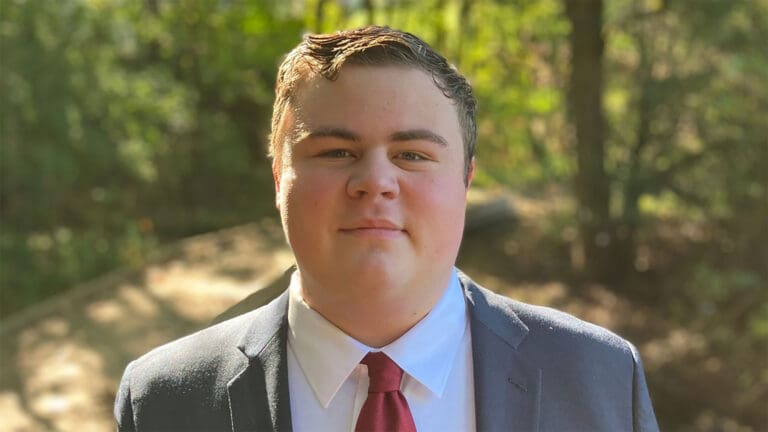
Magnus Trimbach on Learning Supply Chain Management From the Ground Up

For Magnus Trimbach, understanding these connections has become an important part of his career in supply chain operations.
Based in Mooresville, North Carolina, Trimbach works as an Operator 1 at Masco Product Support/Delta Faucet Company. His career has taken him through several warehouse and supply chain positions, giving him experience with the everyday processes that support larger business operations.
At the same time, he’s pursuing a bachelor’s degree in Supply Chain and Logistics Management at Oregon State University. His background also includes music, accounting, and years of involvement in Boy Scouts, making his path into logistics somewhat unconventional.
How Magnus Trimbach Started His Career in Warehouse Operations
Magnus Trimbach grew up in Mooresville, where he attended Mooresville High School. Outside the classroom, he participated in marching band and Boy Scouts, eventually earning the rank of Eagle Scout and becoming a member of the Order of the Arrow.
These activities introduced him to environments where preparation, coordination, and individual responsibility were important. Those same qualities would later become relevant in his professional life.
His career at Masco Product Support began with a warehouse internship. He started by learning how products were received, handled, stored, and shipped.
“Working in a warehouse gives you a different understanding of a business because you see what actually happens to the products,” Trimbach explains. “You start recognizing how one process affects another.”
Following his internship, he moved into a Warehouse Associate position before becoming a Supply Chain Intern. Each role expanded his understanding of logistics and the challenges involved in managing physical inventory.
What Does an Operator 1 Do at Delta Faucet?
Today, Trimbach’s responsibilities involve several stages of warehouse operations. As an Operator 1, he processes returns for Delta Faucet Company, performs initial quality checks, helps replenish stock, and reconciles inventory through cycle counting.
He also assists with fulfillment activities, including picking, packing, and shipping orders.
Although these responsibilities may appear straightforward, they require attention to accuracy and an understanding of how warehouse systems interact.
Inventory reconciliation, for example, involves comparing physical stock with recorded quantities. A difference between the two can create problems for order fulfillment, purchasing decisions, and inventory planning.
“An inventory number isn’t just something in a system,” Trimbach says. “It represents a product that someone needs to locate, move, or ship. When those numbers aren’t accurate, the work becomes more complicated.”
His earlier warehouse experience also included helping support the development of the Delta Re-Certified program, participating in a complete facility transfer project, and contributing to discussions about improving storage procedures.
These experiences introduced him to the practical side of operational change, where even a promising improvement must work within the limits of an active warehouse.
Why Is Hands-On Experience Important in Supply Chain Management?
Supply chain management is often discussed in terms of forecasting, global shipping, purchasing, and technology. Yet many of the challenges businesses face begin with everyday decisions about inventory and product movement.
For Trimbach, working in different warehouse roles has provided context for the business concepts he’s now studying.
A process that looks efficient on paper may require adjustments when employees begin using it. Similarly, an inventory management decision can have consequences that aren’t immediately obvious until products need to be located or orders fulfilled.
“I think there’s value in understanding a process before trying to improve it,” he says. “You need to know what people are doing, why they’re doing it, and where the difficulties actually occur.”
This perspective has shaped his interest in business analytics and operational strategy. Rather than viewing data as separate from warehouse work, he’s interested in how information can help businesses identify problems and make practical improvements.
From Music Education to Business and Logistics
Trimbach’s academic background is not limited to business.
After graduating cum laude from Mooresville High School in 2022, he attended Mitchell Community College. In 2024, he graduated with honors, earning an Associate in Fine Arts in Music alongside a Certificate in Accounting Foundations.
His musical education followed years of participation in high school marching band, where group coordination and individual preparation were essential.
Although music and logistics are different fields, both involve working within structured systems where individual contributions affect the final result.
Trimbach is now pursuing a Bachelor of Science in Supply Chain and Logistics Management at Oregon State University, with an expected graduation date of June 2027.
His studies allow him to explore broader supply chain concepts while continuing to gain practical experience in warehouse operations.
Building a Career Around Better Business Operations
At this stage of his career, Trimbach is focused on expanding his knowledge of logistics, business analytics, and operational strategy.
His progression from warehouse intern to Operator 1 reflects a career built around direct involvement in the systems that support product movement and inventory accuracy.
For him, understanding supply chains means looking beyond individual tasks and considering how each decision fits into a larger operation.
As he continues his education and professional development, that combination of practical experience and academic study remains central to his approach to the industry.

More Stories
Bryce Neighbors and the Business Behind an Independent Auto Shop
Walk into most towns in Southern California and you will find a dealership service department within a few miles of...
Bryce Neighbors and the Business Behind an Independent Auto Shop
Walk into most towns in Southern California and you will find a dealership service department within a few miles of...
Magnus Trimbach on Learning Supply Chain Management From the Ground Up
For Magnus Trimbach, understanding these connections has become an important part of his career in supply chain operations. Based in...
When Should You Replace Spreadsheets with Custom Software?
At some point, you start to wonder whether a proper system would save you money or just cost you more....
When Should You Replace Spreadsheets with Custom Software?
At some point, you start to wonder whether a proper system would save you money or just cost you more....
How Small UK Brands Are Making Video Ads Without a Studio
For a small UK brand, that creates a problem. A single professionally shot product video can cost hundreds or thousands...