
Bryce Neighbors and the Business Behind an Independent Auto Shop

Walk into most towns in Southern California and you will find a dealership service department within a few miles of an independent auto shop like Young’s Automotive Service Center in Covina.
Both fix cars. Only one is run by someone who spent years on a dealership floor before deciding that was not where he wanted to build a career.
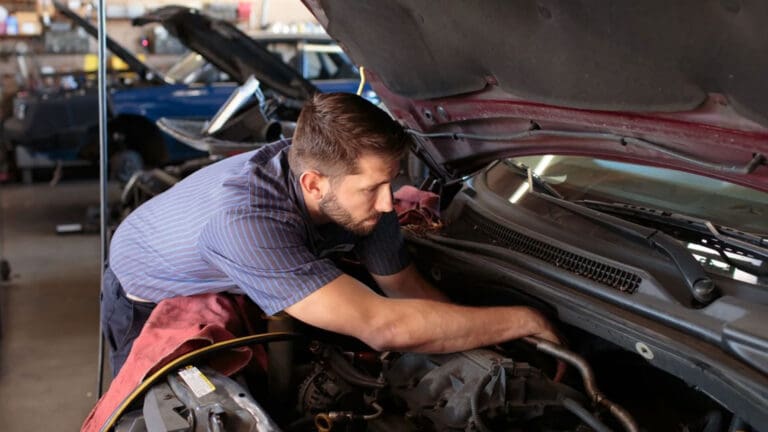
Bryce Neighbors owns Young’s Automotive Service Center. His path to ownership ran through a Chrysler dealership service department and a Lexus dealership before he settled on independent repair, a choice that still shapes how he runs his shop today.
What an ASE Master Technician Credential Means
Before he owned a shop, Neighbors spent more than ten years at Benders Automotive in Covina, where he earned master technician status through the National Institute for Automotive Service Excellence, known in the trade as A.S.E. The certification covers multiple systems on a vehicle, not just one specialty like brakes or electrical work. A technician has to pass tests across those systems and keep the credential current.
For a shop owner, that background matters for a practical reason. A customer dropping off a car with an electrical problem and a transmission problem does not want to be sent to two different specialists. Someone who trained across systems can diagnose both under one roof.
Why Dealership Work Did Not Fit
Neighbors worked service departments at a Chrysler dealership and later a Lexus dealership after completing Toyota training at Citrus College. Dealerships have their advantages: steady volume, manufacturer backing, newer equipment. What they do not always offer is a direct relationship between the technician and the customer. Work gets assigned, cars move through bays, and the person who diagnoses the problem is often not the person who explains it.
That gap is part of why Neighbors moved to Benders Automotive, a small independent shop, instead of staying in dealership service. Independent shops tend to be smaller, which means fewer layers between the technician and the person paying the bill.
Teaching Before Owning
After finishing his associate’s degree in automotive technology at Citrus Community College, Neighbors started teaching part time in the college’s automotive technology department. A full-time position opened up, and he taught automotive technology for six years before buying his own shop.
Teaching a classroom of students how an ignition system works is a different skill than fixing one. It means breaking a process into steps and checking whether the explanation actually landed, not just whether the car started. That habit carried over into shop ownership, where a customer standing at the counter needs the same kind of plain explanation a student needed in a classroom.
Buying Young’s Automotive Service Center
Neighbors purchased Young’s Automotive Service Center in 2020, financing part of the purchase by drawing on his own retirement savings. He has owned and operated the shop for more than two years.
Running a shop is a different job than fixing cars in one, even for someone with master technician status. Scheduling, staffing, ordering parts, and managing a customer base all sit on top of the technical work. Neighbors uses service writing software from Mitchell 1 and Snap-on to keep repair records and customer communication organized, on top of computer diagnostic tools built to read a wide range of makes and models.
Staying Current and Staying Connected to Other Small Businesses
Vehicles change faster than most other equipment a small business depends on. Neighbors sets aside time to study current service information and take classes offered by schools and independent auto companies, a habit he keeps up even after years in the trade.
He is also a member of the National Federation of Independent Business, an organization built around the interests of small business owners rather than large dealership groups or manufacturers. For someone who chose an independent shop over a dealership career twice, that membership lines up with how he has run his business from the start: small, local, and built around a direct relationship with the people whose cars he fixes.
More Stories
Bryce Neighbors and the Business Behind an Independent Auto Shop
Walk into most towns in Southern California and you will find a dealership service department within a few miles of...
Magnus Trimbach on Learning Supply Chain Management From the Ground Up
For Magnus Trimbach, understanding these connections has become an important part of his career in supply chain operations. Based in...
Magnus Trimbach on Learning Supply Chain Management From the Ground Up
For Magnus Trimbach, understanding these connections has become an important part of his career in supply chain operations. Based in...
When Should You Replace Spreadsheets with Custom Software?
At some point, you start to wonder whether a proper system would save you money or just cost you more....
When Should You Replace Spreadsheets with Custom Software?
At some point, you start to wonder whether a proper system would save you money or just cost you more....
How Small UK Brands Are Making Video Ads Without a Studio
For a small UK brand, that creates a problem. A single professionally shot product video can cost hundreds or thousands...