
The Midterm Fraud Machine: How Corruption, Confusion, and Judicial Abdication Are Stealing America’s 2026 Elections

By Stephen Zogopoulos, USNN World News
On November 3, 2026, Americans went to the polls in a midterm election that should have been a straightforward exercise of self-government. Instead, it became a case study in institutional failure, calculated confusion, and the quiet erosion of electoral integrity. What we witnessed was not isolated “irregularities.” It was a pattern: same-name decoys designed to siphon votes, last-minute polling place shifts that turned away legitimate voters, noncitizens appearing on the rolls and in some cases casting ballots, systemic weaknesses in mail-in voting, ballot machine and scanner failures in key jurisdictions, and a Supreme Court that repeatedly declined to enforce clear protections for American citizens. Leave no stone unturned, and the stones all point in the same direction.
Alaska’s “Decoy Dan”: Ballot Confusion as Strategy
In Alaska’s pivotal Senate race between Republican incumbent Dan S. Sullivan and Democrat Mary Peltola, a third candidate appeared on the ballot: Daniel J. Sullivan Jr., a retired schoolteacher with no serious campaign infrastructure. The New York Times reported that individuals linked to Peltola’s campaign and Democratic operatives had worked to recruit people named Dan Sullivan precisely to create voter confusion and siphon support from the incumbent.
Senator Sullivan called it “the biggest election cheating scandal in the history of the state of Alaska—maybe one of the biggest in the U.S. Senate’s history.” Governor Mike Dunleavy ordered a state investigation. The Justice Department expanded a criminal probe, issued target letters, and sought isolation of certain ballots. President Trump demanded prosecution and removal from the ballot. Peltola denied knowledge of any plot. The “decoy” remained on the ballot.
This was not organic. Ranked-choice voting does not magically erase the harm of deliberate name confusion. When campaign-linked actors hunt for same-name candidates to dilute an opponent’s vote, the ballot itself becomes a weapon. Alaskans were asked to navigate a system that some of their political opponents had actively tried to game. That alone should disqualify any claim that the process was clean.
Florida’s Polling Place Shuffle and the Patrick Bet-David Report
In Florida, heavy rain and flooding forced the relocation of polling sites in multiple counties under an emergency order from Governor Ron DeSantis. Legitimate operational necessity can require temporary moves. What followed, however, raised legitimate questions about notice, execution, and disparate impact.
Patrick Bet-David publicly reported being turned away from a location where he had previously voted in Broward County and directed to another site. County officials later stated the Civic Center was not his assigned Election Day precinct (early voting rules differ). The episode still illustrated a broader problem: when voters arrive at familiar locations only to be sent elsewhere—sometimes across traffic or flooded roads—turnout suffers, particularly among those with less flexibility. Reports of system issues, precinct splits from redistricting, and last-minute changes compounded the friction.
In a competitive environment, even small, localized disruptions can matter. When Republicans and conservatives describe being bounced between stations while the administrative apparatus insists everything is fine, trust collapses. Election officials have a duty not only to move sites for safety but to ensure every eligible voter can actually cast a ballot without heroic effort. On November 3, that duty was tested and, in too many places, found wanting.
Mail-In Voting: The Persistent Vulnerability
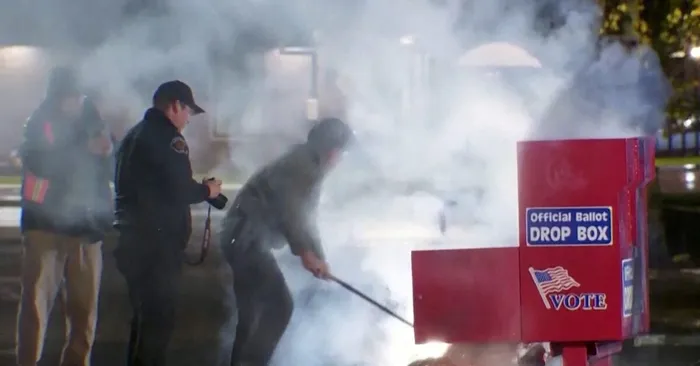
Mail-in and absentee ballots remain one of the weakest links in the system. Chain-of-custody problems, signature verification failures, and opportunities for third-party interference are not theoretical. In 2026, federal prosecutors continued charging cases involving noncitizens who cast mail ballots after falsely claiming citizenship. One California case involved a lawful permanent resident who allegedly voted by mail in multiple cycles, including 2026, while later denying under penalty of perjury that he had ever registered or voted.
A former Utah postal worker was indicted for allegedly discarding approximately 300 mail-in ballots destined for voters in a primary election, throwing them into a dumpster. In New Mexico, a man was charged with attempting to cast his deceased wife’s absentee ballot. In Michigan, signature discrepancies on absentee envelopes submitted by a parent for adult children led to criminal charges for ballot tampering. In Connecticut, a former state senator faced charges related to the illegal possession and handling of absentee ballots during a primary.
These are not exhaustive, nor do they prove coordinated national fraud on a scale that flipped entire states. They do demonstrate that mail ballots create openings for fraud, error, and abuse that in-person voting with proper identification largely closes. Weak verification, delayed counting, and the physical vulnerability of ballots traveling through the postal system and drop boxes invite exactly the kind of problems that erode public confidence. Treating mail-in expansion as risk-free was always a political choice, not a security one.
Ballot Machines and Scanner Failures Across Multiple States
On Election Day itself, voting equipment failures compounded the damage. In Westchester County, New York—home to a competitive House race—ballot scanners at hundreds of polling locations rejected paper ballots due to a programming glitch after a last-minute software update. Officials estimated the problem affected as many as 250,000 ballots. Voters were directed to emergency paper ballots placed in sealed bags for later counting, delaying results in a key battleground.
Similar problems surfaced elsewhere. Georgia required rescans of more than 1,000 early votes after scanner malfunctions. Pennsylvania counties extended voting hours due to machine setup issues. Broward County, Florida, experienced a systemwide glitch that delayed the opening of polls. North Carolina considered extending hours in multiple counties after technical problems. Arizona saw temporary closures from power outages. Kansas ran short of ballots because of an ordering error. Touchscreen machines in several states generated reports of “flipping” or registering the wrong selection—often attributed by officials to calibration or user error, yet still feeding legitimate distrust when voters cannot be certain their intent was recorded.
Machines fail. Paper trails and audits exist for a reason. But when failures cluster in high-stakes jurisdictions, when software updates are applied after testing, and when emergency procedures become the primary path for large numbers of ballots, the process looks less like a secure civic ritual and more like an improvisation. Americans deserve systems they can trust that work reliably on the day that matters most.
Noncitizen Voting: The Open Secret
It remains illegal for noncitizens to vote in federal elections. Yet the Trump administration’s Department of Homeland Security and ICE conducted a nationwide crackdown, arresting dozens of individuals—some with criminal histories—for allegedly registering or voting unlawfully. DHS and ICE statements detailed cases of aliens who admitted voting in recent elections, including 2024 and 2026 cycles. The Justice Department charged scores of people across multiple states under the “voting by aliens” statute and issued sweeping subpoenas for voter records. Many of these cases involved mail ballots.
Critics insist noncitizen voting is vanishingly rare. That claim cannot survive the volume of recent federal actions, the documented presence of noncitizens on rolls in several states, and the reality that weak verification systems invite abuse. Every illegal ballot cancels a legal one. When federal agencies report arrests of people who voted while unlawfully present or while green-card holders who knew they were ineligible, the proper response is rigorous enforcement and clean rolls—not reflexive denial. American elections are for American citizens. Anything less is an invitation to dilute the franchise.
The Supreme Court’s Pattern of Delay and Avoidance
The Court had opportunities to reinforce basic integrity rules before and during this cycle. In multiple election-related matters—challenges involving noncitizen voter lists, mail-ballot deadlines, and related emergency applications—the justices either declined to act, acted with minimal explanation, or allowed lower-court stays that preserved the status quo of weaker safeguards. One high-profile attempt to pause counting of ballots linked to suspected noncitizens in California was rejected in a terse order on the eve of the election.
Courts are not legislatures, and emergency dockets are not ideal venues for sweeping policy. But when clear statutory and constitutional interests in citizen-only voting and fair ballots are at stake, prolonged delay or quiet refusal to intervene functions as a decision. It signals that the system will tolerate ambiguity and risk rather than demand clarity before the votes are cast and counted. That posture does not protect the nation; it leaves the most important civic process vulnerable to the very tactics on display in Alaska, Florida, New York, and beyond.
The Larger Picture
These are not disconnected anecdotes. Same-name recruitment is a form of ballot manipulation. Last-minute polling changes without airtight notice and logistics suppress votes. Mail-in systems create openings for fraud and error that in-person voting largely avoids. Machine and scanner failures in multiple states turn Election Day into an exercise in damage control. Noncitizen participation, even if limited in absolute numbers, is illegal and corrosive. A judiciary that repeatedly defers decisive action on integrity questions effectively ratifies the status quo of vulnerability.
The 2026 midterms will be certified, results will be announced, and the political class will move on. The American people should not. Election integrity is not a partisan slogan. It is the prerequisite for legitimate self-government. When campaigns treat the ballot as a field for deception, when administrative friction falls unevenly, when mail ballots and machines fail under pressure, when noncitizens appear in the process, and when the highest court declines to draw bright lines, the result is not democracy—it is managed decline.
USNN World News will continue to document these failures without apology. The stones have been turned. What lies underneath is unacceptable. The remedy begins with enforcing the law as written, cleaning the rolls, requiring real-time transparency, paper ballots with robust audits, strict chain-of-custody for mail voting, and demanding that every official—from local clerks to the Supreme Court—treat the franchise of American citizens as non-negotiable.
Disclaimer: This is an opinion article reflecting the views of the author, Stephen Zogopoulos, President & CEO of USNN World News Corporation. It is based on publicly reported events, investigations, official statements, and contemporaneous accounts surrounding the November 3, 2026 midterm elections. It does not constitute legal advice or an official finding of guilt. Readers are encouraged to review primary sources and form their own conclusions.


More Stories
US Economy in Late 2026: Steady Growth, Sticky Inflation, and a Return to Tariff-Based Trade Policy
By Stephen Zogopoulos, USNN World News As of early November 2026, the U.S. economy continues to expand at a moderate...
Major Automakers Side With Trump in Legal Battle Over Eased Fuel Economy Standards
By Kimberly Hayek A major auto industry group has thrown its support behind the Trump administration in a lawsuit brought...
Oil Prices Rise After Reports of Explosions on Iran’s Qeshm Island
By Evgenia Filimianova Oil prices climbed by more than 1.5 percent early on Nov. 3 after reports of explosions on...
Spanish Police Launch Investigation Into Death of Soccer Player After On-field Incident
By Elma Aksalic Spanish authorities have launched an investigation following the death of professional soccer player Jesús de Miguel, who...
Trump Designates Anti-Communism Week in Election Day Proclamation
By Travis Gillmore WASHINGTON—President Donald Trump declared Nov. 1 through Nov. 7 as Anti-Communism Week with a presidential action signed...
Trump Declares Outer Space Open for All Humans to Explore
By Jill McLaughlin President Donald Trump signed a proclamation Nov. 3 declaring the solar system and outer space to be...