
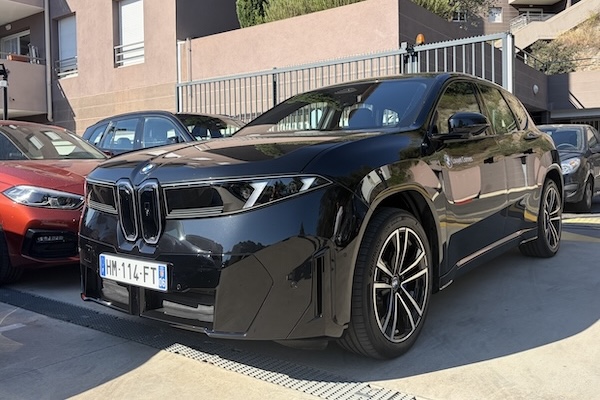
Test Drive: The BMW iX3

Unveiled in March, the BMW iX3 marks a new era for the carmaker. It is the first model to utilise the “Neue Klasse” EV architecture, separating itself entirely from older combustion-derived platforms. This was also the name for the range of sporty saloons that saved the then-languishing company in the 1960s. It marks a clear rupture with the brand’s previous cars, notably as far as the exterior design is concerned. It has already been met with tremendous success, especially in Scandinavia: it finished #3 in Norway in August, #5 in Finland in July and #8 in Sweden in July. As we at BSCB are always interested in knowing the reasons behind a car’s success (or failure), this was a great excuse for a quick test drive to see what the fuss is all about.
First, from the exterior. In my view this is one of the sexiest cars on sale at the moment. I’m mainly talking about the front of the car, with its sharp and thin headlights linked to a much reduced kidney grill – a welcome change, breaking from their recent escalating in size. Even though it’s a “3” in a range that goes up to X7, the iX3 seems very imposing to me, I was quite surprised by its rather intimidating stance when seen “in the flesh”. At 4,730 mm long, it is not particularly big, but it seems so. Perhaps it’s its 1,910 mm width that does the trick. In opposition to the front, the rear of the car is not particularly tasty to me, belying its puffed up appearance. And the car is heavy: it stands at 2,360 kg.
Let’s step inside. First the overall ambience. One of the iX3 I got to see at the dealership had a white colour scheme which looks veeeery classy. The steering wheel looks high tech and rather small, immediately easy to handle. There’s a quirk in its design: the side spokes are cut and don’t connect with the centre of the wheel (see picture above). It gives off a trendy vibe. Commands on the wheel are quite numerous and need a bit of getting used to. There is no screen behind the wheel, with all the important information being displayed at the bottom of the windshield (“Panoramic Display”) and more detailed stuff located on the weirdly, unbalanced shaped centre screen. To be honest I’m not a fan of the iX3’s dashboard design, it doesn’t look as streamlined as recent efforts by competitor Mercedes for example.
There’s quite a few high tech elements in the iX3. For example, there’s no start or stop command. Starting the car is done by pressing on the brake pedal, and to stop it you just turn the electronic parking brake on. The gearbox is a simple toggle located just beside the parking brake command. Electric seat adjustments are placed on the inner door like a Mercedes. Opening the door from the inside is done by a simple press of a button, there’s no handle. Similarly, to open the door from the outside, you just press a button to release the handle from its hidden position, in line with recent trends launched by Tesla. The boot is logically quite generous for the size of the car (520 litres) which positions itself as a family car.
How is it like to drive? Firstly, let’s take a moment to praise the BMW team’s behaviour at the Mougins dealership near Cannes. A truly premium experience, for someone like me used to test drive more mass market cars such as the Renault Twingo and Clio, or the Fiat Grande Panda and BYD Dolphin Surf. Every customer is sit on a sofa with an extra large screen in front of them replicating the salesperson’s computer screen. The test drive of the iX3 was led by a specific team member who accompanied me in the car through the drive to explain all there is to know. The salesperson is different. And the most impressive little element of ownership of the iX3 to me is the fact you can store your key on your smartphone’s wallet so you never use the actual key. To lend the car to a friend you just send them the “key” via sms. Seems very futuristic to good old me.
Once the car is “started”, I felt a little hesitant to drive as the size of the car is larger than what I’m used to. But it comes easily. One of the first elements of the car BMW wanted me to experience is the One pedal system which makes the brake pedal useless by braking as soon as you release the accelerator. I had already tested it during my test drive of the Renault 4 last year, but couldn’t quite master it. Now however this is different, and in a few minutes you can tame the feature by releasing the accelerator very progressively to produce a gradual braking and never use the brake pedal anymore. Being an EV, the iX3 pins you to the back of your seat when you are generous with the accelerator despite its heavy weight (0 to 100 km/h in 4.9 sec!).
Overall, commands are intuitive, and as expected the GPS plans your entire itinerary including recharge stops. As an example BMW showed me a mock itinerary to Lisbon in Portugal and all three stops were detailed, with the total time on the road calculated including the recharges’ duration. As you drive, you end up only needing to check the indications placed at the bottom of the steering wheel, with the high end centre screen taking a step back. The ride is comfortable (it should be for the price) but not overly cushy. As is often the case with German cars, the suspension is a little stiff on bumpy roads and over ruts which can be annoying. The steering has a very natural weight, and gives a good sense of the car’s grip. Nothing too seriously wrong to report here.
Specs? The version I drove was the 50 xDrive M Sport, at 469 ch and with a very large 108.7 kWh battery. This allows for class-leading autonomy: at 789 km average WLTP (more towards 600 km in real life which is still very impressive). Note that leveraging the built-in “Max Range” mode which caps top speeds at 100 km/h, allowed testers at Top Gear to achieve a staggering 965 km on a single charge. To give you an idea of the success of the iX3, commanding one 50 version now put the delivery date at June 2027! However there was one car ready to be sold on the day, and this is the one I drove.
Now onto the wallet, not your phone’s wallet, your actual wallet. The iX3 is not cheap. It comes at 71,950€ standard, but is loaded with options (total 11,550€). These include the M Sport finish including blue brake calipers for 4,000€ (, outside lighting (of the grille – 1,150€), parking assistant (850€) and innovation pack (3 zone air con, Head up Display on top of the Panoramic Vision and Hi-Fi Harman Kardon – 2,000€. Total drive-away price is 85,941€, of which BMW deducted 10% to 76,900€. Note a lease option was never suggested by the salesperson.
Is it worth the price? Maybe, without that many options. Is it love at first sight? Yes for me. Would I drive it? Definitely, just replace the dashboard with a Mercedes one please.

More Stories
Selling a Car Privately vs to a Cash Buyer: What You Actually Net
The decision of how to sell a used car usually gets framed around asking price. The private sale listing shows...
2026 Audi Q8 Invoice Price, Dealer Cost, and How to Get the Best Deal Near You
The 2026 Audi Q8 is delivering some of the strongest documented discounts of any full-size luxury SUV in this guide...
Acura MDX Type S Is Going Away After 2026 as the Lineup Changes Course
Acura is preparing to say goodbye to one of the more interesting performance SUVs in its lineup. Production of the...
Wheel Straps vs. Axle Straps: What is the Safest Way to Secure a Vehicle?
Hauling a car sounds simple until the moment you actually try to do it. You back the truck up, line...
How the World’s Most Powerful Car Brands Drew Inspiration From the Speed and Spirit of Thoroughbred Racehorses
Horses are a clear inspiration for car brands, and they aren’t even hiding it. After all, some of the biggest...
Leno’s Law Is Now Official and Here’s What California Classic Car Owners Need to Know
California classic car owners just scored a long-awaited change to the state’s emissions rules, but anyone expecting an immediate free...