
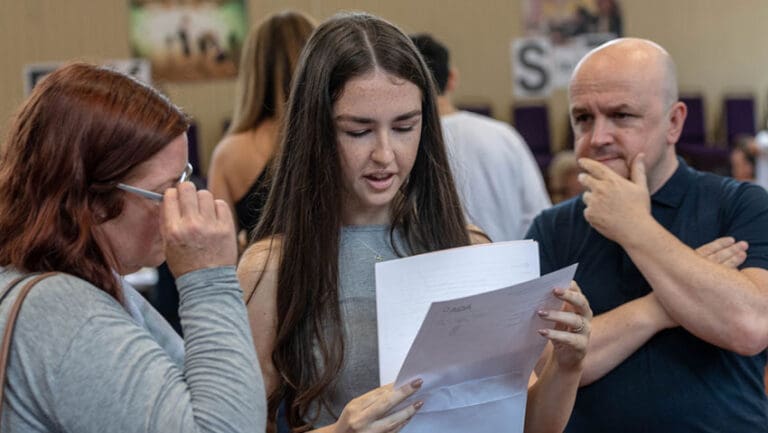
Results day should be a hiring moment, not just a school milestone

This morning, hundreds of thousands of teenagers opened their GCSE results. For most, the next step is already mapped out. For a growing number, it is not, and that is where one of Britain’s most expensive problems begins.
The latest official figures show that 1.01 million 16 to 24 year olds are not in education, employment or training, 13.5 per cent of the age group and the first time the total has passed one million since 2013. The number had been edging towards that mark for months. Analysis by the charity Impetus puts the annual cost in lost GDP at £27 billion.
I have spent 25 years working across education, employability and youth services, and this month I became chief executive of City Year UK. I have argued before that the NEET challenge is now a business problem, because every one of those million young people is a customer, a colleague and a taxpayer the economy is doing without. Results day is where the pipeline into that statistic quietly begins.
Nobody becomes NEET on the day the envelope opens. It happens in the months that follow, when a teenager without family networks cannot find work experience, when entry level vacancies ask for experience nobody will give them, and when the first knock-back turns into a second and a third.
Government is moving. Alan Milburn’s independent review into youth inactivity is due to publish its final report this summer, and the Youth Guarantee is backed by £1.5 billion to help young people into work or training. I have set out elsewhere what I would ask of policymakers. But employers do not need to wait for Whitehall, and the smartest ones will not.
Make service the first rung
At City Year UK we recruit 18 to 25 year olds to spend a year volunteering in schools serving all communities across London, the West Midlands and Greater Manchester. They mentor and tutor pupils who need extra support, and in return they gain training, structure, professional networks and a track record that proves they can turn up, take responsibility and deliver.
It is a straightforward exchange. Schools gain capacity, pupils gain a role model close to their own age, and a young adult gains a launch pad into work. Nothing on a CV says more about readiness than a year spent showing up for other people’s children.
That is exactly what employers say they cannot find at entry level. So here is my ask of business leaders this results week. Offer guaranteed interviews to young people who complete a year of service or similar programmes. Open work experience to teenagers whose parents cannot arrange it through their own contacts. Strip out entry criteria that screen for polish rather than potential.
And remember that six in ten of the million are economically inactive rather than unemployed, many managing health conditions. They will not respond to a job advert. They need employers willing to meet them halfway, through supported routes back in.
The official numbers are updated again within days, and few expect good news. But the figure is not fixed. Every teenager who opened an envelope this morning is somebody’s future hire. Business gets to decide whose.


More Stories
Billionaire David Reuben leaves UK for Monaco
David Reuben, the property tycoon who shares second place on this year’s Sunday Times Rich List with his brother Simon,...
Deliveroo to roll out delivery robots in five UK locations
Deliveroo is to begin using pavement robots to deliver takeaways and groceries in the UK, with its first robot deliveries...
UAE threatens to pull billions from UK over Man City ruling
The United Arab Emirates has warned the government it could cancel billions of pounds of investment in the UK over...
Richard Megson on why people, not AI, will fix the home-moving process
Richard Megson is managing director of ASAP, the Pontefract-based business he co-founded with conveyancer Tony Hill to provide outsourced sales...
Dr Nilesh R. Parmar on the business of dentistry and delegating
Dr Nilesh R. Parmar is clinical director of Parmar Dental, the Essex dental group that the company says was founded...
Russian businessman accuses Biden of stealing his money
Moscow has opened a criminal case over the seizure of Konstantin Malofeev’s US assets and the transfer of some of...