
Test Drive: The Renault Twingo E-Tech

After the Renault Clio VI, we stay with the French manufacturer to now test drive the new Twingo E-Tech. The Twingo nameplate is legendary, having sold over 4 million units across 25 countries since its launch in 1993. Among these, 1.9 million were sold in France and the first generation, by far the most popular, totalled 2.6 million units.
1993 Renault Twingo
The 1993 model, nicknamed “the frog” (la grenouille), was unveiled at the Paris Motor Show in September 1992 and I was there to witness it. After the Renault 5 and 4, the French manufacturer has decided to carry on its electricity-fuelled nostalgia streak and just launched the new Twingo E-Tech, whose exterior design is heavily inspired by the first generation of the model.
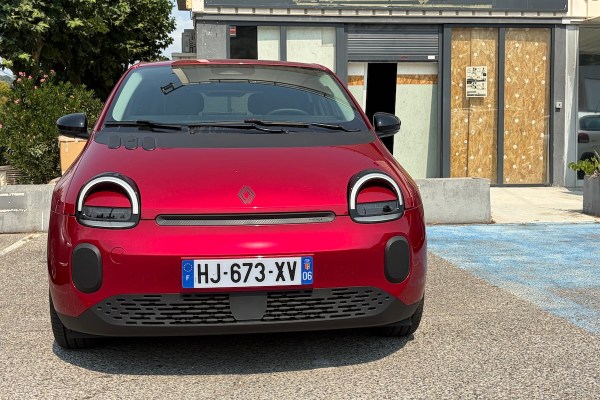
When seeing the first pictures of the car, I was, like for the Renault Clio, not impressed. But seeing it in the flesh is very different. The design of the headlights and taillights inspired by the original model ate the car’s most distinctive feature. They show their modernity and display a satisfying neo-retro feel, despite being rather convoluted. But it works.
The hood has a striking upper black component near the windshield and although you would fear it gives a bargain basement feel it actually looks great. Similar thing for the rear window framed by a black plastic element that gives the car some depth. Little plastic inserts on the bumpers also gives off a playful look. The “Twingo” name, with its very particular font, is printed at the back of the car.
Surprisingly, the boot is larger than the Renault Clio hybrid at 250 dm3 and even 350 dm3 when the rear bench seats are pushed back. Very impressive indeed and also above the 310 dm3 of the Renault 5. The Twingo is strictly 4-seats as there is no middle seat in the rear bench. Space at the back is good, especially when the bench is pushed back. At the front, the manual seat adjustments allow a comfortable position, even through the seats could do with better side support.
Stepping behind the wheel, we are instantly welcomed with a colourful dash, breaking with current cars’ usual monotony. The entire passenger side features a large stripe painted with the car body’s colour and gives a welcome splash of colour and freshness. Yes hard and shiny plastics are everywhere including at the top of the dash but nice motifs make it forgivable.
My Safety Switch button on the leftEasy to understand adaptive cruise control
Where the Twingo impresses is with its features included in the tight pricing. Granted, a lot of these are now mandatory in every car based on EU regulations, but still. Hands free startup, advanced safety features that can be cancelled with just one My Safety Switch button, parking aid, automatic headlights but most of all One Peal mode (absent from the Renault 5), Google GPS, rear view camera and adaptive cruise control. The latter being very easy to learn to master even on the fly driving on the highway. There are physical buttons for the air con, and the instrument panel graphics are gaming-inspired and very original
Getting the car going and here too we are far above we would expect from a car of this price. The Twingo is instantly peppy and dynamic and devours city driving as if a second nature. Responsive steering, good acceleration and true agility on winding roads: it delivers real driving pleasure, which was a surprise to me. This is definitely not a low cost car. Highway driving isn’t flash but acceptable and the car is limited to a top speed of 130 km/h. One negative aspect is its average sound proofing (rolling and air noises at high speed). The air con is noisy but did the job during the heatwave that France is experiencing at the moment.
The Twingo has been manufactured in Novo Mesto, Slovenia since 2007 and this generation stays there. Renault has offshored part of its design and engineering operations to China, even though the brand doesn’t sell cars there anymore. Paris is responsible for drawing up the specifications, design, and electronic architecture based on in-house platforms. The Chinese research centre is tasked with selecting the engine, battery, and interior and exterior trim, as well as integrating them all within 21 months—half the development time typical in Europe.
The Twingo features 27.5 kWh battery for a 262 km range WLTP according to the manufacturer with a consumption of 12.3 kWh/100 km. True average range as tested by the local press is closer to 200 km, with 145 km on highway and 245 km in the city. This means the Twingo is strictly confined to city use, especially with poor charge technology asking for hours to top up the battery. However, with a 500€ option you can charge at 50 kW to replenish the battery from 20 to 80% in just half an hour. This is not available in the entry-level, more expensive Renault 5 which takes a few hours.
What is the price? Here comes what may well be the Twingo’s most attractive feature. The Techno variant (top of the range) that I drove is asking for 21,090€. But current French government subsidies for BEVs amount to 3,620€ and bring the price down to 17,470€. Its base variant, the Evolution, starts 15,900€, making it the cheapest BEV in the French market and one of the cheapest in Europe. And surprisingly, it is not the bargain basement car I would have expected. This augurs well for its success, which can hold its own against its larger sibling the Renault 5. Given the 5 was the best-selling BEV in France in the last few months and sold over 140,000 units in Europe since its launch in 2024, we have high hopes for the Twingo.


More Stories
2027 Nissan Murano Invoice Price, Dealer Cost, and How to Get the Best Deal Near You
The 2027 Nissan Murano is on dealer lots now with pricing confirmed directly from Nissan’s official press release, and TrueCar’s...
Singapore August 2026: GAC at all-time high, Chinese at 51.7% share
GAC sales are up 145.1% year-on-year in August. 4,549 new cars hit Singaporean roads in August, a -2.2% year-on-year contraction....
2027 Hyundai Kona Invoice Price, Dealer Cost, and How to Get the Best Deal Near You
The 2027 Hyundai Kona is on dealer lots now with confirmed pricing and an 89-transaction TrueCar dataset already showing buyers...
2027 Jeep Wrangler JL-2A Pays Tribute to the Original Civilian Jeep With Retro Style and Rubicon Capability
Jeep is reaching deep into its history for one of its most interesting special-edition Wranglers yet. The new 2027 Jeep...
Tesla Roadster Finally Set for October 1 Reveal With SpaceX Thrusters in the Spotlight
Tesla’s next-generation Roadster may finally be ready to step back into the spotlight. CEO Elon Musk has confirmed that Tesla...
Volkswagen Mission Efficiency EV Pushes Nearly 900 Miles of Range With Record-Setting Aerodynamics
Volkswagen has a new electric concept that looks like it was shaped almost entirely by airflow, and that is not...