
AI Assistants Overwhelmingly Cite Third-Party Lists, Not Company Homepages, Study Finds

Artificial intelligence assistants overwhelmingly cite third-party “best-of” and comparison pages rather than companies’ own websites, according to a new study from citations.press. The research analysed 60,350 citations generated across 10,000 commercial prompts spanning 50 industries, comparing how ChatGPT and Claude source the answers they give to buyers.
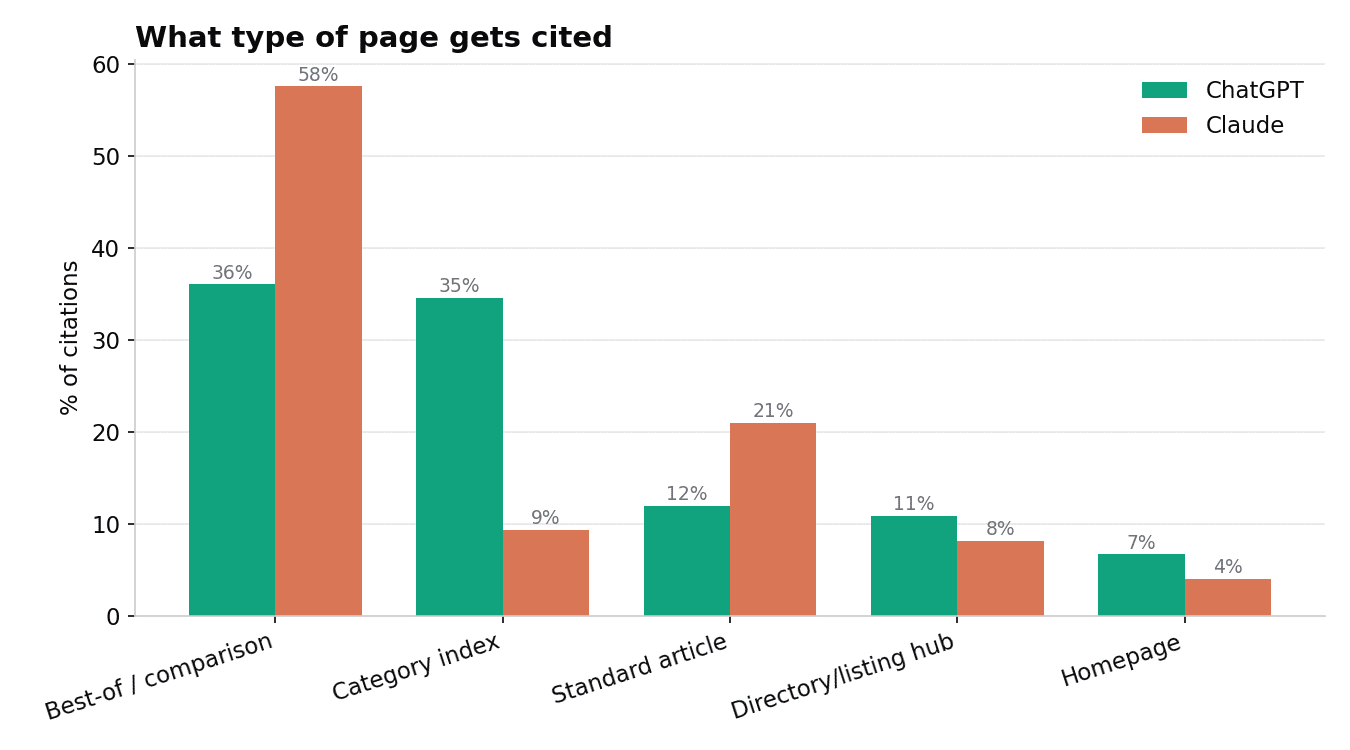
Just 7% of ChatGPT’s citations and 4% of Claude’s pointed to a brand’s homepage. The remainder went, in large part, to ranked lists published by independent media and review sites. For businesses weighing where to spend on marketing, and on AI itself, the finding suggests that owned websites are not where these systems look.
Lists dominate; homepages barely register
Grouping every cited page by type, ranked comparison and category pages accounted for the large majority of citations from both systems: roughly 81% for ChatGPT and 75% for Claude. Homepages were the least-cited page type of all.
Figure 1. Share of citations by page type, ChatGPT vs Claude. Source: citations.press, 2026.
Page typeChatGPT %Claude %Best-of / comparison3658Category index359Standard article1221Directory / listing hub118Homepage74
The pattern is consistent with larger independent datasets. An analysis by Search Engine Land and Evertune of roughly 25,000 of the most-cited URLs found that, across nearly 400 million citations, 63% pointed to listicles, most of them ranked, numbered lists. A separate Search Engine Land review of 8,000 citations reached the same conclusion: AI favours lists, articles and product pages over homepages.
Two assistants, two different source pools
The study also found that the two systems rarely rely on the same sources. ChatGPT and Claude shared only about 18% of their cited domains, and never returned an identical set of sources for the same question. Claude drew on 208 unique domains against ChatGPT’s 110, a broader and longer-tailed pool.
Figure 2. Top 10 cited domains by model. Source: citations.press, 2026.
Independent research points the same way. An audit of 680 million citations reported that only around 11% of domains are cited by both ChatGPT and Perplexity, while Profound’s citation-pattern analysis documented distinct source preferences across the major systems. Different assistants, in effect, read different webs.
In some sectors, official sources dominate
The averages conceal sharp differences by sector. In healthcare, the study found that every ChatGPT citation examined came from an official or authority source such as the NHS, the World Health Organization or the CDC. Dentistry and nutrition showed similar concentrations. In other categories, a small number of destination sites were cited at their homepage.
Figure 3. Share of ChatGPT citations from official or authority sources, selected industries. Source: citations.press, 2026.
Why it matters for budgets
For finance and strategy teams, the study lands in the middle of a wider debate about the gap between AI spending and measurable return. Enterprises have poured money into AI tools without a clear line to the value produced, a pattern examined in Elsewhen’s analysis “The End of Tokenmaxxing.” That piece cites work by researchers at MIT and Wharton tracking more than 100,000 developers: agentic AI tools raised the volume of code written by 741%, yet shipped software rose only 20%. Activity climbed; output did not follow.
The citation findings describe an adjacent mismatch on the demand side. Companies continue to invest in homepages and owned content that AI systems seldom cite, while the pages that shape AI answers, third-party rankings and comparisons, sit outside their direct control. Analysts have argued that returns come from rebuilding processes around AI rather than simply spending on it, a theme Elsewhen also explores in “Why Enterprise AI Fails to Deliver.”
The practical reading is that visibility inside AI answers is increasingly earned through independent coverage, not owned media, and that it differs by system. Content that performs in ChatGPT, which the study found leans toward authoritative and UK sources, is not necessarily the content that performs in Claude, which spreads across a wider editorial base.
About the study
citations.press grouped 60,350 citations by page type and domain across 10,000 commercial prompts in 50 industries, comparing ChatGPT and Claude. Page types were classified by URL structure. The full dataset and chart pack are available from the publisher. Figures cited from Search Engine Land, Evertune, Profound and academic sources link to the original publications.
The post AI Assistants Overwhelmingly Cite Third-Party Lists, Not Company Homepages, Study Finds appeared first on The Next Hint.

More Stories
Wall Street Review: Small Caps Outperform as Bond Yields Ease
By Panos Mourdoukoutas Small-cap stocks outperformed this week as investors rotated out of the volatile AI trade and into interest-rate-sensitive...
Judge Rejects Bail for Former OpenAI Employee Accused of Installing Listening Device
By Lear Zhou SAN FRANCISCO—A federal judge rejected a bail request of a former OpenAI engineer who was accused of...
Trump Announces $4.2 Billion Audi Auto Manufacturing Investment in Georgia
By Travis Gillmore PERRY, Ga.– President Donald Trump unveiled a $4.2 billion investment from automaker Audi to develop its first...
DOJ Gives California County Election Officials 48 Hours to Help Verify Voters’ Citizenship
By Tom Gantert The U.S. Department of Justice has sent letters to county election officials in California warning them they...
French Officials Say 1,300 Arrests Made Amid Latest Unrest
By Jack Phillips More than 1,300 people were arrested in another day of protests and riots, after a mass march...
RFK Jr. Announces American-Made Seafood Label at Midterm Rally in Florida
By Troy Myers Health and Human Services (HHS) Secretary Robert F. Kennedy Jr. has announced a new American-made label for...