
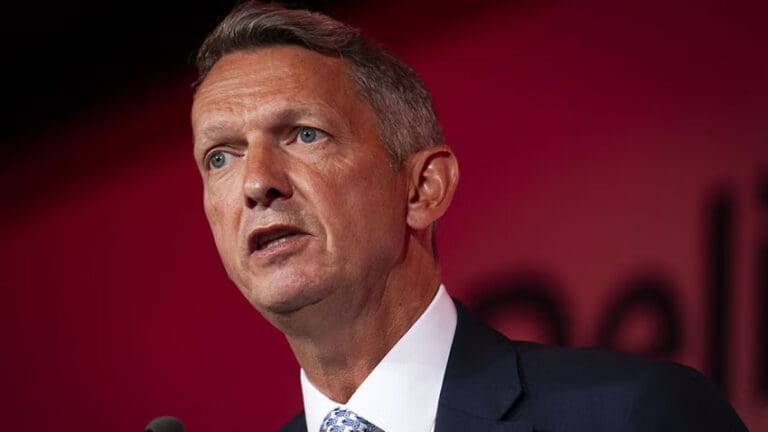
Tie pension tax relief to British investment, says Burnham’s economic adviser

Britain’s tax system should be reshaped to reward investment in homegrown companies and halt the “overseas stripping” of the country’s most innovative businesses, according to one of the economists advising Andy Burnham as he assembles a policy programme for a possible move to Downing Street.
Andy Haldane, president of the British Chambers of Commerce and a former chief economist at the Bank of England, told the organisation’s annual conference in London that the billions of pounds the Treasury spends each year on pension tax relief represented a “ready made” and “largely fiscal-free way” of giving British growth what he called “a genuine giddy-up”.
Haldane, who Burnham has been consulting as the Greater Manchester mayor prepares his pitch for No 10, framed the idea as a “third way” between “unfettered free markets” and the outright “mandation” of how pension funds allocate their money. For SME owners and the scale-up community, the proposal goes to the heart of a long-running complaint: that British capital too often flows everywhere except British business.
The numbers Haldane set out are striking. “This government, startlingly, extends over £50 billion in pension tax relief and more than £10 billion in tax relief for Isas,” he told delegates. “That means, as a country, we spend more in tax relief on savings than we do on defence. Yet these benefits are conferred without any accompanying commitment to support British businesses, or therefore UK growth. Most are implicitly supporting US corporations and indeed foreign governments.”
Redirecting those incentives, he argued, would “deliver a far larger return while keeping decisions on those investments in the hands of managers”, rather than ministers. The distinction matters. The Treasury has so far stopped short of compelling pension funds to back UK companies, wary of criticism that doing so would cut across the duty to secure the best possible returns for savers. Recent reporting has already shown some savers withdrawing pension cash amid fears of tax changes in the run-up to the Budget, underlining how sensitive any reform of pension incentives will be.
Haldane’s pitch is designed to sidestep that objection. Rather than handing ministers the power to mandate where pension money goes, he wants the tax relief itself to do the steering, nudging capital towards domestic firms while leaving the investment calls with fund managers.
Central to his case is the idea that Britain is an international outlier. The debate, he insisted, should not be about “constraining choices” but about mirroring the “home bias” already common elsewhere. “Their pension funds invest between 20 per cent and 40 per cent in their own companies, multiples of their global market share,” Haldane said of pension systems in Europe, Canada, Australia and Japan. “The UK’s pension fund system, big and mature, is the only pension system in the world that does not have such a home bias.”
He also pointed to public appetite for change, citing surveys suggesting more than 70 per cent of British investors would rather see their pensions invested in UK companies. On that basis, he said, there was “a strong case” for the default option under pensions auto-enrolment being into British firms.
Westminster and the City have wrestled for years with how to keep promising ventures growing on home soil rather than being acquired and spirited overseas. Haldane welcomed existing efforts, singling out the British Business Bank and the National Wealth Fund, but said both remained on a “modest scale”. The “quantitative impact” of the government’s Mansion House reforms to lift pension fund investment in UK companies would, he added, “still be modest in the near term”.
His warning to policymakers was blunt. “We simply cannot afford to allow the continuation of overseas stripping of our greatest growth asset, innovative businesses, on this scale,” he said. “Doing so is tantamount to willingly sacrificing growth and jobs.” Government, he argued, needed a “level of boldness” to “act at speed and scale” and take “full advantage of the UK’s brilliant businesses before they perish on the vine or are plucked off by overseas foreign raiders”.
He ended with a flourish aimed squarely at the country’s business and political leadership: “Fortunately, in the UK we have, hiding in plain sight, not one but two gift horses, British business and British capital. Let’s not, as leaders, continue to look these in the mouth.”
Speaking later on the conference fringes, Haldane said a Burnham-led government should radically simplify what he described as a “stupendously complex” tax code, and called for a “systematic and seismic” cutting back of “the thicket of regulation”, themes that will resonate with smaller firms who routinely cite red tape and compliance costs as a brake on growth.
The conference drew senior figures from across the five main parties. Among them was Rachel Reeves, the chancellor, who told the audience she had “unfinished business”, including pursuing fiscal devolution.
Whether Haldane’s “third way” makes it into a formal programme remains to be seen. But with more than £60 billion of annual tax relief in play, and a growing political consensus that British savings should do more for British growth, the question of how that money is directed looks set to stay firmly on the agenda.


More Stories
Lidl to open more than 50 stores after sales rise to £13bn
Lidl GB increased turnover by 10.8 per cent to £13bn in the financial year ended 28 February 2026, with operating...
Nandy intervenes in BT’s TalkTalk deal, citing risk to life
The government has intervened in BT Group’s acquisition of TalkTalk, with Lisa Nandy, the Secretary of State for Digital, Culture,...
Getting to know you: Professor David Keene MBE, CEO, Aurrigo
Professor David Keene MBE is the founder and chief executive of Aurrigo International plc, the AIM-listed Coventry company that builds...
Getting to know you: Malcolm Seagrave, CEO, Hedgehog Lab
Malcolm Seagrave is chief executive of Hedgehog Lab, the Newcastle upon Tyne digital product studio that designs and builds software...
Tax experts call for inflation relief if capital gains tax rises
Any rise in capital gains tax (CGT) at the budget on 28 October must be accompanied by “inflation relief” on...
Tesco considers offer for 210-store Majestic Wine chain
Tesco is considering an offer for Majestic Wine Group, the UK’s largest wine retailer, which was put up for sale...