
Investment in Wayve gives UK ‘seat at the table’ in global robotaxi race

The UK government has secured what it describes as a “seat at the table” in the fast-moving global race to commercialise driverless cars, after the British Business Bank backed a landmark $1.5 billion fundraising round for British autonomous driving firm Wayve.
The investment round, completed last week, valued the Cambridge-founded artificial intelligence company at $8.6 billion, the highest valuation yet achieved by a UK AI start-up. The round was led by SoftBank and supported by global heavyweights including Microsoft, NVIDIA, Uber, as well as major automotive groups Nissan, Stellantis and Mercedes-Benz.
The British Business Bank invested £25 million in the round, one of its largest direct equity commitments to date, signalling growing government ambition to anchor high-growth technology firms in the UK rather than see them migrate or list abroad.
Leandros Kalisperas, chief investment officer at the state-backed lender, said the participation was about more than financial return.
“It will ultimately be for the company itself to determine its exit strategy,” he said. “But being invested gives us a seat at the table.”
Founded in 2017 by Cambridge PhD researchers Alex Kendall and Amar Shah, Wayve has become one of Europe’s most prominent players in autonomous driving. Unlike some rivals that rely heavily on high-definition mapping and complex sensor stacks, Wayve has focused on end-to-end AI models capable of learning to drive using large volumes of real-world data, an approach the company believes will allow faster scaling across cities and geographies.
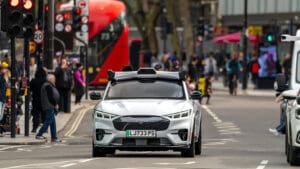
Kalisperas recently experienced the technology first-hand during a demonstration drive in London alongside Kendall. He described the underlying AI architecture as “a fantastic technology that we want to support,” adding that its potential applications could materially shape urban mobility in the UK and internationally.
The investment comes at a pivotal moment for the company. Wayve is transitioning from what Kalisperas described as “technology risk to scale-up risk”, moving beyond proving its system works, to commercial deployment and global expansion.
Wayve plans to begin commercial robotaxi trials in 2026, working alongside Uber, and is targeting broader international rollout thereafter. The company has also indicated ambitions to license its autonomous driving software directly to carmakers, embedding its technology in consumer vehicles rather than operating fleets itself.
The British Business Bank’s involvement reflects a broader shift in government industrial strategy. Since Labour’s spending review last year, ministers have pledged to expand the scale and pace of the bank’s direct investments, committing £6.6 billion of additional capital and increasing its total capacity to more than £25 billion.
The objective is clear: prevent promising UK technology firms from being forced to seek capital abroad or sell prematurely to overseas buyers. The UK has historically struggled to retain ownership of its fastest-growing technology companies, with many listing in the US or being acquired by global competitors.
By investing directly into late-stage scale-ups such as Wayve, the government hopes to encourage greater participation from domestic institutional investors, including pension funds.
Kalisperas said part of the strategy was to “make the ecosystem bigger, and therefore the British involvement in British companies to be bigger,” helping to crowd in additional private capital.
That approach has not gone unchallenged. Last month, Cressida Hogg, president of the Confederation of British Industry, questioned whether state equity stakes genuinely attract private capital or risk distorting markets.
Kalisperas rejected that characterisation, arguing that Wayve’s commercial fundamentals alone justified the investment.
“We would have made this in any and all scenarios in all likelihood because we’re compelled by the narrative and the commercial returns to the taxpayer,” he said.
The scale of the funding round underscores the growing strategic importance of autonomous mobility technology. Global carmakers and technology firms are racing to secure leadership in software-defined vehicles, with AI increasingly seen as the decisive competitive differentiator.
For the UK, Wayve represents one of the few domestically founded companies operating at the very frontier of AI-driven transportation. With backing from some of the world’s largest investors and industrial partners, its progress will now serve as a test case for whether Britain can nurture and retain globally competitive technology champions.
Read more:
Investment in Wayve gives UK ‘seat at the table’ in global robotaxi race

More Stories
Ukrainian attacks fueling global ‘energy shock’ – US Treasury secretary (VIDEO)
Disrupted supplies have put upward pressure on prices worldwide, Scott Bessent has said Ukrainian attacks on Russian energy infrastructure have...
How Path of Exile 2 Built a Player Economy That Behaves Like a Real Market
Most video games treat money as a simple convenience. You defeat enemies, collect coins, and hand them to a shopkeeper....
Recruitment tycoon who sold his classic cars to build an empire faces High Court bankruptcy fight
David Spencer-Percival, the recruitment entrepreneur who sold almost everything he owned to build a business empire, is facing a High...
Cambridge spinout Flower Labs launches Endeavor AI model to rival OpenAI and Anthropic
Flower Labs, a Cambridge University spinout, has launched a British frontier AI model that it says can match the performance...
London housing costs are choking firms’ access to young talent, LCCI warns ahead of Budget
London businesses have warned the Prime Minister that the capital’s housing costs are damaging their ability to hire and keep...
Return of tax-free shopping would give UK economy £11.5bn boost, says CEBR
Reintroducing tax-free shopping for overseas visitors would generate £11.5 billion in additional economic output, support more than 153,000 jobs across...