
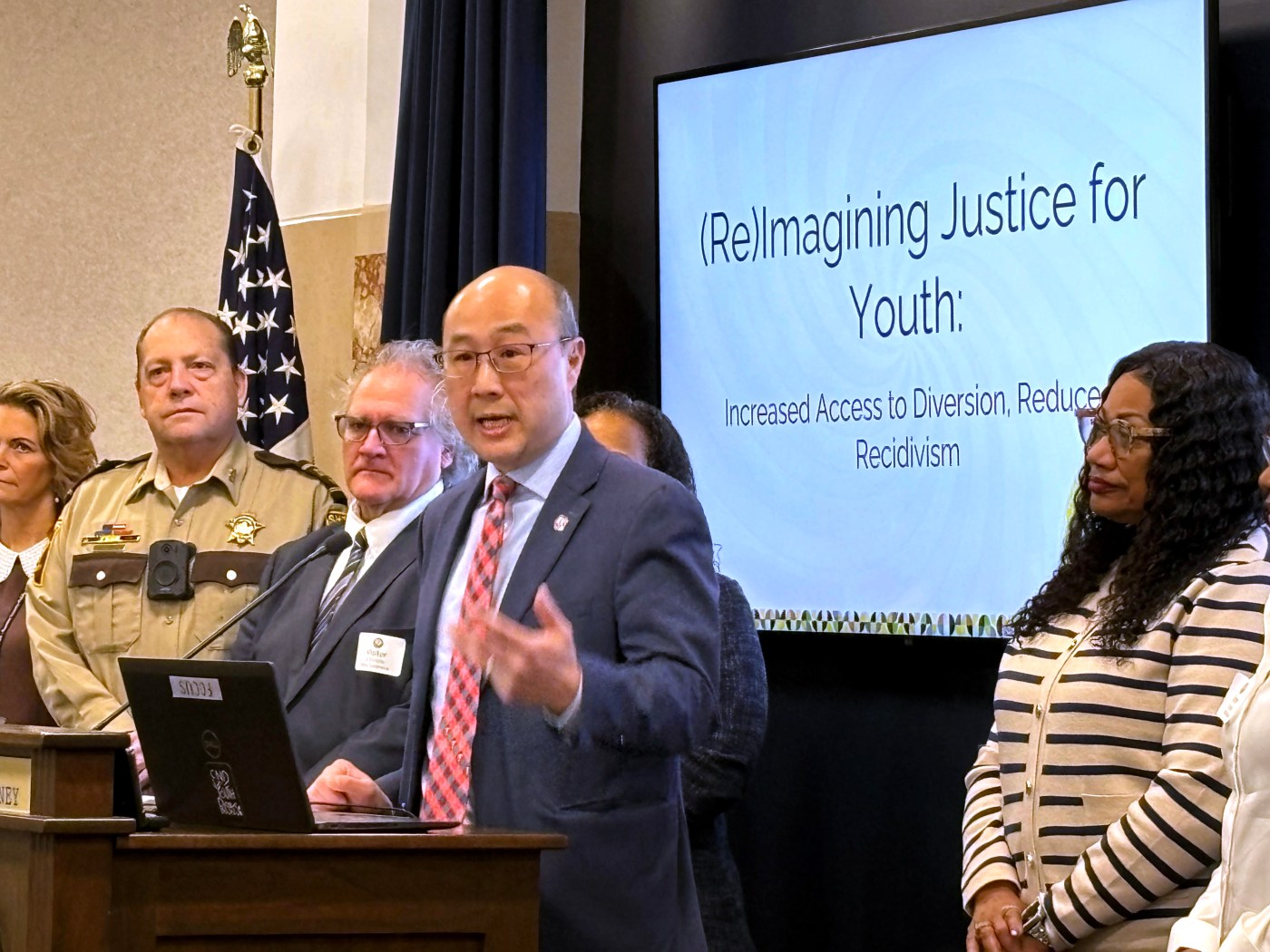
New UMN report: Ramsey County’s restorative justice for youth initiative is paying off

The traditional juvenile justice system wasn’t working, Ramsey County Attorney John Choi and others declared back in 2019.
Too often, the system mirrored the adult justice system, with strict punishment while not “fully recognizing and addressing the unique developmental needs of youth,” according to Choi.
And data showed outcomes were counterproductive. When juveniles were referred to the legal system, they likely went on to re-offend, both as youth and as adults. And when juveniles were hit with serious charges, they went on to commit felony-level crimes as adults at higher rates than youth who faced less serious charges.
So in July 2021, the attorney’s office sought change by collaborating with the Ramsey County Public Defender’s Office, community groups and law enforcement. They came up with a new program called (Re)Imagining Justice for Youth, an effort that identifies alternative paths instead of prosecution.
On Tuesday, Choi and others who’ve been integral to the mission joined together to say the new restorative, community-based response is resulting in lower recidivism rates than traditional court.
And, for the first time, they had numbers over a four-year period — thanks to a report after research by the University of Minnesota Medical School — to back it up.
Choi acknowledged the change in course was met with concern and criticism.
“I’m going to give grace to all of those people that thought that this was not the right thing to do, because it’s understandable,” Choi said, “because we have been raised to believe that somehow, by bringing things into the legal system, that that will produce more public safety, it will produce more justice for all. But the real truth is … we are producing a better version of safety, because we have lower recidivism, lower rereferral rates.”
The numbers
Before the change, law enforcement submitted cases to the county attorney and prosecutors would decide alone whether to charge, divert or decline a case.
With the launch of the (Re)Imagining Justice initiative, a major change included how those decisions were reached: with a collaborative review team of a prosecuting attorney, a public defender and a trained community member considering who had been harmed, what their needs might be, who caused the harm and how developmental needs may have played a role.
The outcomes are “meaningful,” said lead U of M researcher Kara Beckman.
Between July 2021 and December 2024, youth cases processed in court dropped to 50%, while cases sent to community based accountability increased to 25%.
“The increase in cases addressed through community accountability occurred despite submitted cases being more severe on average in the past four years compared to the decade prior,” Beckman said. “This means the range of cases being addressed in community accountability was indeed different.”
Researchers especially saw changes in cases that were previously ineligible for diversion. For example, prior to (Re)Imagining Justice for Youth, assault cases were 1% of diverted cases; since then, they make up 19% of cases sent to community accountability.
Recidivism rates in the diversion program fell significantly: Only 4% of youth referred through the (Re)Imagining initiative re-offended within one year, compared to 29% for cases processed in traditional court.
“This would mean young people successful in community accountability after their first case are 86% less likely to recidivate,” Beckman said.
The findings clearly indicate that community accountability outperforms traditional court processing, Beckman said. Youth with first-referral assault cases had 66% reduced risk of recidivism compared to traditional court. Youth with felony or gross misdemeanor cases had 50% lower risk of recidivism.
“And in all other models, youth successful in community accountability did just as well as youth whose cases were processed in court in terms of recidivism or re-referrals,” she said.
“In other words, (Re)Imagining Justice for Youth is working.”
‘It’s about human beings’
It’s just not about numbers, said Ramsey County Chief Public Defender John Reimer.
“It’s about human beings’ outcomes,” he said. “It’s about connecting.”
Reimer, who has been a public defender for 30 years, joked that he was smart enough to listen to his attorneys Erik Sandvick and Amanda Weitekamp when they approached him and asked whether it was worth their time.
Related Articles
Feds formally exclude MN officials from Alex Pretti shooting investigation
Medical examiner rules September death of 20-month-old Woodbury boy a homicide
Searchers find wreck of luxury steamer lost in Lake Michigan more than 150 years ago
Hmong grandmother detained in Texas for 2 weeks still doesn’t know why
William Robiner: Power combined with anonymity is a recipe for cruelty
“Because I have seen public resources that go left and right and try to do something different,” Reimer said. “Because what do we want? We want better outcomes for people. The community wants to be safe. And quite frankly, when we can reduce recidivism, it reduces case loads.”
A few years ago, Sandvick learned the importance of knowing the whole story. A case came across his desk that involved a teen caught sleeping in a car he stole in St. Paul. Through (Re)Imagining Justice for Youth, it came out that the teen had been dealing with a domestic abuse situation at home and wanted a safe place to sleep.
“I know this kid went to that program and did something restorative instead of going through the traditional process,” said Sandvick, who is in his 18th year as a public defender. “I think this work truly makes our community safer. The statistics speak for themselves, and it’s great to see the numbers and see the actual impact.”


More Stories
£57m GE Aerospace Prestwick expansion expected to bring 150 jobs
GE Aerospace is to expand and modernise its aircraft maintenance, repair and overhaul (MRO) site next to Prestwick Airport in...
Bumble shares rise almost 50 per cent on $1bn takeover talks reports
Shares in Bumble rose by almost 50 per cent yesterday after reports that the dating app is in advanced takeover...
Scientific and Industrial Research Reference Campus Institute” (SIR) Unveils Its Groundbreaking Initiative Aimed at Elevating Global Quality Benchmarks
Today, economic enterprises across manufacturing, technological applications, and specialized services face the imperative not only to produce goods, but also...
Inside the Economics of Fibre: Who Profits From Your Broadband Bill?
That simple transaction reveals an important feature of the broadband industry: the company selling the connection often does not own...
What SMEs Should Ask a Software Partner About AI in 2026
That email is landing in SME inboxes every week. The old supplier questionnaire, with its SOC 2 report, GDPR clauses...
Your Media List Is Wrong for the Way AI Cites Sources
The outlets that answer engines quote are a narrow, lopsided set, and they overlap with the Google top ten far...