
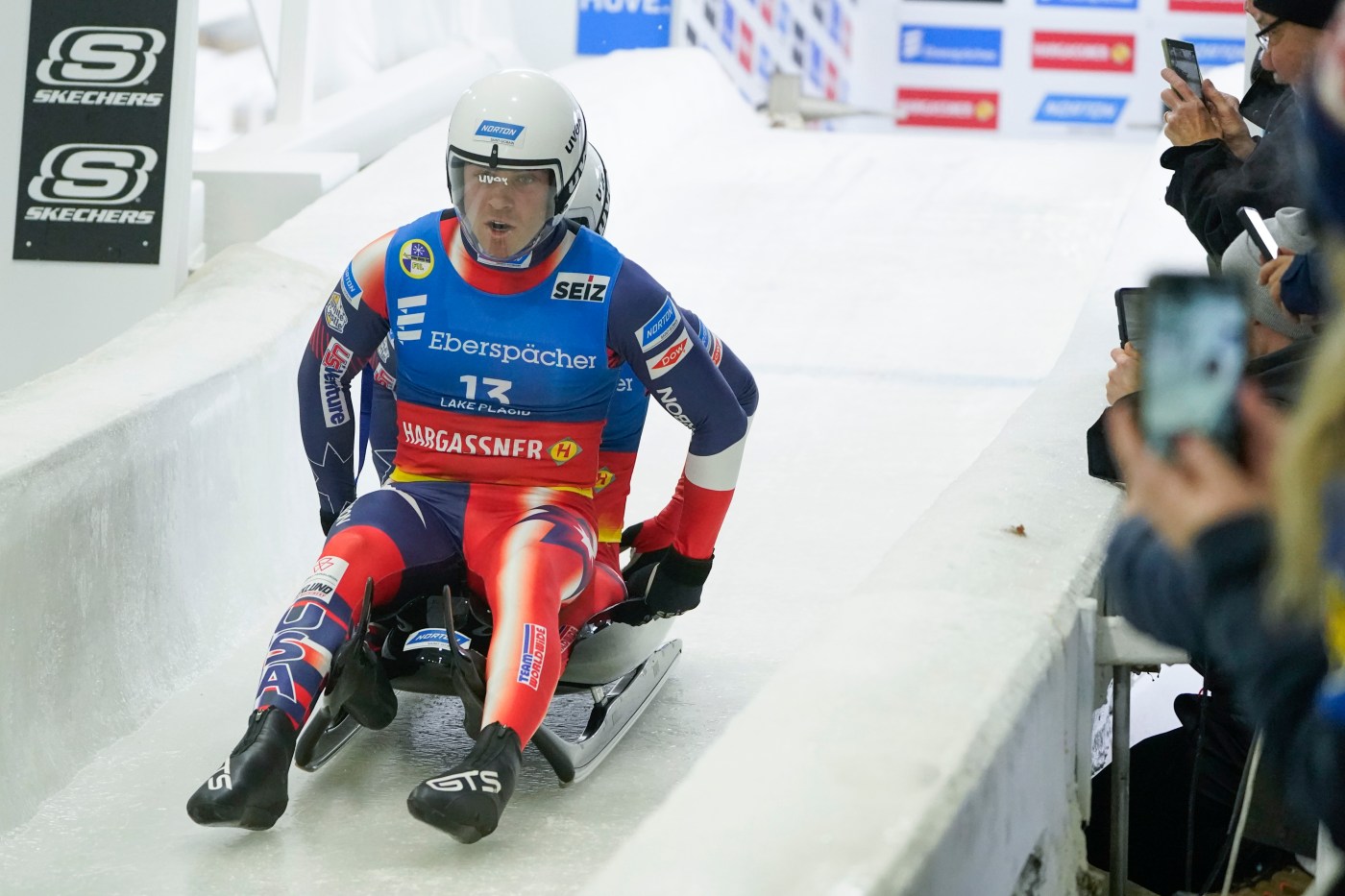
‘Pushing the limits’: Zack DiGregorio, Ansel Haugsjaa complete Winter Olympics quest

It all starts at the top of a platform that leads to a ramp for Zack DiGregorio and Ansel Haugsjaa.
What awaits them once they have pushed off on their small, compact sled and start going downhill while lying on their backs is not for the faint of heart.
DiGregorio and Haugsjaa, both Massachusetts natives who are parts of two U.S. Olympic luge doubles teams at the Milan Cortina Winter Games, whip around a winding and curving course made out of rock-hard ice at around 90 mph. They have 5 Gs of force throttling their bodies through the sharp turns they take. They have a razor-thin margin for error as one wrong move could cause serious injury.
And to up the ante, the two compete in luge with a partner, who lies either on top or below them.
“You’re pushing the limits in every way possible,” DiGregorio said. “You don’t have much protection, and you have to be pretty much perfect to make it down clean and to go fast.”
In less than 60 seconds, the journey down the frozen terrain comes to an end. And despite all the inherent dangers, they get up and do it again and again.
“I think when you start out it’s definitely a lot of crazy and I remember a lot of times when I was younger, if you have to go to a new track or move up higher on a track, being really scared, for sure,” Haugsjaa said. “But you kind of get used to it. And after a while it starts to feel shockingly normal.”
There are motivating factors at play that make DiGregorio and Haugsjaa continue this treacherous and invigorating pursuit. Perhaps the biggest of which is a shot at the Olympics.
DiGregorio, a 24-year-old Medway native, already got the thrill of competing at the Olympics in 2022 in Beijing and now is a two-time Olympian with his luge partner Sean Hollander. Milan and Cortina represents the first Olympic opportunity for the 21-year-old Haugsjaa, who hails from Framingham.
The pressure to qualify for the Olympics, whether it’s for a return trip or as a first-timer, is immense. The qualifying period ramps up in late November with five races over a two-month span.
The countless hours of rigorous physical training, time spent in the sled room and endless work practicing on the track can come down to miniscule differences as racers finish just seconds apart. And if Olympic status isn’t achieved, then it’s four long years to wait for the opportunity again.
“It was really like nothing I’ve ever experienced before,” said Haugsjaa, who won a gold medal with partner Marcus Mueller at the FIL World Cup in December. “Usually I only really have nerves on race day, but leading up to the first qualification opportunity… even really two, three days before the actual race day, I would wake up nervous. Feeling basically what I would sometimes feel for actual races just to show up to training that day.”
Marcus Mueller and Ansel Haugsjaa of the United States compete during the men’s sprint race at the Luge World Cup in Igls near Innsbruck, Austria, Saturday, Dec. 7, 2024. (AP Photo/Matthias Schrader)
Qualifying for the Olympics wasn’t exactly on the minds of DiGregorio or Haugsjaa when they first started luge. Their involvement in the sport was more by chance than anything else.
DiGregorio was around 10 when his family took a trip to Carlisle for some ice cream at Kimball Farm. DiGregorio and his brother tried out at a nearby White Castle Slider Search, an event that tries to identify candidates for the U.S. luge junior development team.
DiGregorio impressed, and just like that, was hooked on the sport.
“It was a random summer day that turned into a pretty life-changing one,” DiGregorio said.
Haugsjaa said he got into luge “totally by accident.” He accompanied a friend to Wachusett Mountain when he was 11 and took part in a luge challenge. He was lapping the sledding hill for nearly 30 minutes when he was approached by someone, who handed him a business card and invited him to Lake Placid, N.Y., where U.S. luge headquarters are located.
“I don’t even think I actually knew what luge was at all or what I was going to do. I thought it was just sledding,” Haugsjaa said.
Luge, like all Olympic sports, requires an unwavering commitment to achieve success.
DiGregorio missed around 110 out of 180 school days during his sophomore year at Medway High as he competed in international competitions. He ended up finishing school online given his demanding luge schedule.
Haugsjaa, who went to Sudbury Valley School, used to take car rides with his parents to Lake Placid for training and then drive all the way back to Framingham in the same day before he made luge his full-time focus at 18.
The two, despite traveling all around the world for luge, keep their Massachusetts roots a part of them and are grateful to have been immersed in a sports-crazed culture.
“It’s the perfect place to grow up if you’re into sports, and I think everyone sees that,” DiGregorio said.
DiGregorio and Haugsjaa will now look to put the perfect ending on their journey to the Olympics. That would mean coming away with a medal, especially a gold.
But a medal spot could come at the expense of one another. The two will compete against one another in the doubles event, which begins Sunday with training runs. That doesn’t stop them from cheering each other on or providing advice for one another. They both want to see each other do well and grow the U.S. doubles luge team.
And as Haugsjaa said, there’s room on the podium for both of them.
“We’ve been talking that we just need to both do it at the right time in Cortina and it will be nice and fun for both of us,” DiGregorio said.


More Stories
Getting to know you: Andrew Fishwick, founder and CEO, Hestia
Andrew Fishwick is the founder and chief executive of Hestia, a London-based platform that acquires premium restaurant groups and gives...
What UK SMEs Get Wrong About Their First Office
However, the first office selection process is always made on the basis of cost, convenience of location, or even size...
Why Tech Talent Is Moving Into Traditional Business – and What It Can Bring, According to La Royale Group CEO Madelynn Loo
Experienced operators who built careers in technology are moving into financial services, consumer businesses, logistics, investment groups and other established...
Getting to know you: Ross McCarthy, founder, Fruga
Ross McCarthy is the founder of Fruga, a Manchester insurtech that turns everyday spending data into retention tools and customer...
The Role of Digital Communication Tools in Modern Corporate Training
They are opening up learning possibilities that are beyond classrooms, printed manuals, and occasional workshops. These digital platforms that we...
The AI Questions Your Clients Are About to Start Asking You
Somewhere between the insurance certificates and the cyber security questions, larger clients have started asking what AI tools their suppliers...