
St. Paul mayor’s race: What voters say about Kaohly Her’s victory

Kaohly Her recalls the day a Summit Hill couple approached her and confided that they were unhappy with the state of the city, but they had no interest in throwing their vote away on just any challenger to St. Paul Mayor Melvin Carter, a two-term incumbent whom they supported in the past.
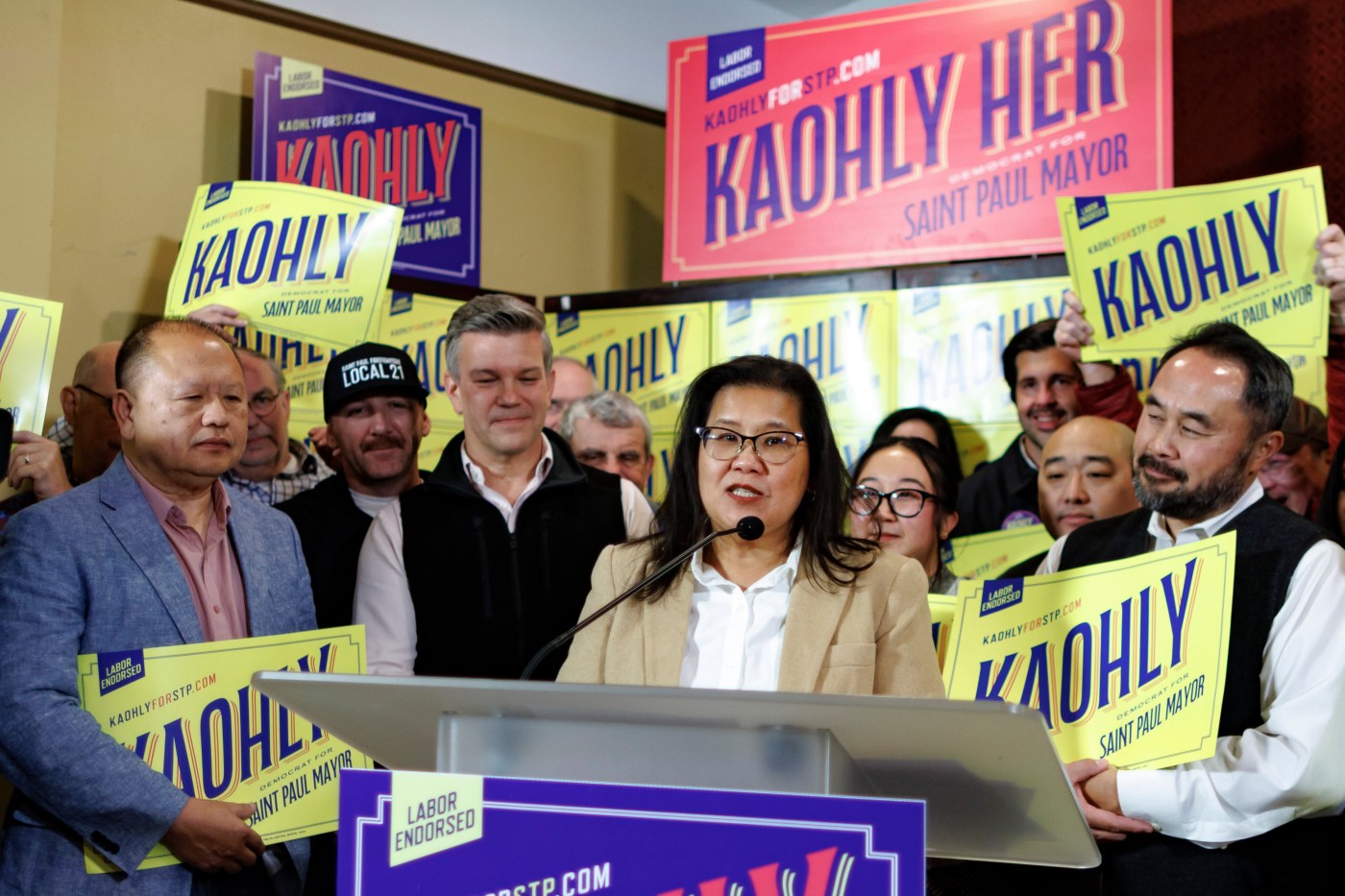
St. Paul Mayor-elect Kaohly Her photographed in St. Paul’s Midway neighborhood on Wednesday, Nov. 5, 2025. Her became St. Paul’s first woman mayor and first Hmong mayor in Minnesota after her upset ranked choice victory over incumbent Melvin Carter. (John Autey / Pioneer Press)
Her, a state representative, expressed sympathy but didn’t know what to tell them, until they provided an answer for her. Would she ever consider a run for office?
The conversation, which unfolded July 19 at the Rondo Days celebration held within Carter’s childhood neighborhood, has become a kind of mayoral origin story for Her, who greeted the same couple on Tuesday during her Election Night victory party at Sweeney’s Saloon on Dale Street.
The mayor-elect, who initially lagged Carter in the first round of ballot counting, received 48% of the vote to Carter’s 45% after the redistribution of ballots that had initially supported challengers Yan Chen, Mike Hilborn and Adam Dullinger. Her’s numbers climbed by a full 10 percentage points, propelling her to the win, while Carter’s climbed by about 4 points.
Her announced her campaign on Aug. 4, and the race — which pitted two prominent DFLers against each other — unfolded in 93 days, garnering an outcome that surprised even some of her supporters. A sitting mayor has not been unseated in St. Paul since Chris Coleman defeated Randy Kelly in 2005.
What drove voters to the polls?
What, exactly, drove voters to the polls?
“What was ‘the thing’? I don’t think it was a thing. It was a feeling,” said Her, who in mayoral forums had called economic development stagnant and criticized the Carter administration for a general lack of responsiveness. “The feeling there were not transparent processes, that the decisions were already made.”
A general sense of stagnation may have helped boost Her downtown, on the East Side and in southwest corners of the city like Highland Park and Macalester-Groveland, all areas where she fared well.
Still, rising property taxes and specific neighborhood concerns like the Summit Avenue bikeway — which Her had expressed skepticism toward — also loomed large during mayoral forums, as did the shuttered Midway Cub Foods grocery store, the shuttered downtown Lunds & Byerlys grocery and the former CVS drugstore at the corner of Snelling and University avenues.
Her said she felt confident of her chances after discovering this summer that the mayor had done little, if any, door knocking and had yet to hire a campaign manager.
“We simply had a better ground game,” said Elise Shih, Her’s field director, on social media. “We ran a stereotypical house DFL playbook. … Ask any DFLer and they could probably tell you what that looks like: 40,000 doors knocked, along with approximately 5,000 calls and 5,000 lit drops.”
“I know it was probably a surprise watching people flip in less than a month, but at a certain point in the campaign we were knocking over 1,000 doors a day — almost a precinct a day,” Shih added.
Her, who is Hmong, may have commanded a following among a loyal Hmong voting bloc, but she fared just as well, if not even better, in her home district — House District 64A, which follows Summit Avenue — than in areas of heavy Hmong concentration on the East Side. The North End, which has a large Asian population, voted for Carter.
What voters say
Voters and analysts have their own takes on the election, in which the St. Paul DFL made no endorsement and some other key players sat out. Here’s a selection taken from interviews and social media:
Rebecca Noecker, St. Paul City Council President: “I credit the mayor with driving down gun violence. I credit the mayor with being an amazing booster for the city, raising our profile nationally, but it has to be matched with that attention to detail, and that attention to basic city services and relationships with the people who put you put there. … She worked her tail off, for one thing. That doesn’t hurt. Knocked on tons of doors. She tapped into something that people are really feeling right now. They want their government to work. They want their calls and emails responded to. They don’t want things to take a long time. I also think a lot of people had a lot of different dissatisfactions with the mayor and the administration over a lot of things, and she promised to listen more, and better partnerships. I wasn’t close to either campaign … but what I heard from a lot of people was ‘I saw her, I never saw him.’”
Jordan Brasher, a GIS analyst: “Most St. Paulites feel downtown and the city have experienced steep decline while property owners’ taxes went up. She pushed to lower those taxes and questioned the Summit Avenue bike trail, which was a huge wedge issue amongst wealthy homeowners in the area she got the most support.”
Chad McCauley, via Facebook: “It’s not rocket science — downtown’s a mess, Midway’s trashed, Grand Ave.’s struggling, lamp wiring’s being stolen, taxes are sky-high, and rent control killed investment. No wonder people are angry.”
Megan Thomas, a former Carter supporter and former resident of the downtown Lowry Apartments, which were condemned a year ago: “She had a strong, effective campaign with a strong volunteer core including the remaining ‘Wellstonati’ (Sen. Paul Wellstone) core group. She has a good platform and vision. … The people in her district voted for her and it is one of the highest, if not the highest, for voter turnout. And there was genuine dissatisfaction with Mayor Carter’s job performance.
“I have been a die-hard supporter of him in the past. Until last year. We were getting nowhere with the city to pay any attention to the hellhole the Lowry had become, right across the street. It wasn’t until that first article (the Pioneer Press) wrote that we saw serious city safety efforts. And, the collapse of the City DFL played a big role. Mayor Carter would have gotten the endorsement easily and that endorsement does come with resources and brand value.”
Haley Cobb, a government relations specialist and Her supporter: “I’ve been continually frustrated with basic city functions and processes working too slowly, poorly, or not at all. Snow plowing, trash collection (how humiliating was that state of emergency?), and permitting all come to mind. A lot of the problems our city is facing — like downtown vacancy and decline — are not Mayor Carter’s fault. But he hasn’t done a good job of communicating a sense of urgency around tackling these issues.”
“I voted for Rep. Her because I have worked with her at the Legislature and know she is dogged in getting things done. I want a fresh perspective — someone who will critically look at every policy we have and make changes as needed.”
Christopher Woxland, an accountant and Carter supporter: “Feels very much like a change for change sake vote. The same way sports fans always want to fire a coach, expecting something new will always be better. I agree that Carter could have tried to get more yard signs out or more boosted ads but don’t think he warranted replacing. Also, her non-answers to questions like the Summit Avenue bikeway that Carter kept getting barraged with let her dodge backlash. She got to throw ‘questions’ at Carter but her campaign was short enough that she didn’t really have to answer any. I’m hoping her answers are good for the city.”
Chey Eisenman, a professional driver: “St. Paul was reluctant to give Carter a third term due to a struggling city. Even those who genuinely like him and voted for him twice. During the month of October they went from indecisive on voting for him again, to ‘let’s give someone else a shot.’”
Thomas Anderson, a St. Paul-based educator: “The tax burden is too much and shows no sign of abatement. A general sense of poor moves for the city in the last few years. Even if they weren’t really all on Carter, there’s no reason to think he’ll turn things around. Someone else might.”
Matt Beckman, a biologist and former St. Paul resident who used to bike commute along Summit Avenue, which he called “a wretched ride”: “She opposed a bike lane and campaigned.”
Laurel Avenue resident John Evans, retired: “It was a solid win, and the vote transfers from the ranking system played a role. But Her only received 3,604 more vote transfers than Carter. I think this was just a very low turnout election in which a slightly more motivated faction or neighborhood makes a big difference.”
Blois Olson, publisher of the “Morning Take” news and political analysis: “I think there was an undercurrent of lacking confidence in the mayor that was talked about in bars and homes, but nobody had yelled it out loud. It only took a challenger to be in the right place, at the right time, with the right tone, and she fit that mold. … She said, ‘I think we can do a better job,’ and the people of St. Paul said, ‘Yeah, I think that too.’ There’s these lingering issues in the city that had been dismissed, like ‘we’ll get through that.’ When I drive on Grand and Summit, it’s striking how lacking energy it is. Her personality is the most St. Paul win ever — just straight shooter, nothing flashy, almost asking to be underestimated.”
Maddie Love, a data professional and political strategist: “The voters who ranked her second were people who just wanted ‘something different.’ There’s no ideologically coherent reason someone would rank one of the minor candidates first and Kaohly second. I don’t even think it was anti-Melvin, just a desire for something new.”
Anders Bloomquist, a St. Paul-based labor organizer, noting the city DFL units made no endorsements in St. Paul or Minneapolis: “Due to neither race having a formal DFL endorsement for admittedly vastly different reasons, it allowed many folks to start making too-clever calculations about who to support and how, rather than simply getting on program with a plan to win.”
Cole Hanson, a nutritionist and Democratic Socialists of America-supported former candidate in the Ward 4 city council election: “I think this victory shows the true merits of ranked choice voting, and we should praise the system as a way to bring more people in who would otherwise sit out. When you look at the other votes, it’s clear there was broad dissatisfaction, and now it’s up to Her to weave them back together.”
Bob Collins, a retired editor of Minnesota Public Radio’s political unit: “She campaigned.”
Related Articles
Joe Soucheray: Seems Mayor-to-be Kaohly Her brings regard for detail and private success. Pinch me!
St. Paul Mayor-elect Kaohly Her on her new path at City Hall
Ranked-choice voting: How Kaohly Her surpassed Melvin Carter
Kaohly Her’s priorities: On ICE raids, safer neighborhoods, transparent budgeting
St. Paul mayor: Kaohly Her wins in upset over Melvin Carter


More Stories
UK risks missing AI boom without hardware push, Blair report says
The Tony Blair Institute has called on the government to raise manufacturing’s share of UK gross value added from 8...
Ditching Russian gas cost Germany €50 bn – media
The Finance Ministry has provided the estimate covering a range of relief and stabilization measures Germany has spent some €50...
TUC chief suggests Burnham could call early general election
TUC general secretary Paul Nowak has suggested Andy Burnham could call an early general election if the prime minister decides...
Cigar importer says plain packaging would cut its range by 75 per cent
Hunters & Frankau, which has imported Cuban cigars into the UK for more than 230 years, says it would have...
Stardust has raised $75m to develop sunlight-reflecting particles
Stardust Solutions, an Israeli-American start-up developing technology to disperse reflective particles high in the atmosphere so that less sunlight reaches...
World Cup and hot weather help UK economy grow 0.4 per cent in July
The UK economy grew by 0.4 per cent in July, well above the consensus forecast for no growth, according to...