
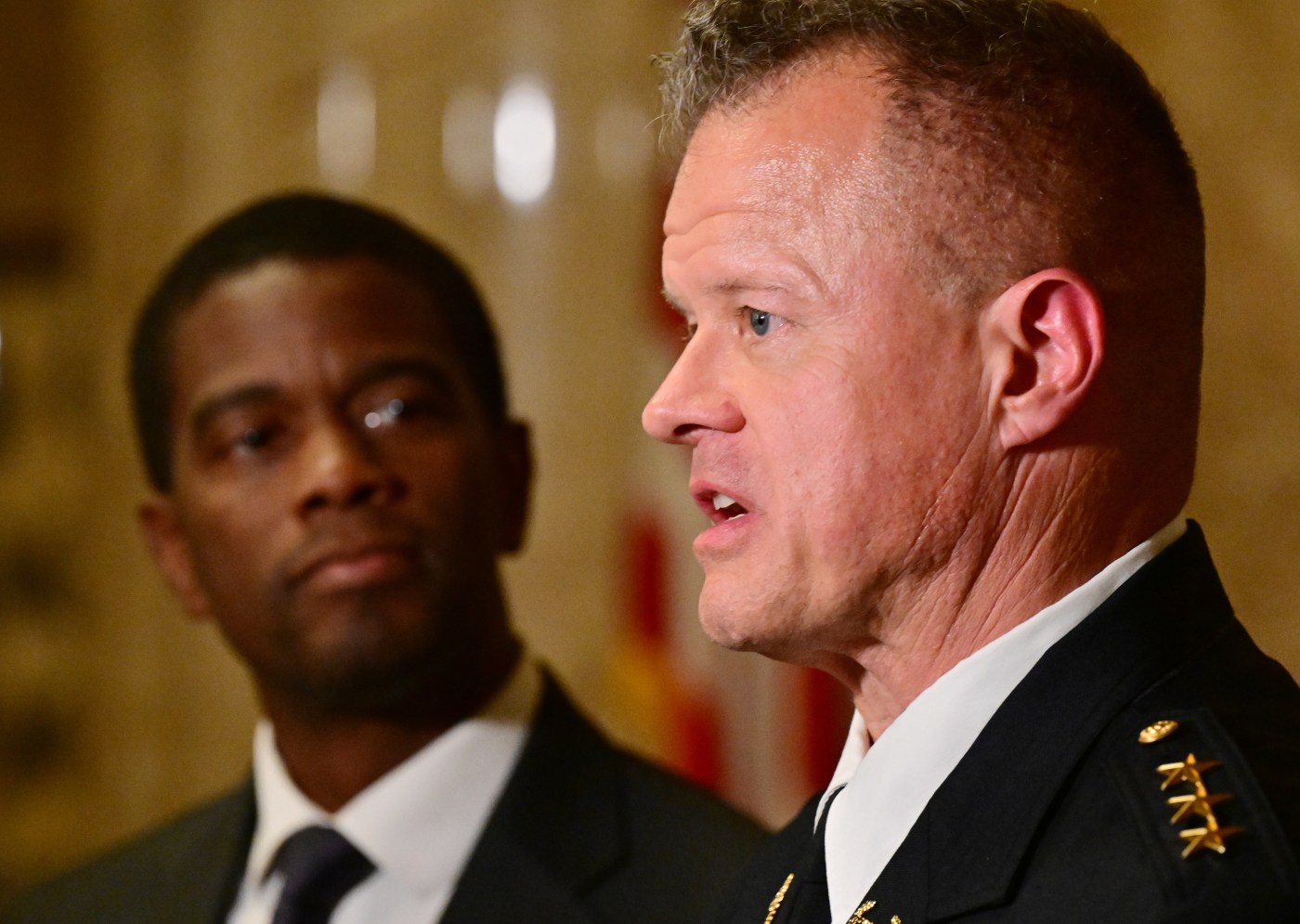
As salaries of St. Paul city leaders stagnate, concern grows over losing talent

Monday marked three years from the date that Mayor Melvin Carter offered Axel Henry the police chief job.
Henry accepted it, knowing he would be taking a $25,000 pay cut from what he was being paid at the time as a commander, though he puts in more hours and has more responsibilities as chief, he said in an interview this week.
Henry believed the salary discrepancy would be fixed more quickly, but he’s reached the halfway mark of his term.
Henry, 57, said he doesn’t want to retire, but he’d bring home more money from his pension than his current salary. St. Paul Fire Chief Butch Inks, 56, is in the same situation.
“I’m paying to come to work now,” Henry said. “I will not and do not want to abandon my leadership position. I take it very seriously, but I also have to make sure that we get this pay problem fixed.”
St. Paul business leaders have joined Henry in raising concerns to Carter over the pay of the city’s police chief and top staff, saying they should be compensated more and they want to ensure recruiting and retention is not impacted.
The problem extends to the salaries of department heads throughout city government in St. Paul.
It’s come to a head as St. Paul tries to hold the line on its budget — including not increasing property taxes more than the 5.3 percent proposed for next year.
“This is the balance that we have to do,” Carter said in an interview this week. Salaries for department leaders are among “a lot of fiscal pressures that the city faces right now. We’ve conveyed to our team that … we are committed to helping address them.”
Carter said the pressures the city faces this year include: A $7.5 million payment in a lawsuit after a jury found a St. Paul officer used excessive force in fatally shooting a man in 2017; a cyberattack on St. Paul, for which the final costs are still being determined; and the federal administration threatening federal funding.
9% added to salary range, not implemented
Until last year, Henry and Inks — and their handful of leadership staff — were paid at the top salary for their job titles in a range listed by the city.
The city set new salary ranges for non-union managers, dated to December 2024. They increased the ranges by 9 percent to account for potential performance pay increases that were negotiated into the 2023-2025 agreements of three unions of city workers, according to Jason Schmidt, St. Paul human resources deputy director.
However, the city has not moved up the salaries of managers within the new ranges and will not “until negotiations with line staff are completed,” Schmidt said.
“Increasing the range is the first step of the process,” Carter said.
Inks’ salary is $201,968 and Henry’s is $207,688. The current top salary under the new range would be $220,147 for fire chief and $226,387 for police chief.
The police chief salary would need to be about $256,000 to reach the market rate, Henry said, referencing the city’s recent job study.
Carter’s proposed budget for next year includes pay raises, though not the 9 percent increases that the city calculated for the city’s managers.
The non-union city managers each received cost of living increases of 1.8 percent in December and 1.6 percent in June.
Police, fire chiefs say they’re losing talent
Top staff in the police and fire departments, excluding Henry and Inks, are now looking into unionizing; the rank-and-file workforce already are in unions. Minneapolis police assistant and deputy chiefs recently unionized.
Henry, who has a good working relationship with Carter and considers him a friend, said he told the mayor when he appointed him as police chief in 2022 that the next chief would not accept a similar salary, which is lower than some chiefs in suburban departments with far fewer staff.
Related Articles
Ex-Lakeville dance teacher gets 2-month jail term for sexually assaulting teen student
Farmington mourning police officer who died at 41
Skyline Tower in St. Paul revises number of residents evacuated to 773
Minnesota couple charged after 8-year-old son’s gun death last month
Self-described ‘right wing libertarian’ vandalized Pride flags, anti-Trump signs in St. Paul, charges say
“The fact that we’re three years into something that I’ve been asking to be addressed for three years, and we’ve had no movement, we’re going the wrong direction, is very disheartening and frustrating,” Henry said this week. “… This is not us trying to do a money grab, but we need to make sure that we are fairly compensated.”
Henry and Inks say they’re losing talented staff that the city has invested in. Both departments have traditions of leadership working their way up through the ranks and serving for decades.
Eagan has tapped a well-respected St. Paul police district chief to be its next police chief. Salim Omari has been regarded as a contender to be Henry’s successor, if Henry doesn’t seek another term when his ends in three years. The current Eagan police chief’s salary is more than Henry’s.
“He’s an incredible leader that we hate to lose,” Carter said of Omari. “That’s exactly a part of why we did the wage study.”
Business leaders sound alarm
Businessman Jim Kelly sent an email to Carter about the pay issues over the summer.
“St. Paul has the second biggest population … and yet our chief makes $100,000 less than the chief in Minneapolis,” wrote Kelly, who owns Pauly’s Pub & Grill and Eagle Street bar and grill. “I also learned that our assistant and deputy chiefs make far less than their counterparts.”
Kelly wrote that the letter was endorsed by other business owners — including real estate developer David Brooks, real estate owner Bryan Larson, and Pat Boemer, owner of Patrick McGovern’s Pub & Restaurant, who each confirmed to the Pioneer Press that they’re concerned about the compensation of St. Paul Police Department leadership, and recruiting and retaining talent.
Kelly noted that with Henry at the department’s helm, “I and other business owners have witnessed the reduction of crime and safer streets in downtown St. Paul.”
Market study of St. Paul wages
The city signed a contract for $49,900 in August 2024 for an outside firm to complete a market study of wage competitiveness. The results were provided to St. Paul’s human resources director in September.
The Pioneer Press requested a copy of the study. Citing state law, Carter’s press secretary said it is not public because it’s part of labor relations negotiations. She released a redacted version of the study, which didn’t show information about salaries, and said the study as a whole will likely be public early next year.
St. Paul is using information from the wage study to help determine more competitive salaries for department leaders, which Carter said he knows is needed to retain talent.
“We’ve been trying to push up the pay of our frontline workers, which creates a wage compression challenge,” when the wage gap between employees gets smaller, Carter said.
City Council President Rebecca Noecker said this week that she hasn’t seen the study and she expects it will be shared with the Council, “especially to the extent that there are budget implications.”
Noecker said she’s been hearing about compensation of police leaders.
“If we don’t level up our salary scale commensurate with their experience, then we risk losing those folks to other departments who haven’t invested in them,” she said.
Took pay cut to become police chief
Henry made more as a commander because he was eligible for overtime and night pay under the St. Paul Police Federation contract. The union represents all ranks of officers except for the police chief, assistant chief and four deputy chiefs.
It would cost about $100,000 a year to give the 9 percent raise to the six leadership staffers, if they stayed on the high end of the payscale, according to Deputy Police Chief Tim Flynn.
“If (the city) paid me the wage that the market would say I should be paid, there would still be employees that made more than the chief of police,” Henry said. “This isn’t an issue of the chief should be the highest paid person, or the deputy chiefs or the assistant chiefs.”
The issue is that officers covered by the Federation’s contract with the city have continued to get raises, while wage increases for the department’s leadership haven’t been close to keeping pace, Henry said.
Related Articles
Letters: Rebutting arguments against administrative citations in St. Paul
MN Children’s Museum: Free admission in November for those on SNAP
Judge dismisses Macalester alum’s lawsuit over college’s animal testing in psychology labs
St. Paul: What you need to know about the school levy question
Readers’ picks for our 2025 Best Burgers guide
Salary ranges for non-union managers in the city have been based on the average increase of the five largest unions in the city per a long-standing council resolution, according to Schmidt.
When Henry became chief, he said he told Carter about the need to resolve the salary issue “because we are at risk of making it so that the future leaders of this police department are not going to want to ascend to the top spots.”
Henry said there have been three people who he wanted to promote to deputy chief, but they told him they couldn’t take the job due to the pay cut they’d face.
Meanwhile, Inks said his department’s three assistant chiefs work more than 40 hours a week.
“We’re not paying them for it and that is not a reasonable thing to ask employees to do,” he said, adding that he has a meeting scheduled with city officials to discuss options, which may include the assistant chiefs organizing into a union.

More Stories
Russia-US diesel deal already having positive effect – Putin aide to RT (VIDEO)
The agreement has helped lower American fuel prices and could pave the way for broader economic cooperation, Kirill Dmitriev has...
A Practical Guide to Pricing Your First Paid Community Tier
Then launch day arrives, a number gets picked more or less on instinct, and six months later nobody can say...
A Complete Guide to IT Support for Small Businesses in Leicester
Even a minor fault can slow employees down and leave customers waiting. This is where professional IT Support Leicester businesses...
A Practical AI Video Workflow for Small-Business Marketing
A polished clip that leaves the offer unclear is unlikely to help. AI image and video tools give teams another...
Michael Aronovici on What the Work at Interaction Restaurants Group Actually Involves
Over more than 30 years, he has owned and operated brands including Pizza Hut in Quebec, the Cultures restaurant chain,...
The Energy Capacity Problem Real Estate Developers Rarely See Coming, According to Ron Yeffet
That gap tends to surface at the worst possible time: after the concrete is poured, after tenants have signed, sometimes...